


The S&P 500 Trails the Global Stock Market by Its Widest Margin Since 1995 as President Trump's Policies Rattle Investors
Key Points
The S&P 500 has underperformed the global stock market by 9 percentage points year to date and 25 percentage points since President Trump took office.
Investors have gravitated toward international equities because U.S. stocks are expensive and President Trump’s policies threaten to slow economic growth.
Goldman Sachs analysts expect emerging market equities to outperform the S&P 500 by a substantial margin during the next decade.
- 10 stocks we like better than S&P 500 Index ›
The S&P 500 (SNPINDEX: ^GSPC) is the benchmark for the U.S. stock market. It has advanced less than 1% year to date. The MSCI ACWI ex U.S. Index is a benchmark for the global stock market (excluding U.S. equities). It has returned 10% year to date.
The S&P 500 has not lagged the MSCI ACWI ex US Index by such a wide margin at this point in any year since 1995, according to Kevin Gordon, head of macro research and strategy at Charles Schwab.
Where to invest $1,000 right now? Our analyst team just revealed what they believe are the 10 best stocks to buy right now, when you join Stock Advisor. See the stocks »
In fact, the global stock market has consistently outperformed the U.S. stock market during President Trump's second term due to concerns that his trade policies will hurt the U.S. economy (although that is now in question due to the Supreme Court overturning most of the tariffs). And some analysts expect that outperformance to continue in future years, especially in emerging markets. Here's what investors should know.
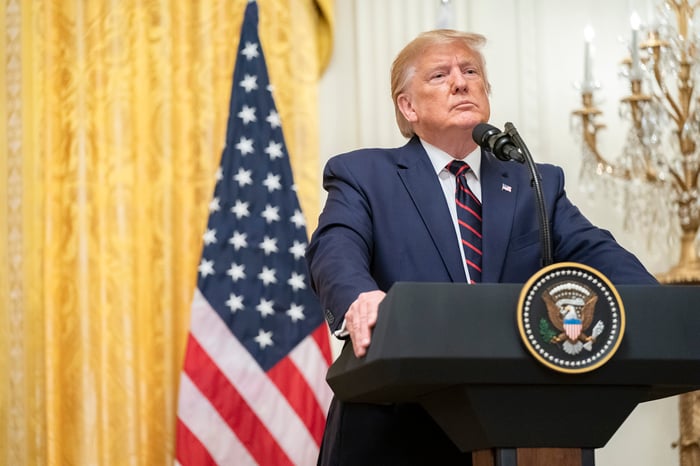
Image source: Official White House Photo by Shealah Craighead.
The global stock market has crushed the S&P 500 under President Trump
Global stocks have outperformed of late partly because they have cheaper valuations. For instance, the MSCI ACWI ex U.S. Index's forward price-to-earnings multiple is about 32% below that of the S&P 500. While U.S. stocks have regularly traded at a premium to international stocks over the last two decades, the current premium is nearly twice the historical average, according to JPMorgan Chase.
Global stocks have also outperformed due to the devaluation of the U.S. dollar, which has turbocharged returns in international stocks when funds are converted back to U.S. currency. The U.S. Dollar Index has dropped 10% under President Trump because sweeping tariffs, rising federal debt, and regular attacks on the Federal Reserve threaten to hurt the U.S. economy. And a weak economy typically leads to a weak currency by pushing investors to move their money to other markets.
Since President Trump returned to office in January 2025, the MSCI ACWI ex U.S. Index has advanced 40%, while the S&P 500 has advanced 15%. That means international stocks have outperformed U.S. stocks by an astonishing 25 percentage points during his second term. That is unprecedented in recent history.
Emerging market stocks are forecast to crush the S&P 500 in the next decade
Goldman Sachs analysts led by Peter Oppenheimer estimate the S&P 500 will compound at 6.5% annually during the next decade, but they anticipate much stronger returns in other stock markets (as measured in U.S. dollars):
- Europe: 7.5% annually
- Japan: 12% annually
- Asia (excluding Japan): 12.6% annually
- Emerging Markets: 12.8% annually
Goldman's forecasts make emerging market equities look particularly attractive. Investors can get exposure to those stocks with the Vanguard FTSE Emerging Markets ETF (NYSEMKT: VWO) or the iShares MSCI Emerging Markets ETF (NYSEMKT: EEM). Both index funds are heavily exposed to China, Taiwan, India, and Brazil, but there are two important differences:
- The iShares fund provides heavy exposure to South Korean stocks, but the Vanguard fund does not count South Korea as an emerging market.
- The iShares fund has a much higher expense ratio of 0.72%, while the Vanguard fund has an expense ratio of 0.06%.
In the past year, the iShares fund has returned 42%, while the Vanguard fund has returned 30%. The iShares fund has outperformed because it includes two popular South Korean stocks: Samsung and SK Hynix, the largest memory chip manufacturers in the world. The artificial intelligence (AI) boom has created strong demand for memory chips, so both stocks have performed very well.
However, the two index funds have delivered nearly identical returns during the last five years because the lower expense ratio on the Vanguard fund has offset the better returns in the iShares fund. To that end, either index fund is a good option for patient investors who want exposure to emerging markets.
Having said that, I would still keep a larger percentage of my portfolio in U.S. stocks (or an S&P 500 index fund). Technological innovation tends to drive economies over long periods, and the U.S. is the clear leader in that category.
Should you buy stock in S&P 500 Index right now?
Before you buy stock in S&P 500 Index, consider this:
The Motley Fool Stock Advisor analyst team just identified what they believe are the 10 best stocks for investors to buy now… and S&P 500 Index wasn’t one of them. The 10 stocks that made the cut could produce monster returns in the coming years.
Consider when Netflix made this list on December 17, 2004... if you invested $1,000 at the time of our recommendation, you’d have $424,262!* Or when Nvidia made this list on April 15, 2005... if you invested $1,000 at the time of our recommendation, you’d have $1,163,635!*
Now, it’s worth noting Stock Advisor’s total average return is 904% — a market-crushing outperformance compared to 194% for the S&P 500. Don't miss the latest top 10 list, available with Stock Advisor, and join an investing community built by individual investors for individual investors.
See the 10 stocks »
*Stock Advisor returns as of February 23, 2026.
Charles Schwab is an advertising partner of Motley Fool Money. JPMorgan Chase is an advertising partner of Motley Fool Money. Trevor Jennewine has no position in any of the stocks mentioned. The Motley Fool has positions in and recommends Goldman Sachs Group, JPMorgan Chase, and Vanguard FTSE Emerging Markets ETF. The Motley Fool recommends Charles Schwab and recommends the following options: short March 2026 $100 calls on Charles Schwab. The Motley Fool has a disclosure policy.
Recommended Articles


