


Where Will Costco Be in 5 Years?
Key Points
By opening new warehouses, Costco Wholesale will be generating higher revenue in 2031.
Analysts see double-digit earnings gains going forward, but the pace will likely decelerate.
Due to a steep starting valuation, Costco stock might underperform the broader market.
- 10 stocks we like better than Costco Wholesale ›
Costco Wholesale (NASDAQ: COST) is having a wonderful start to the year. So far in 2026, shares have climbed a notable 18% (as of Feb. 16). This extends a long streak of impressive gains. In the past five years, Costco has put up a total return of 205%.
Where will this retail stock be in the next five years?
Will AI create the world's first trillionaire? Our team just released a report on the one little-known company, called an "Indispensable Monopoly" providing the critical technology Nvidia and Intel both need. Continue »
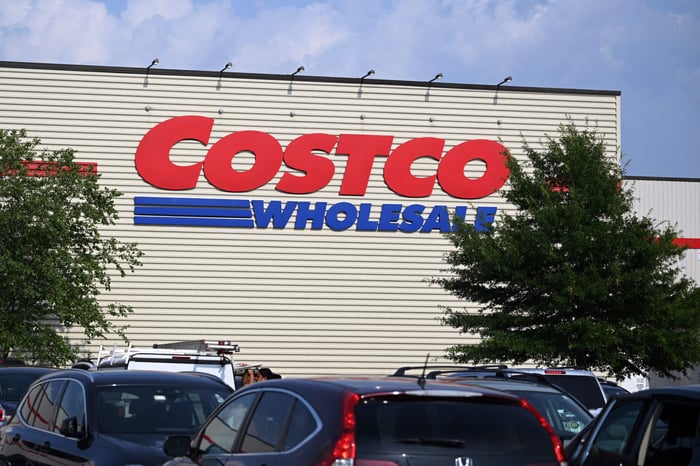
Image source: Getty Images.
On track to be a larger business
As of Nov. 23, Costco had 921 warehouses in total. It raked in $66 billion in net sales in first-quarter 2026. This is a massive entity. The growth story is not ending anytime soon, though.
Five years from now, Costco will be a larger business. It has plans to open 28 new stores just this fiscal year. The leadership team has a goal of getting to 30 or more openings annually in the future. The expansion will be diverse, with opportunities in both the U.S. and in foreign markets. Low prices on quality merchandise clearly have global appeal.
Costco is viewed as a favorite in-person shopping destination, which won't change. But investors should expect online sales to become a more important driver in the future.
Steady earnings growth will continue
If Costco will be generating more revenue in five years, it's not surprising that the profit pool will be larger as well. Between fiscal 2020 and fiscal 2025, diluted earnings per share (EPS) grew at a compound annual rate of 15.1%, which was a faster clip than the top line's rise.
There's likely still some operating leverage inherent in the business model. Costco thrives because of its scale, which leads to cost advantages that support operational efficiencies. Wall Street analysts predict that EPS will increase at an annualized clip of 10.7% between fiscal 2025 and fiscal 2028. This pace will probably decelerate as time passes.
Shares face a notable headwind
Investors should be critical of the stock because of its steep valuation. Shares trade at a price-to-earnings (P/E) ratio of 54.6. That resembles a high-growth tech business, not a mature retailer.
Five years from now, is it reasonable to assume that the stock will still trade at a P/E multiple near 55? Consider that in 2031, Costco will be even later on in its life cycle. This means it will have a smaller growth opportunity ahead of it, even though it will still be a dominant force in the world of retail. That situation might command a lower valuation ratio.
As a result, investors should temper expectations. Costco isn't likely to produce the same monster returns it did in the past. There's a chance that the stock will lag the overall market over the next five years.
Should you buy stock in Costco Wholesale right now?
Before you buy stock in Costco Wholesale, consider this:
The Motley Fool Stock Advisor analyst team just identified what they believe are the 10 best stocks for investors to buy now… and Costco Wholesale wasn’t one of them. The 10 stocks that made the cut could produce monster returns in the coming years.
Consider when Netflix made this list on December 17, 2004... if you invested $1,000 at the time of our recommendation, you’d have $420,595!* Or when Nvidia made this list on April 15, 2005... if you invested $1,000 at the time of our recommendation, you’d have $1,152,356!*
Now, it’s worth noting Stock Advisor’s total average return is 901% — a market-crushing outperformance compared to 194% for the S&P 500. Don't miss the latest top 10 list, available with Stock Advisor, and join an investing community built by individual investors for individual investors.
See the 10 stocks »
*Stock Advisor returns as of February 19, 2026.
Neil Patel has no position in any of the stocks mentioned. The Motley Fool has positions in and recommends Costco Wholesale. The Motley Fool has a disclosure policy.
Recommended Articles


