


In a Vote of Confidence for Apple Stock, It Is Berkshire Hathaway's Biggest Investment as Warren Buffett Steps Down as CEO
Key Points
Apple accounts for nearly a fifth of Berkshire's equity portfolio.
The stock is one of only two in Berkshire's portfolio worth more than $50 billion.
Apple grew revenue 16% and earnings per share 19% year over year in its most recent quarter.
- 10 stocks we like better than Apple ›
While Berkshire Hathaway's (NYSE: BRKA)(NYSE: BRKB) investment activity in Warren Buffett's final quarter as CEO is interesting, perhaps the most telling information from the conglomerate's latest 13-F filing is the significant size of the Oracle of Omaha's biggest positions upon his departure. Put another way, I'm more interested in what Buffett left Berkshire with than any trimming or adding of various stocks in his final quarter running the company's portfolio. After all, you can bet he took great care to consider Berkshire's biggest equity holdings as he worked to seal his legacy.
So, what were the conglomerate's top positions when Buffett left Berkshire at the end of 2025?
Will AI create the world's first trillionaire? Our team just released a report on the one little-known company, called an "Indispensable Monopoly" providing the critical technology Nvidia and Intel both need. Continue »
Based on the share counts reported at the end of Q4 and their current market values, iPhone-maker Apple (NASDAQ: AAPL) is the bet Warren left as Berkshire's biggest position upon his departure. It is an investment valued at more than $60 billion, and it accounts for about 19% of the company's equity portfolio.
The only position close to this size is integrated payments company American Express -- a $52 billion position that represents about 17% of Berkshire's portfolio.
The conglomerate's third-biggest position is Coca-Cola, representing about 10% of Berkshire's portfolio. And there are only two more positions accounting for 5% or more of the portfolio: Bank of America and Chevron, at about 9% and 7% of holdings, respectively.
But what's notable about Warren departing Berkshire with Apple accounting for about 19% of the portfolio is that the famed investor has generally eschewed technology stocks. So the fact that he's willing to leave it as such a big position is particularly notable. Not only does the size of the position imply he likely expects good long-term returns from the stock, but it also suggests he believes the tech company has unusual staying power.
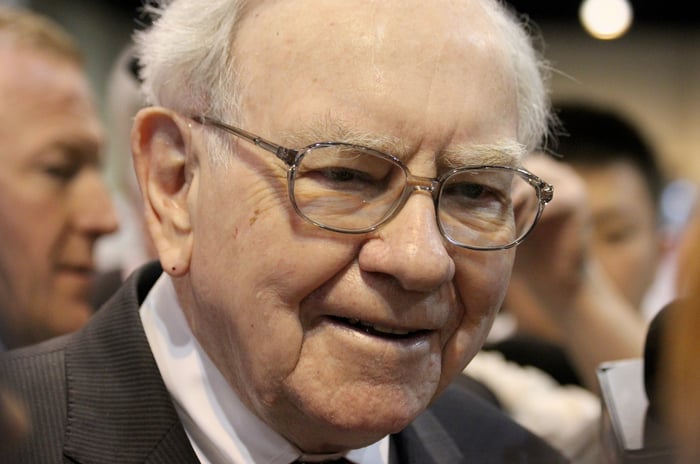
Warren Buffett. Image source: The Motley Fool.
Warren Buffett loves Apple
Berkshire first initiated a stake in Apple in 2016, and it continued building the position into 2017. In early 2017, when Buffett suddenly more than doubled his position in Apple, he told CNBC that he liked Apple stock because it has "quite a sticky product, and an enormously useful product to the people that use it." And even in his final annual letter to shareholders last year, Buffett listed Apple, alongside American Express, Coca-Cola, and Moody's, as a "household" name.
Of course, the biggest reason we can infer that Buffett loves Apple stock is his actions, not his words. While Berkshire did trim its Apple stock position during Buffett's final quarter as CEO, it was only by about 4% -- a huge slowdown from the third quarter of 2025, when Apple sold about 15% of the position.
Ultimately, Buffett hung up his hat as Berkshire's CEO with Apple as a major bet, representing about 19% of the conglomerate's more than $300 billion equity portfolio.
Apple will likely remain a top bet
While I could be wrong, I believe that Berkshire's sales of Apple stock in Q4 may be its last -- at least for now. With Greg Abel taking the reins, it would seem unwise to make any major changes to the Oracle of Omaha's biggest positions in the near term. A more likely scenario is that Abel focuses intently on Berkshire's operations in his first year, considering meaningful changes to the equity portfolio only if a no-brainer opportunity arises.
After all, Buffett wrapped up his time at Berkshire with an extraordinary track record.
Why play with a winning formula?
Since Warren acquired control of Berkshire in 1965, the stock has compounded at an average annualized rate of about 20%, for a cumulative return of more than 5,000,000%.
Sure, returns like this aren't sustainable. But it's a testament to Buffett's business prowess and his stock-picking ability.
Of course, no investment is without risk, including Apple. But there's more reason for Abel to continue betting on Buffett's top bet in a post-Buffett era than the Oracle of Omaha's endorsement.
How about his reason to be bullish on Apple? The tech company's business is firing on all cylinders. Revenue in the company's important holiday quarter rose 16% year over year, and earnings per share jumped 19%. And with more than 2.5 billion active Apple devices worldwide, the company has a long runway to continue monetizing this user base through a high-margin services business.
Should you buy stock in Apple right now?
Before you buy stock in Apple, consider this:
The Motley Fool Stock Advisor analyst team just identified what they believe are the 10 best stocks for investors to buy now… and Apple wasn’t one of them. The 10 stocks that made the cut could produce monster returns in the coming years.
Consider when Netflix made this list on December 17, 2004... if you invested $1,000 at the time of our recommendation, you’d have $415,256!* Or when Nvidia made this list on April 15, 2005... if you invested $1,000 at the time of our recommendation, you’d have $1,133,904!*
Now, it’s worth noting Stock Advisor’s total average return is 889% — a market-crushing outperformance compared to 193% for the S&P 500. Don't miss the latest top 10 list, available with Stock Advisor, and join an investing community built by individual investors for individual investors.
See the 10 stocks »
*Stock Advisor returns as of February 18, 2026.
Bank of America is an advertising partner of Motley Fool Money. American Express is an advertising partner of Motley Fool Money. Daniel Sparks and his clients have positions in Apple and Berkshire Hathaway. The Motley Fool has positions in and recommends Apple, Berkshire Hathaway, Chevron, and Moody's. The Motley Fool has a disclosure policy.
Recommended Articles


