


Prediction: Nvidia Stock Will Drop After Feb. 25
Key Points
Nvidia could face a high-expectations problem with its upcoming Q4 update.
The GPU maker will also report its quarterly results in an environment of skepticism about the ROI for AI investments.
If Nvidia's stock does drop after Feb. 25, it will be a gift to long-term investors.
- 10 stocks we like better than Nvidia ›
Many Nvidia (NASDAQ: NVDA) investors have probably circled Feb. 25, 2026, on their calendars. That's the date the giant chipmaker is scheduled to announce its fiscal 2025 fourth-quarter results. Nvidia plans to release its results following the market close and hold its quarterly conference call with analysts shortly afterward.
It's easy to predict that Nvidia's share price will surge after its Q4 update. The company's results will almost certainly be fantastic and reflect a booming underlying business. However, I have a contrarian take. I predict that the GPU stock will drop after Feb. 25.
Will AI create the world's first trillionaire? Our team just released a report on the one little-known company, called an "Indispensable Monopoly" providing the critical technology Nvidia and Intel both need. Continue »

Image source: Nvidia.
A high-expectations problem
The consensus Wall Street Q4 revenue estimate for Nvidia is $65.6 billion, according to S&P Global (NYSE: SPGI). The average Q4 adjusted earnings estimate is $1.52 per share. Both estimates reflect year-over-year growth of roughly 71%.
Does my prediction assume that Nvidia will fail to meet these estimates? Actually, no. Nvidia has an excellent track record of beating Wall Street's numbers, delivering better-than-expected results in each of the last four quarters. I think the company will do it again.
However, beating analysts' estimates doesn't always translate to a subsequent stock gain. Look at the chart below. Each of the "Es" on the chart shows when Nvidia reported earnings. As I just mentioned, the company exceeded expectations in each earnings report. But notice what happened with Nvidia's share price afterward. The stock fell following three of the four quarterly updates.
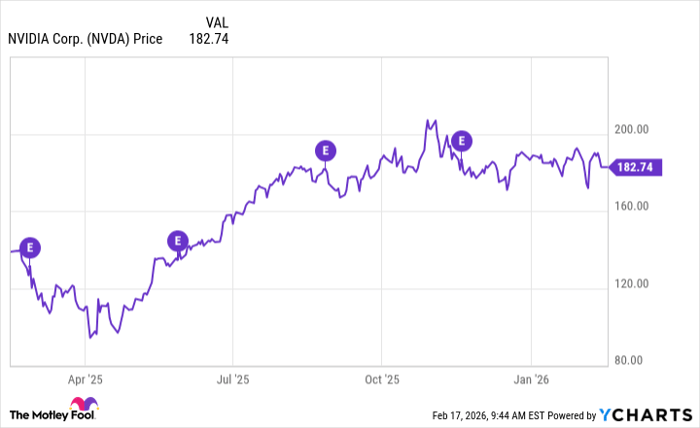
NVDA data by YCharts
What's behind those post-earnings declines? Sometimes, Wall Street has "whisper numbers" that are higher than the official revenue and earnings estimates. Another factor is that investors have often already priced in great expectations for earnings results and get nervous if there's even a hint of anything less than perfect in the quarterly update.
One potential issue that could rattle investors during Nvidia's Q4 earnings call is the memory shortage. If Nvidia's management indicates that memory availability could even slightly affect GPU sales later this year, we could see the stock tumble.
AI ROI skepticism
Nvidia also faces another challenge heading into its Q4 update. Some analysts and investors are skeptical of the return on investment (ROI) that AI spending is delivering.
Microsoft (NASDAQ: MSFT) handily beat revenue and earnings estimates in its most recent quarterly results. But its stock plunged afterward. One factor behind the sell-off was the company's increased spending on AI infrastructure.
It was a similar story with Alphabet (NASDAQ: GOOG) (NASDAQ: GOOGL). Google's parent delivered terrific Q4 results on Feb. 4, 2026. However, the stock fell moderately the next day. The decline was primarily due to concerns about Alphabet's significant increase in AI-related capital expenditures. Many investors also fretted about Amazon's (NASDAQ: AMZN) massive capex forecast of over $200 billion for this year.
Microsoft, Alphabet, and Amazon aren't just top AI stocks. They're also major customers of Nvidia. I suspect that this environment of AI ROI skepticism will make it difficult for Nvidia to truly wow investors in its Q4 update.
A predicted dip that will be a gift
Granted, my prediction that Nvidia's stock will drop after Feb. 25 could be wrong. If any company can knock the ball out of the park even in a challenging climate, it's Nvidia.
I think that long-term investors should want my prediction to come true, though. Any pullback in Nvidia's share price would be a gift, in my opinion. I fully expect that the company's Rubin ramp later this year will be a smashing success. I believe that the ROI for AI will be clearly demonstrated over time. A short-term drop would therefore present an excellent opportunity to buy this stock on the dip.
Should you buy stock in Nvidia right now?
Before you buy stock in Nvidia, consider this:
The Motley Fool Stock Advisor analyst team just identified what they believe are the 10 best stocks for investors to buy now… and Nvidia wasn’t one of them. The 10 stocks that made the cut could produce monster returns in the coming years.
Consider when Netflix made this list on December 17, 2004... if you invested $1,000 at the time of our recommendation, you’d have $414,554!* Or when Nvidia made this list on April 15, 2005... if you invested $1,000 at the time of our recommendation, you’d have $1,120,663!*
Now, it’s worth noting Stock Advisor’s total average return is 884% — a market-crushing outperformance compared to 193% for the S&P 500. Don't miss the latest top 10 list, available with Stock Advisor, and join an investing community built by individual investors for individual investors.
See the 10 stocks »
*Stock Advisor returns as of February 18, 2026.
Keith Speights has positions in Alphabet, Amazon, and Microsoft. The Motley Fool has positions in and recommends Alphabet, Amazon, Microsoft, Nvidia, and S&P Global. The Motley Fool has a disclosure policy.
Recommended Articles


