


Here Comes Tesla's First Vehicle Without a Steering Wheel: Will There Be Enough Demand?
Key Points
With Cybercab and Robotaxi, the electric vehicle company is transforming into a transportation-as-a-service business.
The Cybercab will have just two seats.
Tesla is seeing a surge in demand for its Full Self-Driving (Supervised) subscriptions.
- These 10 stocks could mint the next wave of millionaires ›
In a post on X, Tesla (NASDAQ: TSLA) CEO Elon Musk confirmed that the company is still planning to bring to market a steering-wheel-free, pedal-free all-electric vehicle -- and he confirmed that it's coming soon.
"Cybercab, which has no pedals or steering wheel, starts production in April," Musk said on Monday.
Will AI create the world's first trillionaire? Our team just released a report on the one little-known company, called an "Indispensable Monopoly" providing the critical technology Nvidia and Intel both need. Continue »
This comes as the company is ramping up its autonomous ride-sharing service, Robotaxi, and benefiting from a surge in customers subscribing to its "Full Self-Driving (Supervised)" software.
While the electric vehicle company is clearly making significant progress in self-driving technology, investors now face a tough question: Will demand for this new vehicle be sufficient to drive the significant sales growth already baked into the growth stock's pricey valuation?
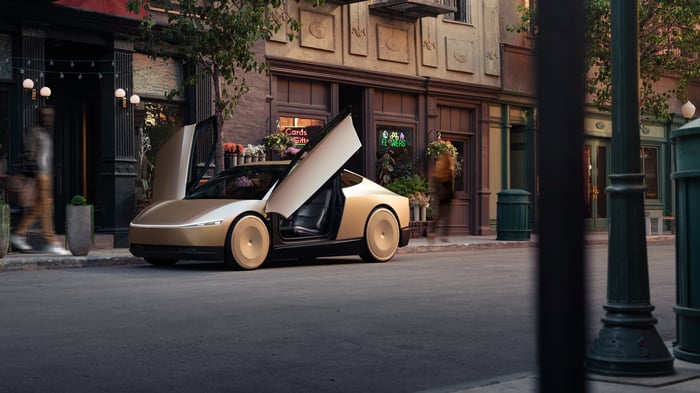
Cybercab. Image source: Tesla.
What we know about Cybercab
Tesla first unveiled its steering-wheel-free Cybercab at its "We, Robot" event in October 2024. The two-seat vehicle had no pedals or steering wheel and was purpose-built for an era of autonomy.
The car, Tesla said, would be deployable in the company's autonomous ride-sharing network, Robotaxi, in which customers who own the vehicle can participate in a revenue-sharing program with Tesla, similar to how Airbnb hosts can add or remove their homes from Airbnb's inventory.
Some investors may have speculated that the vehicle would launch with pedals and a steering wheel after all, but Musk's comment on Monday suggests that won't be the case. Though the CEO did, interestingly, post his tweet alongside a video from a decade ago, in which he explained a self-driving car concept that could include an "auxiliary steering wheel that only pops out when you need to take manual control for whatever reason." So it's possible there's an emergency manual steering feature like this included.
Notably, even Robotaxi's doors are built for an autonomous era, with upward-opening butterfly doors that are better suited for dropping off and picking up customers than for opening in tight parking spots.
Another interesting tidbit is that the so-called "Cybercab" may actually launch with a different name.
"[I]n some states, we're not allowed to use the word cab or taxi, so it's going to get even more strange," Musk explained during the company's fourth-quarter earnings call. He proposed that a more likely name is something closer to "cyber car" or "cyber vehicle."
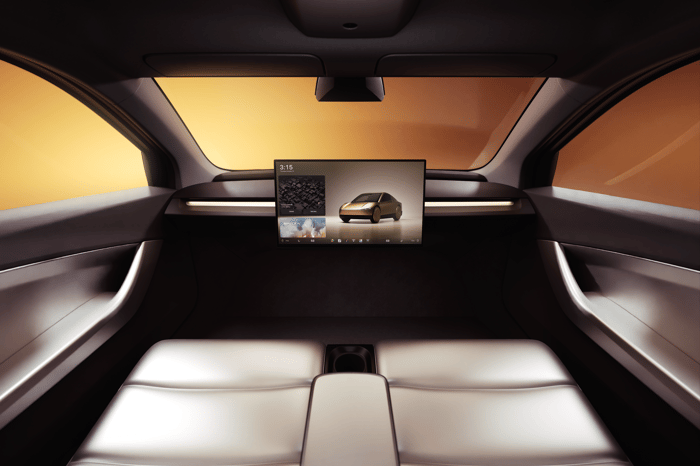
Cybercab. Image source: Tesla.
Tesla's vision
Tesla's yet-to-launch Cybercab is arguably the culmination of the company's shifting strategy as a company. Over the last few years, the company has been investing heavily in autonomy and robotics, with plans to transform into a higher-margin, recurring-revenue business and one increasingly focused on robotics.
Not only does Tesla believe that this will bolster sales growth and profitability over time, but also that it will also expand the company's addressable market.
In an era of autonomy, "you have to start thinking about us as moving to providing transportation as a service more than the total addressable market for the purchased vehicles alone," explained Tesla vice president of engineering Lars Moravy in the company's fourth-quarter earnings call.
"The vast majority of miles traveled will be autonomous in the future," Musk added during the call. He estimated that anywhere between 1% and 5% of driving will likely be done manually in the future.
While Tesla's Robotaxi service is still in its early innings, the company is already monetizing self-driving technology -- albeit with driver supervision. The company disclosed in its fourth-quarter update that it now boasts 1.1 million active Full Self-Driving (Supervised) subscriptions, up 38% year over year. With the software using the cabin camera to monitor driver attentiveness, the self-driving technology is very close to a truly self-driving experience.
While Tesla's vision for autonomy sounds exciting and its Cybercab looks promising, there are many uncertainties. And probably the biggest unknown is what demand will look like for a two-seat, steering-and-pedal-free car like this.
Don’t miss this second chance at a potentially lucrative opportunity
Ever feel like you missed the boat in buying the most successful stocks? Then you’ll want to hear this.
On rare occasions, our expert team of analysts issues a “Double Down” stock recommendation for companies that they think are about to pop. If you’re worried you’ve already missed your chance to invest, now is the best time to buy before it’s too late. And the numbers speak for themselves:
- Nvidia: if you invested $1,000 when we doubled down in 2009, you’d have $474,159!*
- Apple: if you invested $1,000 when we doubled down in 2008, you’d have $48,705!*
- Netflix: if you invested $1,000 when we doubled down in 2004, you’d have $414,554!*
Right now, we’re issuing “Double Down” alerts for three incredible companies, available when you join Stock Advisor, and there may not be another chance like this anytime soon.
See the 3 stocks »
*Stock Advisor returns as of February 17, 2026.
Daniel Sparks and/or his clients have positions in Tesla. The Motley Fool has positions in and recommends Airbnb and Tesla. The Motley Fool has a disclosure policy.
Recommended Articles


