


Should You Buy the Vanguard S&P 500 ETF With the Stock Market Near a Record High? History Offers a Clear Answer
Key Points
The S&P 500 is a diversified stock market index featuring 500 companies from every sector of the economy.
The index has delivered a compound total annual return of 10.6% since its inception in 1957, even after accounting for every sell-off along the way.
The Vanguard S&P 500 ETF tracks the performance of the S&P 500, and history suggests it could be a great long-term buy.
- 10 stocks we like better than Vanguard S&P 500 ETF ›
The S&P 500 (SNPINDEX: ^GSPC) is America's most widely followed stock market index because of its diverse composition. It's made up of 500 companies from 11 different economic sectors, so it holds artificial intelligence (AI) powerhouses, banks, and everything in between.
The S&P 500 has delivered an average annual return of 10.6% since its inception in 1957, but it's coming off a much higher-than-average gain of 17.8% in 2025 thanks to the significant growth produced by the emerging AI industry. The index is off to a more volatile start to 2026, but it's still sitting just 2% below its recent all-time high.
Where to invest $1,000 right now? Our analyst team just revealed what they believe are the 10 best stocks to buy right now, when you join Stock Advisor. See the stocks »
The Vanguard S&P 500 ETF (NYSEMKT: VOO) is an exchange-traded fund (ETF) that tracks the performance of the index by holding the same stocks and maintaining similar weightings. History is clear that timing the stock market is practically impossible, so should investors jump in and buy the ETF right now?

Image source: Getty Images.
The ideal index fund for investors of all experience levels
Although the S&P 500 is diversified, it's weighted by market capitalization. This means the largest companies in the index have a much greater influence over its performance than the smallest. That's why the information technology sector alone represents a whopping 34.4% of the entire value of the S&P 500 -- it's home to four of the world's 10 largest companies: Nvidia, Apple, Microsoft, and Broadcom, which have a combined value of $12.7 trillion.
Below are the next five largest sectors in the index, along with a few of their most noteworthy constituents:
|
S&P 500 Sector |
Weighting |
Noteworthy Stocks |
|---|---|---|
|
Financials |
13.4% |
Berkshire Hathaway, JPMorgan Chase, Goldman Sachs |
|
Communication services |
10.6% |
Alphabet, Meta Platforms, Netflix |
|
Consumer discretionary |
10.4% |
Amazon, Tesla, Home Depot |
|
Healthcare |
9.6% |
Eli Lilly, Johnson & Johnson, AbbVie |
|
Industrials |
8.2% |
Caterpillar, Boeing, Deere & Company |
Data source: Vanguard. Sector weightings are accurate as of Dec. 31, 2025, and are subject to change.
The remaining five S&P 500 sectors are consumer staples, energy, utilities, real estate, and materials.
AI stocks are creating the most value for investors at the moment, and many leaders in this emerging space -- like Alphabet, Meta, Amazon, and Tesla -- fall outside the information technology sector. However, information technology has the highest concentration of AI powerhouses by far, which is why it has become so influential over broader market returns.
In fact, the S&P 500 has delivered a return of 78% since the AI boom started gathering momentum at the start of 2023, but if you exclude the information technology sector, that return drops to just 56%.
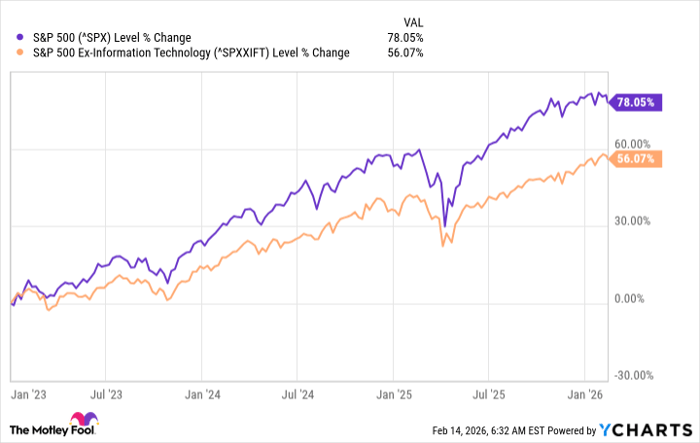
Data by YCharts.
As a result, the S&P 500 (and by extension, the Vanguard S&P 500 ETF) consistently offers investors a very high exposure to the fastest-growing stock market trends, while maintaining a healthy splash of diversification.
Should you buy the Vanguard S&P 500 ETF now?
History proves there is rarely a bad time to invest in the stock market. Volatility is a normal part of the journey, and it's often impossible to foresee, but investors who stay the course over the long term typically earn the best results. As I mentioned at the top, the S&P 500 has delivered a compound annual return of 10.6% since its inception in 1957, and that's after accounting for every correction along the way.
In fact, according to Capital Group, the S&P 500 suffers a decline of at least 5% once per year, on average, and corrections of 10% or more typically come around every two and a half years. While much rarer, even bear markets (defined by peak-to-trough declines of at least 20%) tend to happen every six years or so.
Since the S&P 500 is trading near a record high right now, investors who bought any dip over the last seven decades likely did very well. By the same token, investors who bought at previous record highs would also be sitting on a positive return, even if there was a correction or two in between.
The Vanguard S&P 500 ETF offers investors a simple way to gain exposure to the S&P 500 index, and it's known to be one of the cheapest index funds available. It has an expense ratio of just 0.03%, which means an investment of $10,000 would incur an annual fee of just $3. With that in mind, there is no time like the present to enter the market as long as investors maintain a long time horizon, preferably of five years or more.
Should you buy stock in Vanguard S&P 500 ETF right now?
Before you buy stock in Vanguard S&P 500 ETF, consider this:
The Motley Fool Stock Advisor analyst team just identified what they believe are the 10 best stocks for investors to buy now… and Vanguard S&P 500 ETF wasn’t one of them. The 10 stocks that made the cut could produce monster returns in the coming years.
Consider when Netflix made this list on December 17, 2004... if you invested $1,000 at the time of our recommendation, you’d have $414,554!* Or when Nvidia made this list on April 15, 2005... if you invested $1,000 at the time of our recommendation, you’d have $1,120,663!*
Now, it’s worth noting Stock Advisor’s total average return is 884% — a market-crushing outperformance compared to 193% for the S&P 500. Don't miss the latest top 10 list, available with Stock Advisor, and join an investing community built by individual investors for individual investors.
See the 10 stocks »
*Stock Advisor returns as of February 17, 2026.
JPMorgan Chase is an advertising partner of Motley Fool Money. Anthony Di Pizio has no position in any of the stocks mentioned. The Motley Fool has positions in and recommends AbbVie, Alphabet, Amazon, Apple, Berkshire Hathaway, Boeing, Caterpillar, Deere & Company , Goldman Sachs Group, Home Depot, JPMorgan Chase, Meta Platforms, Microsoft, Netflix, Nvidia, Tesla, and Vanguard S&P 500 ETF. The Motley Fool recommends Broadcom and Johnson & Johnson. The Motley Fool has a disclosure policy.
Recommended Articles


