


This Economic Indicator Just Hit an All-Time Low; History Says This Is What Happens Next for Stocks
Key Points
The University of Michigan Current Economic Conditions Index has historically acted as a contrarian indicator for stocks.
The highest forward-looking returns for the S&P 500 have come when the index reading is at its lowest.
Since it just hit a new all-time low, that could be a good sign for the S&P 500 here.
- 10 stocks we like better than S&P 500 Index ›
While the S&P 500 (SNPINDEX: ^GSPC) and Nasdaq 100 indices are still near all-time highs, a number of indicators suggest things aren't quite so positive at the moment.
I've discussed a number of times in the recent past how the labor market is stagnant, and the number of job openings available is hitting post-COVID lows. That data alone would suggest a troubling outlook, but sentiment surrounding current conditions is even more dismal.
Where to invest $1,000 right now? Our analyst team just revealed what they believe are the 10 best stocks to buy right now, when you join Stock Advisor. See the stocks »
The University of Michigan Current Economic Conditions Index just hit a new all-time low.
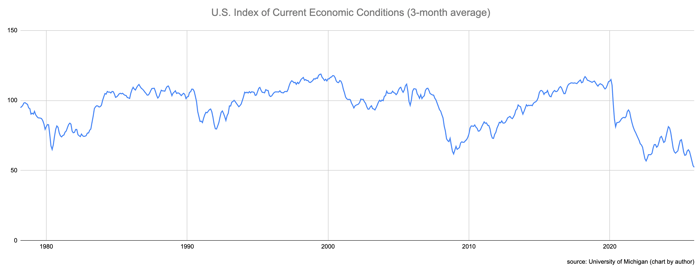
Source: University of Michigan.
The December 2025 reading was 50.4, and the 3-month rolling average in January 2026 hit 52.3. Both of those numbers are the lowest ever seen on this report going all the way back to the late 1970s.
Poor sentiment might be a contrarian indicator
Of course, any indicator that suggests things are worse now than they have been at any point in the past 50 years isn't a good thing. But can it actually be read as a contrarian indicator? Sort of a "buy low" type signal?
History suggests that the answer is yes! But let's dig into the data first.

Source: Getty Images.
To start, I pulled every monthly Current Economic Conditions Index reading going back to 1978. In addition, I pulled all month-end S&P 500 index values over the past 50 years.
My intention is to look at forward-12-month index returns to gauge how the S&P 500 performs with different Current Economic Conditions Index readings as the starting point. The 12-month period for the purposes of my analysis begins with the month following the report release date. For example, if the report was for January 1991, I looked at S&P 500 returns from Feb. 1, 1991 to Jan. 31, 1992.
I also grouped monthly report readings into 5-point "buckets." For example, a monthly reading of 84.4 would fall into the "80-84.9" group. Here are the results of my study.
| Current Conditions Range | Number of Instances | Average Forward-12-Month S&P 500 Return |
|---|---|---|
| 55-59.9 | 3 | 14.89% |
| 60-64.9 | 12 | 18.38% |
| 65-69.9 | 19 | 19.05% |
| 70-74.9 | 33 | 12.15% |
| 75-79.9 | 34 | 8.16% |
| 80-84.9 | 45 | 9.79% |
| 85-89.9 | 37 | 13.92% |
| 90-94.9 | 37 | 7.80% |
| 95-99.9 | 57 | 3.17% |
| 100-104.9 | 75 | 8.26% |
| 105-109.9 | 123 | 13.89% |
| 110-114.9 | 65 | 12.30% |
| 115+ | 23 | 3.20% |
Source: Investing.com
While there is some choppiness present in each of the individual buckets, there is a fairly clear pattern that emerges.
The best forward-looking returns by average occur when the Current Economic Conditions Index is at its lowest point. Returns generally look a little more average in that middle range but look either good or bad when readings are up in the triple digits.
There's enough variability here that it's difficult to say how any individual scenario will play out. But I also don't think it can be ignored that the three buckets with the highest forward-looking returns occur where economic conditions appear their worst.
Right now, we're in that area, and this could be a prime buying opportunity.
Should you buy stock in S&P 500 Index right now?
Before you buy stock in S&P 500 Index, consider this:
The Motley Fool Stock Advisor analyst team just identified what they believe are the 10 best stocks for investors to buy now… and S&P 500 Index wasn’t one of them. The 10 stocks that made the cut could produce monster returns in the coming years.
Consider when Netflix made this list on December 17, 2004... if you invested $1,000 at the time of our recommendation, you’d have $414,554!* Or when Nvidia made this list on April 15, 2005... if you invested $1,000 at the time of our recommendation, you’d have $1,120,663!*
Now, it’s worth noting Stock Advisor’s total average return is 884% — a market-crushing outperformance compared to 193% for the S&P 500. Don't miss the latest top 10 list, available with Stock Advisor, and join an investing community built by individual investors for individual investors.
See the 10 stocks »
*Stock Advisor returns as of February 16, 2026.
David Dierking has no position in any of the stocks mentioned. The Motley Fool has no position in any of the stocks mentioned. The Motley Fool has a disclosure policy.
Recommended Articles


