


Big Tech Will Spend $700 Billion on Artificial Intelligence in 2026. Here's My Top Stock to Buy to Take Advantage.
Key Points
Amazon, Alphabet, Microsoft, Meta, and Oracle will spend over $700 billion on data centers this year.
This company can expect a huge increase in revenue regardless of how big tech allocates its budget.
The stock trades for a great value relative to the growth opportunity ahead of it.
- 10 stocks we like better than Taiwan Semiconductor Manufacturing ›
Wall Street expected there to be a significant step-up in spending by the biggest hyperscalers this year. Computing needs for large language model training and inference are only growing larger as models expand and usage increases. But few analysts predicted the five biggest spenders budgeting over $700 billion in 2026.
Amazon (NASDAQ: AMZN), Alphabet (NASDAQ: GOOG) (NASDAQ: GOOGL), Microsoft (NASDAQ: MSFT), and Oracle (NYSE: ORCL) are all facing growing backlogs of compute demand for their cloud services. Meta Platforms (NASDAQ: META) sees enormous potential in developing its own leading AI capabilities, and it's investing as much as it can to get there. While several companies could be big beneficiaries of big tech's massive budgets, there's one stock that looks particularly appealing right now.
Will AI create the world's first trillionaire? Our team just released a report on the one little-known company, called an "Indispensable Monopoly" providing the critical technology Nvidia and Intel both need. Continue »
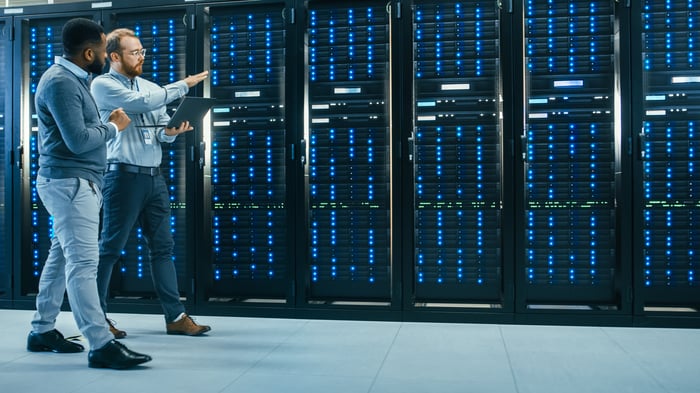
Image source: Getty Images.
Big tech's spending plans
Before diving into the biggest beneficiaries of big tech's spending, it's worth exploring how much each company is planning to spend this year and what exactly they're spending it on.
The table below breaks down each of the five hyperscalers' capital expenditure budgets and the year-over-year growth.
| Company | 2026 Budget | 2025 Actual Spend | Growth (YOY) |
|---|---|---|---|
| Amazon | $200 billion | $128.3 billion | 56% |
| Alphabet | $180 billion | $91.4 billion | 97% |
| Microsoft | $151 billion | $118 billion | 28% |
| Meta Platforms | $125 billion | $72.2 billion | 73% |
| Oracle | $58.8 billion | $35.5 billion | 66% |
Data source: Visible Alpha via The Wall Street Journal. YOY = year over year.
Each company has various other capital expenditure needs, but the vast majority of the spending is going toward building and outfitting new artificial intelligence (AI) data centers. Amazon may be the only company with significant amounts that aren't going toward that endeavor, as it also operates massive logistics networks across the U.S. and Europe. Even so, it's significantly shifted its focus toward the artificial intelligence opportunity.
Of course, there's a lot that goes into a data center: building materials, construction, and all the equipment that goes into them, including server racks, cooling, networking equipment and cables, and the AI accelerator chips and server CPUs themselves.
Microsoft CFO Amy Hood provided some insights into exactly how much goes toward the latter versus everything else during the company's second-quarter earnings call. "Roughly two-thirds of our capex was on short-lived assets, primarily GPUs and CPUs," she told analysts. It's a good bet the other hyperscalers are seeing a similar split in their expenditures. Some might spend more or less, depending on exactly which types of chips they outfit their data centers with.
That means these five companies are set to spend over $450 billion on GPUs, CPUs, and other AI accelerator chips in 2026. That's excellent news for chipmakers, and one company in particular.
My top stock for the AI spending boom
While hyperscalers will work with GPU makers like Nvidia or custom AI accelerator designers like Broadcom to outfit large swaths of their data centers, the better opportunity for investors may be the company supplying those chipmakers. Taiwan Semiconductor Manufacturing (NYSE: TSM) is the company behind the most cutting-edge chip designs. And while management already expected companies to spend a lot of money on TSMC's advanced chip manufacturing this year, it could outperform those lofty expectations based on the updated guidance from the big tech companies.
TSMC is the largest contract semiconductor manufacturer in the world. That lead is supported by its advanced technological capabilities to print and package chips with ever-smaller transistor sizes. With more revenue than its competitors, it can invest more in the R&D needed to maintain its technology lead.
Management provided optimistic guidance for 2026 when it reported its full-year 2025 earnings last month. It said first-quarter revenue should come in around 38% higher (in U.S. dollars) with gross margin expanding to 64% at the midpoint of its guidance (up from 62.3% in the fourth quarter). It's already ahead of that pace based on its reported January revenue.
Long-term, management increased its annualized revenue growth outlook for the five-year period from 2024 through 2029 to 25% from the 20% per year outlook it provided a year ago. That's supported by spending on AI accelerator chips rising at a mid-50% rate.
But based on big tech's spending plans, that growth could be even faster, or at least front-loaded. The demand should give it even more pricing power, enabling it to deliver a stronger gross margin and substantial profit growth over the next few years.
To be sure, the positive trends favoring TSMC aren't lost on the rest of the market. The stock is now trading at an all-time high. But it still looks like a great value at 26 times forward earnings expectations (and those earnings expectations may still be too low). TSMC offers great value and a secular way to invest in the growing demand for AI chips amid massive tech companies spending hundreds of billions on data centers this year.
Should you buy stock in Taiwan Semiconductor Manufacturing right now?
Before you buy stock in Taiwan Semiconductor Manufacturing, consider this:
The Motley Fool Stock Advisor analyst team just identified what they believe are the 10 best stocks for investors to buy now… and Taiwan Semiconductor Manufacturing wasn’t one of them. The 10 stocks that made the cut could produce monster returns in the coming years.
Consider when Netflix made this list on December 17, 2004... if you invested $1,000 at the time of our recommendation, you’d have $414,554!* Or when Nvidia made this list on April 15, 2005... if you invested $1,000 at the time of our recommendation, you’d have $1,120,663!*
Now, it’s worth noting Stock Advisor’s total average return is 884% — a market-crushing outperformance compared to 193% for the S&P 500. Don't miss the latest top 10 list, available with Stock Advisor, and join an investing community built by individual investors for individual investors.
See the 10 stocks »
*Stock Advisor returns as of February 16, 2026.
Adam Levy has positions in Alphabet, Amazon, Meta Platforms, Microsoft, and Taiwan Semiconductor Manufacturing. The Motley Fool has positions in and recommends Alphabet, Amazon, Meta Platforms, Microsoft, Nvidia, Oracle, and Taiwan Semiconductor Manufacturing. The Motley Fool recommends Broadcom. The Motley Fool has a disclosure policy.
Recommended Articles


