

Should You Buy the Dip in Microsoft Stock?

Source The Motley Fool

Key Points

  • Microsoft faces intensifying competition from Amazon and Alphabet in the cloud computing space.

  • Some investors worry that Microsoft's rising infrastructure costs aren't yielding a sufficient return.

  • However, Microsoft stock is hovering near its cheapest levels since the AI revolution started.

  • 10 stocks we like better than Microsoft ›

A little more than three years ago, Microsoft (NASDAQ: MSFT) helped kick off the artificial intelligence (AI) revolution after the company invested billions into ChatGPT developer OpenAI. Since then, the Windows maker has swiftly integrated AI throughout its massive ecosystem -- from cloud computing to data analytics, software coding, and more.

Despite Microsoft being one of the most influential leaders of the AI boom, investors have been punishing its stock as of late -- with shares plummeting 16% since the company reported earnings on Jan. 28. Let's dive into the factors plaguing Microsoft stock right now and assess if the ongoing sell-off is actually an opportunity for smart investors to buy the dip.

Will AI create the world's first trillionaire? Our team just released a report on the one little-known company, called an "Indispensable Monopoly" providing the critical technology Nvidia and Intel both need. Continue »

Microsoft Windows logo.

Image source: Getty Images.

Why is Microsoft stock dropping?

One of the primary use cases for AI is how hyperscalers integrate the technology into their cloud platforms. While Amazon Web Services (AWS) holds the largest market share among major cloud services providers, Microsoft Azure is right behind it.

With each passing earnings report, investors dial in on Azure's growth relative to its peers. For the quarter ended Dec. 31, Azure's revenue increased 39% year over year. By comparison, AWS grew by 24% and Google Cloud Platform (GCP) rose 48%. While GCP is accelerating at a much faster pace than Azure and AWS, it's also a far smaller business.

With this in mind, I don't think concerns over Azure's growth are the only culprit behind Microsoft's sell-off. Rather, the company's rising infrastructure costs are beginning to make investors nervous.

During the earnings call, Microsoft CFO Amy Hood said she thinks investors are making a "direct correlation" between Microsoft's capital expenditures (capex) and Azure's revenue. This is a subtle way of saying management realizes that investors are questioning the return on investment around Microsoft's accelerating AI infrastructure build-outs.

Is Microsoft a good stock to buy now?

From a valuation perspective, Microsoft stock hasn't been this cheap since the dawn of the AI revolution. The company's price-to-earnings (P/E) multiple of 25 is hovering near its lowest levels in roughly three years.
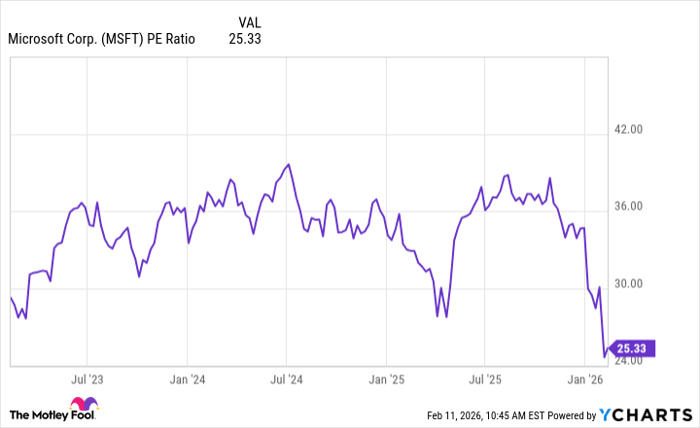
MSFT PE Ratio Chart

MSFT PE Ratio data by YCharts

On top of that, the consensus price target for Microsoft stock among sell-side analysts is $596 -- implying 48% upside from current levels. To me, this suggests that Wall Street remains bullish on Microsoft's AI road map and is confident in management's ability to allocate capital strategically.

Given its attractive valuation profile and upside potential, buying Microsoft stock hand over fist might seem like a no-brainer. That said, there is still some execution risk when it comes to the company's infrastructure build-outs and their ability to bear fruit and impact Azure, as well as other pockets of Microsoft's ecosystem, in an accretive way.

For this reason, I would cautiously buy the dip in Microsoft stock right now but wouldn't bet the farm. I think the sell-off is overblown and taking advantage of the depressed price action could prove to be a savvy choice in the long run.

Should you buy stock in Microsoft right now?

Before you buy stock in Microsoft, consider this:

The Motley Fool Stock Advisor analyst team just identified what they believe are the 10 best stocks for investors to buy now… and Microsoft wasn’t one of them. The 10 stocks that made the cut could produce monster returns in the coming years.

Consider when Netflix made this list on December 17, 2004... if you invested $1,000 at the time of our recommendation, you’d have $414,554!* Or when Nvidia made this list on April 15, 2005... if you invested $1,000 at the time of our recommendation, you’d have $1,120,663!*

Now, it’s worth noting Stock Advisor’s total average return is 884% — a market-crushing outperformance compared to 193% for the S&P 500. Don't miss the latest top 10 list, available with Stock Advisor, and join an investing community built by individual investors for individual investors.

See the 10 stocks »

*Stock Advisor returns as of February 15, 2026.

Adam Spatacco has positions in Amazon and Microsoft. The Motley Fool has positions in and recommends Amazon and Microsoft. The Motley Fool has a disclosure policy.

Disclaimer: For information purposes only. Past performance is not indicative of future results.
placeholder
Bitcoin CME gaps at $35,000, $27,000 and $21,000, which one gets filled first?Prioritize filling the $27,000 gap and even try higher.
Author  FXStreet
Aug 22, 2023
Prioritize filling the $27,000 gap and even try higher.
placeholder
Pinduoduo Earnings Incoming: Morgan Stanley Sees Long-Term Profit Potential​Insights – On November 21, Chinese e-commerce giant Pinduoduo (PDD) will release its Q3 2024 earnings.
Author  Mitrade
Nov 20, 2024
​Insights – On November 21, Chinese e-commerce giant Pinduoduo (PDD) will release its Q3 2024 earnings.
placeholder
Elon Musk’s xAI and Neuralink Launch New Funding Rounds​Billionaire Elon Musk recently raised funds for his two high-profile tech companies, xAI and Neuralink.
Author  Insights
Jun 03, 2025
​Billionaire Elon Musk recently raised funds for his two high-profile tech companies, xAI and Neuralink.
placeholder
Bitcoin briefly loses 2025 gains as crypto plunges over the weekend.Bitcoin experienced a sharp decline this weekend, briefly erasing its 2025 gains and dipping below its year-opening value of $93,507. The cryptocurrency fell to a low of $93,029 on Sunday, representing a 25% drop from its all-time high in October. Although it has rebounded slightly to around $94,209, the pressures on the market remain significant. The downturn occurred despite the reopening of the U.S. government on Thursday, which many had hoped would provide essential support for crypto markets. This year initially appeared promising for cryptocurrencies, particularly after the inauguration of President Donald Trump, who has established the most pro-crypto administration thus far. However, ongoing political tensions—including Trump's tariff strategies and the recent government shutdown, lasting a historic 43 days—have contributed to several rapid price pullbacks for Bitcoin throughout the year. Market dynamics are also being influenced by Bitcoin whales—investors holding large amounts of Bitcoin—who have been offloading portions of their assets, consequently stalling price rallies even as positive regulatory developments emerge. Despite these sell-offs, analysts from Glassnode argue that this behavior aligns with typical patterns seen among long-term investors during the concluding stages of bull markets, suggesting it is not indicative of a mass exodus. Notably, Bitcoin is not alone in its struggles, as Ethereum and Solana have also recorded declines of 7.95% and 28.3%, respectively, since the start of the year, while numerous altcoins have faced even steeper losses. Looking ahead, questions linger regarding the viability of the four-year cycle thesis, particularly given the increasing institutional support and regulatory frameworks now in place in the crypto landscape. Matt Hougan, chief investment officer at Bitwise, remains optimistic, suggesting a potential Bitcoin resurgence in 2026 driven by the “debasement trade” thesis and a broader trend toward increased adoption of stablecoins, tokenization, and decentralized finance. Hougan emphasized the soundness of the underlying fundamentals, pointing to a positive outlook for the sector in the longer term.
Author  Mitrade
Nov 17, 2025
Bitcoin experienced a sharp decline this weekend, briefly erasing its 2025 gains and dipping below its year-opening value of $93,507. The cryptocurrency fell to a low of $93,029 on Sunday, representing a 25% drop from its all-time high in October. Although it has rebounded slightly to around $94,209, the pressures on the market remain significant. The downturn occurred despite the reopening of the U.S. government on Thursday, which many had hoped would provide essential support for crypto markets. This year initially appeared promising for cryptocurrencies, particularly after the inauguration of President Donald Trump, who has established the most pro-crypto administration thus far. However, ongoing political tensions—including Trump's tariff strategies and the recent government shutdown, lasting a historic 43 days—have contributed to several rapid price pullbacks for Bitcoin throughout the year. Market dynamics are also being influenced by Bitcoin whales—investors holding large amounts of Bitcoin—who have been offloading portions of their assets, consequently stalling price rallies even as positive regulatory developments emerge. Despite these sell-offs, analysts from Glassnode argue that this behavior aligns with typical patterns seen among long-term investors during the concluding stages of bull markets, suggesting it is not indicative of a mass exodus. Notably, Bitcoin is not alone in its struggles, as Ethereum and Solana have also recorded declines of 7.95% and 28.3%, respectively, since the start of the year, while numerous altcoins have faced even steeper losses. Looking ahead, questions linger regarding the viability of the four-year cycle thesis, particularly given the increasing institutional support and regulatory frameworks now in place in the crypto landscape. Matt Hougan, chief investment officer at Bitwise, remains optimistic, suggesting a potential Bitcoin resurgence in 2026 driven by the “debasement trade” thesis and a broader trend toward increased adoption of stablecoins, tokenization, and decentralized finance. Hougan emphasized the soundness of the underlying fundamentals, pointing to a positive outlook for the sector in the longer term.
placeholder
Silver Price Forecast: XAG/USD falls to near $72.00 amid fading safe-haven demandSilver price (XAG/USD) continues to lose ground after registering tiny losses in the previous day, trading around $72.90 during the Asian hours on Thursday. The safe-haven demand for the precious metal fades amid rising optimism over Middle East peace.
Author  FXStreet
Apr 02, Thu
Silver price (XAG/USD) continues to lose ground after registering tiny losses in the previous day, trading around $72.90 during the Asian hours on Thursday. The safe-haven demand for the precious metal fades amid rising optimism over Middle East peace.
goTop
quote