


Is Nvidia Set to Help Joby Aviation Become the Tesla of the Skies?
Key Points
Joby is partnering with Nvidia to develop autonomous flight technology.
The company's approach differs from competitors Archer and Wisk, balancing piloted and autonomous strategies.
Joby's first-mover advantage and risk management make it appealing for exposure to the eVTOL market.
- 10 stocks we like better than Joby Aviation ›
In late 2025, the news that Joby Aviation (NYSE: JOBY) and Nvidia were teaming up to develop an autonomous flight capability hit the market by surprise. Given that Joby is pursuing a vertically integrated strategy (designing, manufacturing, owning, and operating its own aircraft as a transportation company) in the electric vertical take-off and landing (eVTOL) market, the parallel with Tesla's robotaxi rollout is obvious. Is it set to make Joby the undisputed eVTOL champion?
Joby, Nvidia, and the underappreciated risk in the eVTOL market
The collaboration will involve Joby using Nvidia's computing power via its new IGX Thor Platform, which is under development alongside Joby's Superpilot autonomous flight technology. It's an interesting move that highlights the differences in approaches among Joby, Archer Aviation, and the eVTOL company no one talks about: Boeing's Wisk.
Will AI create the world's first trillionaire? Our team just released a report on the one little-known company, called an "Indispensable Monopoly" providing the critical technology Nvidia and Intel both need. Continue »
Each company has its own strategy. Archer aims to be an eVTOL manufacturer and will sell its aircraft to others. Joby and Wisk, on the other hand, want to run transportation services. The key difference is that Joby, like Archer, is starting with piloted aircraft, while Wisk is focused only on autonomous planes.
Having pilots means that Joby and Archer are significantly ahead in the certification process. Still, if Wisk's autonomous eVTOL gets certified later, they're highly likely to substantially undercut Joby's airtaxis, in the same way that Tesla's robotaxis are likely to be heavily price-competitive with conventional taxis.

Image source: Getty Images.
How Joby is handling risk
The potential threat from Wisk is somewhat mitigated by Joby's ongoing development with Superpilot and, more recently, the Nvidia collaboration. Joby plans to develop autonomous functions (mission management, radar processing, etc.) that will act as a digital copilot to assist a human pilot.
However, Joby plans to use Nvidia's technology platform to continue developing Superpilot so it can ultimately "pursue certifiable autonomy for near-term defense and long-term civil applications as the Federal Aviation Administration advances the capabilities of national airspace," according to a Joby press release.
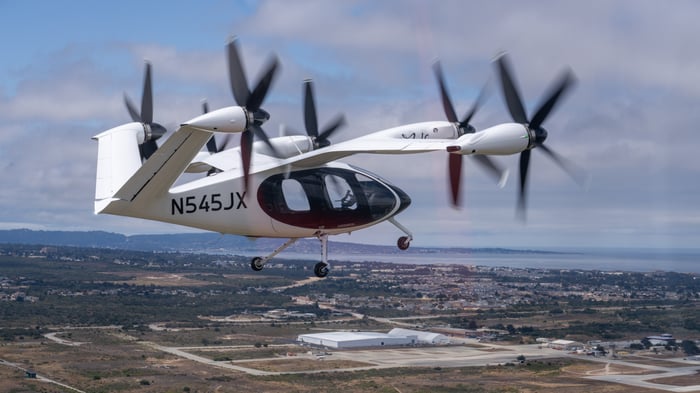
Image source: Joby Aviation.
What's next for Joby
The company's plan to develop autonomous eVTOLs for the military in the near term makes sense, as it could establish and test its technology ahead of civil adoption. Moreover, the plan to use Superpilot as a digital copilot on civil airtaxis will give the company substantial flight-hour data to improve it ahead of a potential launch. Again, the analogy with Tesla works, as the EV company has billions of miles of data on its full-self-driving (FSD) software from Tesla drivers.
By working with Nvidia, Joby is reducing the risk that Wisk will overtake it in the autonomous market. The company could have piloted airtaxis in service, and possibly even autonomous ones for the military, before Wisk's civil autonomous eVTOL is certified.
Joby's first-mover advantage could prove telling in funding rounds and establishing technology and trust in the marketplace. Consequently, it's an attractive stock for investors looking for eVTOL exposure.
Should you buy stock in Joby Aviation right now?
Before you buy stock in Joby Aviation, consider this:
The Motley Fool Stock Advisor analyst team just identified what they believe are the 10 best stocks for investors to buy now… and Joby Aviation wasn’t one of them. The 10 stocks that made the cut could produce monster returns in the coming years.
Consider when Netflix made this list on December 17, 2004... if you invested $1,000 at the time of our recommendation, you’d have $409,108!* Or when Nvidia made this list on April 15, 2005... if you invested $1,000 at the time of our recommendation, you’d have $1,145,980!*
Now, it’s worth noting Stock Advisor’s total average return is 886% — a market-crushing outperformance compared to 193% for the S&P 500. Don't miss the latest top 10 list, available with Stock Advisor, and join an investing community built by individual investors for individual investors.
See the 10 stocks »
*Stock Advisor returns as of February 14, 2026.
Lee Samaha has no position in any of the stocks mentioned. The Motley Fool has positions in and recommends Boeing and Nvidia. The Motley Fool has a disclosure policy.
Recommended Articles


