


Got $1,000? 2 Top Growth Stocks to Buy That Could Double Your Money.
Key Points
One company dominates the AI chip market, and that will help it record terrific growth over the next five years.
The other growth stock is up more than 180% in the past six months, and favorable end-market conditions suggest the rise will continue.
- 10 stocks we like better than Nvidia ›
Buying fast-growing companies and holding their shares for the long run can help investors achieve market-beating returns. That's because growth stocks represent those companies capable of increasing their revenue and earnings at a faster pace than the broader market.
Their above-average performance is usually rewarded with healthy gains on the stock market, thereby creating substantial gains for investors. If you have $1,000 in investible cash right now after meeting your expenses, saving enough for difficult times, and clearing up your high-interest-rate debt -- and you're looking for market-beating returns -- you can put that money into the two growth stocks discussed in this article (either individually or combined).
Where to invest $1,000 right now? Our analyst team just revealed what they believe are the 10 best stocks to buy right now, when you join Stock Advisor. See the stocks »

Image source: Nvidia
Nvidia: The world's largest company still has a lot of upside to offer
You may be wondering why Nvidia (NASDAQ: NVDA), the world's largest company with a $4.6 trillion market cap, is on this list of growth stocks capable of doubling your money. The reason is very simple: Nvidia is head and shoulders above its rivals in the artificial intelligence (AI) chip market.
The company controls 81% of the AI chip market, according to market research firm IDC. Though other companies have been trying to take share away from Nvidia, the company has managed to sustain its dominance, due to its aggressive product-development moves and control over the supply chain.
For instance, Nvidia's next-generation Vera Rubin AI graphics processing units (GPUs), which will go on sale in the second half of 2026, are expected to reduce AI inference costs by 10x and GPU requirements for model training by 4x, according to the company. Not surprisingly, Nvidia has already lined up major hyperscalers and AI companies, such as Anthropic and OpenAI, as customers for its next-generation processors.
With spending by the four major hyperscalers in the U.S. anticipated to jump to a whopping $700 billion in 2026 from $394 billion last year, Nvidia seems to be in a solid position to capitalize on this massive incremental opportunity, with the help of its new chips. Also, the performance gains Nvidia is promising suggest it could indeed sustain its terrific share of the AI chip market.
In addition, Nvidia's stature in AI chips means that it can sustain the outstanding growth in its data center business in the long run. RBC Capital Markets expects the AI chip market to grow by 2.5x in size by 2028, generating $550 billion in annual revenue. Nvidia's current market share suggests it could generate well over $400 billion in AI chip revenue over the next three years, which is probably why analysts are bullish on its earnings-growth potential.
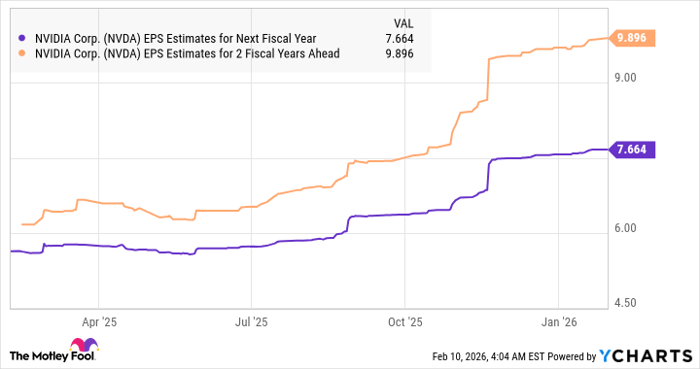
Data by YCharts.
Nvidia's earnings in the recently concluded fiscal 2026 reportedly increased by 57% to $4.69 per share. The chart above suggests that its bottom-line growth is on track to improve this year, followed by another solid jump in the next one. Such solid earnings growth is likely to be rewarded with strong gains on the market, especially considering that Nvidia stock is trading at an attractive 24 times forward earnings.
Investors looking to buy a growth stock trading at an attractive valuation can consider buying Nvidia, as it has the potential to double from current levels and even reach a $10 trillion market cap in the next five years.
Seagate Technology: Booming memory demand and an attractive valuation point toward more gains
Seagate Technology (NASDAQ: STX) stock has jumped by a whopping 183% in the past six months. This stunning surge has been driven by favorable conditions in the data storage market, where demand for storage solutions, such as hard-disk drives (HDDs) and solid-state drives (SSDs), is booming, thanks to AI.
Seagate released its fiscal 2026 second-quarter results (for the three months ended Jan. 2, 2026) on Jan. 28. The company's revenue increased by 21% year over year to $2.82 billion. However, its non-GAAP earnings rose an impressive 53% year over year. The big jump in Seagate's bottom line was driven by fatter margins, which can be explained by the favorable pricing environment in storage chips.
AI data centers have been gobbling up the world's supply of HDD and SSD storage so that they can store the huge datasets needed for AI model training and inference applications. This explains the average increase of 46% in HDD prices over the past four months, according to one estimate. The prices of SSDs, on the other hand, have also taken off and are reportedly costing 16x more than HDDs, as reported by Tom's Hardware last month.
An important thing to note here is that enterprise HDD capacity is reportedly sold out for the next two years. The good news for Seagate investors is that AI-fueled storage demand is anticipated to clock an annual growth rate of 23% through 2030, according to Mordor Intelligence, creating a $76 billion addressable opportunity by the end of the decade.
Seagate should be able to sustain strong levels of earnings and revenue growth in the long run, which explains why analysts have raised their growth expectations.
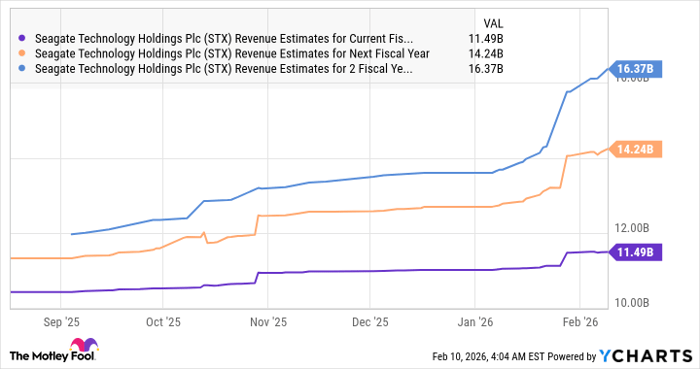
Data by YCharts.
What's more, the stock trades at 9.5 times sales right now, which isn't all that expensive when compared to the U.S. technology sector's average sales multiple of 8.3. The slightly higher valuation seems justified, as Seagate's growth is poised to significantly exceed the average growth of S&P 500 companies.
There's a good chance of Seagate stock maintaining its premium valuation in the future as the memory market surges higher on the back of AI-fueled demand, and that could pave the way for significant upside in this AI stock. Even if Seagate trades at 12 times sales after three years and achieves the $16.1 billion in revenue that analysts expect, its market cap could hit $194 billion -- just over double its current market cap.
Investors can therefore consider buying this growth stock before it skyrockets further.
Should you buy stock in Nvidia right now?
Before you buy stock in Nvidia, consider this:
The Motley Fool Stock Advisor analyst team just identified what they believe are the 10 best stocks for investors to buy now… and Nvidia wasn’t one of them. The 10 stocks that made the cut could produce monster returns in the coming years.
Consider when Netflix made this list on December 17, 2004... if you invested $1,000 at the time of our recommendation, you’d have $409,108!* Or when Nvidia made this list on April 15, 2005... if you invested $1,000 at the time of our recommendation, you’d have $1,145,980!*
Now, it’s worth noting Stock Advisor’s total average return is 886% — a market-crushing outperformance compared to 193% for the S&P 500. Don't miss the latest top 10 list, available with Stock Advisor, and join an investing community built by individual investors for individual investors.
See the 10 stocks »
*Stock Advisor returns as of February 13, 2026.
Harsh Chauhan has no position in any of the stocks mentioned. The Motley Fool has positions in and recommends Nvidia. The Motley Fool has a disclosure policy.
Recommended Articles


