


3 Reasons NextEra Energy Shares Could Soar in 2026
Key Points
Shares of NextEra Energy are up about 13.1% 2026, far outpacing the S&P 500 performance of 1.4%.
Even so, shares have risen by just 8.3% over the last five years, badly lagging the broader market.
There are three reasons to think the stock's recent dramatic outperformance can continue through 2026 and beyond.
- 10 stocks we like better than NextEra Energy ›
Over the last five years, shares of Florida-based utility company NextEra Energy (NYSE: NEE) have badly lagged the markets. In a stretch in which the S&P 500 (SNPINDEX: ^GSPC) returned 77.5%, NextEra shares rose just 8.3%.
While the stock's return since February 2021 is disappointing to investors, it shouldn't be surprising. Utility stocks, which are mostly defensive in nature, tend to compete with bonds for the favor of yield-seeking investors with little appetite for risk. Therefore, high interest rates have held back the sector that The New York Times once called "widow and orphan stocks" because of their resistance to economic downturns.
Will AI create the world's first trillionaire? Our team just released a report on the one little-known company, called an "Indispensable Monopoly" providing the critical technology Nvidia and Intel both need. Continue »
Interestingly, The New York Times shared that assessment in the spring of 2000-- and in the 26 years since, NextEra shares haven't just been good for risk-averse people. They've been good for everybody, returning 1,700% while the dividend rose every year. Strikingly, the tech-heavy Nasdaq Composite (NASDAQINDEX: ^IXIC) has returned just 415% in that time frame.
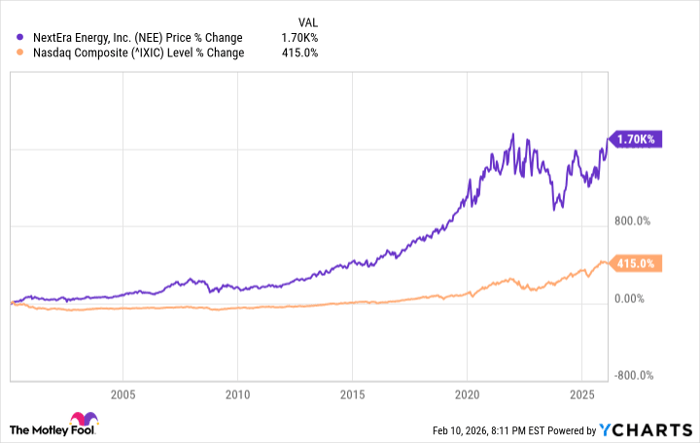
Data by YCharts.
Meanwhile, its dividend was no slouch, either. Since 2000, it's risen by 737%, well above the 92% inflation rate in that time span.
Over the long term, NextEra has proven to be something truly rare: a defensive, high-income play that also behaves like a high-growth tech stock. And there are three reasons to think its old identity is starting to reassert itself.
1. A "unique moment" with NextEra's industry front and center
If you've noticed your electricity bills rising lately, it's not just you. In the company's Q2 2025 earnings call nine months ago, CEO John Ketchum pointed to America's surging electricity demand, which is driven in large part by the global artificial intelligence (AI) revolution and its energy-hungry data centers.
Ketchum called this "a unique moment" because for decades, electricity demand in America was largely constant. In the age of AI, in which data centers are projected to soon consume as much electricity as Japan, a nation of 125 million people, that's no longer the case.
Utility companies are, of course, regulated in the price increases they can impose. In an industry where profit margins are restricted, companies can grow earnings by selling much more of their product. NextEra now has a 95-gigawatt pipeline of new energy capacity, which could power over 83 million homes. For context, it provides electricity to 6 million households today.
2. NextEra could claim the lion's share of lucrative tax credits
Last July, when Congress passed what it called the "big, beautiful bill," it phased out tax credits for wind and solar projects by making them available only for projects that had begun construction by July 1, 2026.
In NextEra's earnings call the following month, Ketchum called the rules "tough, but constructive," in that NextEra was already "constantly in a state of construction," with a large pipeline of early- and late-stage projects well underway.

Image source: Getty Images.
The mad scramble to build wind, solar, and nuclear power generators by July 1 led the research firm BloombergNEF to forecast that record clean energy capacity could be added in 2026 and 2027. Since NextEra is already the largest provider of clean power in North America, no company can match its scale as this race unfolds.
3. Dividend Champions should thrive from lower rates
The Federal Reserve is widely expected to lower interest rates by April or June, perhaps by as much as 75 basis points. This would bring rates down to the 2.75% to 3% range, making dividend yields much more tempting to income investors -- particularly Dividend Champions like NextEra that have raised payouts for 25 years or more.
NextEra's dividend-hiking streak goes back 31 years to 1994, and the company currently yields 2.5%. Management has issued dividend guidance of 10% this year, with 6% hikes in 2027 and 2028.
Thanks to the powerful combination of a shift to income stocks, supercharged demand from the AI revolution, and its unique positioning to claim lucrative tax credits by July 1, I believe this company is about to surprise a lot of people. NextEra's 11% rally so far this year could be just the beginning of a multiyear or even multi-decade surge like the one seen in 2000. Whether you prioritize growth or income, this company belongs on just about everyone's buy list.
Should you buy stock in NextEra Energy right now?
Before you buy stock in NextEra Energy, consider this:
The Motley Fool Stock Advisor analyst team just identified what they believe are the 10 best stocks for investors to buy now… and NextEra Energy wasn’t one of them. The 10 stocks that made the cut could produce monster returns in the coming years.
Consider when Netflix made this list on December 17, 2004... if you invested $1,000 at the time of our recommendation, you’d have $429,385!* Or when Nvidia made this list on April 15, 2005... if you invested $1,000 at the time of our recommendation, you’d have $1,165,045!*
Now, it’s worth noting Stock Advisor’s total average return is 913% — a market-crushing outperformance compared to 196% for the S&P 500. Don't miss the latest top 10 list, available with Stock Advisor, and join an investing community built by individual investors for individual investors.
See the 10 stocks »
*Stock Advisor returns as of February 12, 2026.
William Dahl has positions in NextEra Energy. The Motley Fool has positions in and recommends NextEra Energy. The Motley Fool has a disclosure policy.
Recommended Articles


