


Forget Applied Digital: This Under-the-Radar Cash Machine Is a Far Simpler Profit Play
Key Points
Artificial intelligence (AI) data center construction is booming—but its biggest name isn’t automatically the best investment.
Meanwhile, a slower-growing tech sector is proving highly profitable for one key player.
The analyst community says this outfit’s stock offers an 80% upside in the foreseeable future.
- 10 stocks we like better than GoDaddy ›
Data centers have become one of the artificial intelligence (AI) revolution's hottest must-have trades, thrusting Applied Digital (NASDAQ: APLD), data center construction company, into the spotlight.
This sudden swell of bullish attention doesn't come without its risks, though. Chiefly, the stock's big gains since early last year have made it very expensive. And never mind its lack of profits right now and for the foreseeable future. APLD shares are priced at roughly 30 times this year's projected revenue, versus the S&P 500's (SNPINDEX: ^GSPC) price/sales ratio of only around 3.4. Even if and when Applied Digital starts turning a plausible profit, it's still going to be an incredibly expensive stock.
Will AI create the world's first trillionaire? Our team just released a report on the one little-known company, called an "Indispensable Monopoly" providing the critical technology Nvidia and Intel both need. Continue »
Meanwhile, although Applied Digital may be the biggest and best-known builder in this space, as the AI data center construction industry matures, specialty construction outfits like Jacob and Emcor are penetrating this market. It's not clear if Applied Digital will remain the business's top go-to name.
Fortunately, there's a far simpler alternative from the technology sector that's worth considering adding to your portfolio right now, and it's a cash machine: GoDaddy (NYSE: GDDY).
GoDaddy's roots are planted deep
If the name rings a bell, it may be because the web domain registration and web hosting outfit did a great deal of television advertising back in the early 2010s. Perhaps most memorably, retired race car driver Danica Patrick served as a spokesperson for the company. GoDaddy was founded, however, all the way back in 1997.

Image source: Getty Images.
It's not a very big company, for the record. The $13.5 billion outfit is only on pace to report revenue of around $5 billion for 2025. It's not exactly a high-growth company either. That top line of $5 billion will only be about 8% better than 2024's sales, with comparable growth in the cards for the year now underway.
This business is reliably profitable, though. GoDaddy hasn't failed to turn a non-GAAP (generally accepted accounting principles) profit in any year since fighting its way out of the red and into the black back in 2017, in fact. Indeed, the consistency of its sales and earnings growth is nothing less than incredible, allowing the organization to shrug off the ebb and flow in demand that most other technology names forever face.
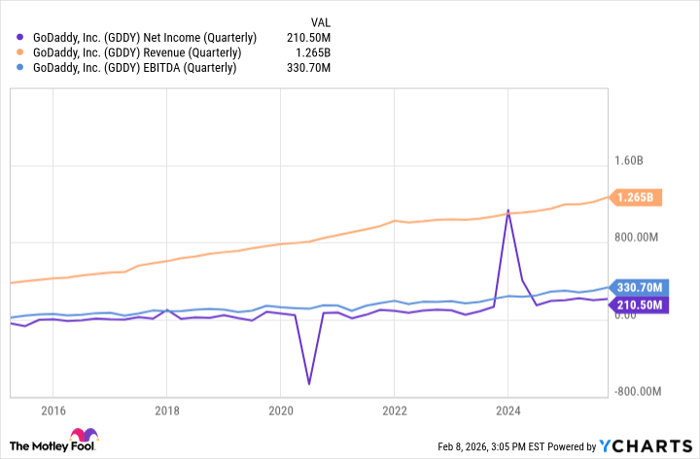
GDDY Net Income (Quarterly) data by YCharts.
A business that's been built, and rebuilt, to last
This ongoing growth isn't apt to change in the near or distant future either -- if ever -- for one obvious reason. That is, the worldwide web isn't going away. It's only going to get bigger, in fact.
Data from the Domain Name Industry Brief indicates there were 386.9 million website registrations completed during the fourth quarter of 2025 alone, extending growth that's been in place since the 1990s.
These sites are being increasingly utilized as well, with industry research outfit Hostinger reporting the number of active websites growing at an average clip of about 5% per year, outpacing the number of sites that are created but then left dormant.
It's not just ongoing new registrations, though, each of which generates revenue for a registrar like GoDaddy. Organizations need their websites to do more and store more information, which means customers are paying their web hosts for more storage space and higher-level service. Hostinger predicts that the global web-hosting industry is set to grow at an average annual rate of more than 23% through 2029, when it will be worth an expected $356 billion.
And GoDaddy is undeniably plugged into this growth. The company's average revenue per user (or ARPU) improved by 10% year over year during Q3, driving comparable earnings before interest, taxes, depreciation, and amortization (EBITDA) growth. The company's growth is likely to accelerate sooner rather than later too, catching up with Hostinger's projected growth pace.
Credit the advent of artificial intelligence tools that make it easier than ever to build complex, high-functioning websites without any real coding know-how, mostly. GoDaddy recently updated its generative AI site-building platform called Airo, for instance, making it a full-blown agentic AI-powered solution. The resulting revenue growth driven by such self-service options should be high-margin revenue as well, bolstering the company's already-robust cash flow growth and wide margins.
There's nothing not to like
Solid, reliable growth of any company's bottom line is bullish. Since GoDaddy doesn't pay dividends, its single-digit growth doesn't exactly compare to the double-digit growth reported by a slew of other tech companies.
So what makes this regular flow of profits so special to would-be GoDaddy investors right now? Through stock buybacks. In the first three quarters of 2025, management bought back 137 million shares, worth a total of $1.4 billion, bringing its four-year stock-buyback total to $5.2 billion.
To put that number in perspective, again, GoDaddy's current market cap is only $13.5 billion. That's why per-share profit growth has so easily outpaced sales growth during this time frame, expanding at a double-digit pace even if sales haven't.
It's unlikely these stock repurchases will slow down anytime soon, either, given the stock's strangely low valuation of less than 14 times this year's projected per-share profit of $7.19. (And for what it's worth, GoDaddy's topped its past three earnings estimates.) The company's getting these shares back at a bargain price.
The kicker: The analyst community's current consensus target of $175 is 80% above the stock's present price.
So, the bullish argument is solid, and the value is clear. The stock's 55% pullback from its early 2025 peak is overdone and a gift to investors willing to step back and see the bigger picture.
Should you buy stock in GoDaddy right now?
Before you buy stock in GoDaddy, consider this:
The Motley Fool Stock Advisor analyst team just identified what they believe are the 10 best stocks for investors to buy now… and GoDaddy wasn’t one of them. The 10 stocks that made the cut could produce monster returns in the coming years.
Consider when Netflix made this list on December 17, 2004... if you invested $1,000 at the time of our recommendation, you’d have $429,385!* Or when Nvidia made this list on April 15, 2005... if you invested $1,000 at the time of our recommendation, you’d have $1,165,045!*
Now, it’s worth noting Stock Advisor’s total average return is 913% — a market-crushing outperformance compared to 196% for the S&P 500. Don't miss the latest top 10 list, available with Stock Advisor, and join an investing community built by individual investors for individual investors.
See the 10 stocks »
*Stock Advisor returns as of February 12, 2026.
James Brumley has no position in any of the stocks mentioned. The Motley Fool has positions in and recommends EMCOR Group and SentinelOne. The Motley Fool recommends GoDaddy. The Motley Fool has a disclosure policy.
Recommended Articles


