


For Better or Warsh: The Federal Reserve May Be Wall Street's Ticking Time Bomb in 2026
Key Points
President Trump has nominated Kevin Warsh to succeed Jerome Powell when his term as Fed chair ends on May 15.
Warsh has previously favored deleveraging the central bank's balance sheet, which could have unintended consequences.
The next Fed chair will be contending with a historic level of division within the Federal Open Market Committee (FOMC).
- 10 stocks we like better than S&P 500 Index ›
For much of the last seven years, optimists have been in firm control on Wall Street. The benchmark S&P 500 (SNPINDEX: ^GSPC) has risen by at least 16% in six of the last seven years (the 2022 bear market being the exception), while the iconic Dow Jones Industrial Average (DJINDICES: ^DJI) and growth-powered Nasdaq Composite (NASDAQINDEX: ^IXIC) have both rallied to several record-closing highs.
While upside catalysts have been plentiful, including the rise of artificial intelligence, the advent of quantum computing, and the prospect of lower interest rates on the horizon, there are always headwinds threatening to pull the rug out from beneath investors. Sometimes these risks come from unlikely sources, such as our nation's foremost financial institution, the Federal Reserve.
Where to invest $1,000 right now? Our analyst team just revealed what they believe are the 10 best stocks to buy right now, when you join Stock Advisor. See the stocks »
With Jerome Powell's term as Fed Chair set to end on May 15, President Donald Trump nominated former Fed Governor Kevin Warsh as his replacement on Jan. 30. While Warsh will still need to be confirmed by the Senate Banking Committee, followed by the Senate itself, his potential ascension to head of the central bank adds another layer of concern for the stock market.
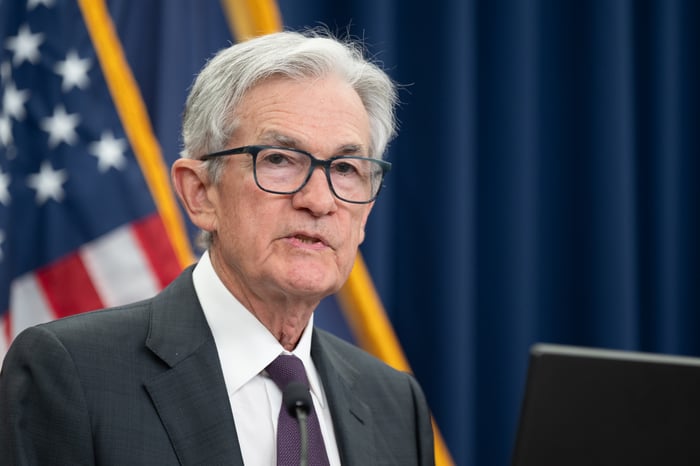
Fed Chair Jerome Powell's term ends on May 15, 2026. Image source: Official Federal Reserve Photo.
Warsh's desire to deleverage the Fed's balance sheet may come with adverse consequences
To preface the following discussion, understand that every potential Fed chair nominee to replace Powell would come with question marks. The Federal Open Market Committee (FOMC) -- the 12-person body, including the Fed chair, responsible for setting our nation's monetary policy -- doesn't always make the right move. In other words, members of the FOMC are fallible, and every Fed chair and prior nominee has had their faults on display.
Warsh, who served on the Board of Governors of the Federal Reserve from Feb. 24, 2006, to March 31, 2011, has previously been criticized for his focus on taming inflation during the financial crisis rather than tackling a challenging labor market. His past desire to keep interest rates elevated has commonly earned him the label of "hawkish" (i.e., someone who favors tightening monetary policy to combat inflation).
But it's not Warsh's potential take on interest rates that risks stirring the pot at the nation's central bank. Instead, it's his opinion that the Fed shouldn't be an active market participant and is better suited to be on the sidelines. In short, Trump's nominee favors deleveraging the Federal Reserve's $6.6 trillion balance sheet, which is primarily comprised of U.S. Treasuries and mortgage-backed securities.
Putting aside whether deleveraging is the right or wrong move, selling Treasuries could create challenges for the U.S. economy. Since bond prices and yields are inversely related, the nation's central bank dumping Treasury bonds and depressing their price would increase interest rates at the long end of the yield curve. In turn, this can drive up borrowing costs, including mortgages.
Although Warsh's desire to deleverage the Fed's balance sheet would likely drag down the prevailing inflation rate, it could adversely affect housing affordability and drive up lending costs elsewhere.
Image source: Getty Images.
Warsh would take over a historically divided Federal Reserve
However, the question marks that come with a new Fed chair nominee represent just one piece of a potentially dangerous puzzle for Wall Street and investors.
Traditionally, the Fed has been viewed as a stabilizing, if not outright boring, force on Wall Street. Though the FOMC is often behind the curve with its interest rate decisions -- this stems from economists basing their decisions on backward-looking economic data -- investors take solace in the 12-member body having a unified approach.
But what we've witnessed since the summer of 2025 is nothing short of historic division at the central bank. Each of the last five FOMC meetings has featured dissents from the agreed-upon decision.
Furthermore, two of these meetings (October and December) had dissents in opposite directions. While the consensus FOMC decision was a 25-basis-point reduction of the federal funds target rate in October and December, both meetings featured at least one member who favored no rate cut and another who supported a 50-basis-point reduction. There have only been three FOMC meetings in the last 36 years with opposite dissents, and two have occurred over the previous 3.5 months.
Anna is correct below when she says:
-- Jim Bianco (@biancoresearch) September 17, 2025
"I have not seen a meeting with so much contradictions."
---
This meeting was a mess.
See the labels in the dot plot below.
One member of the FOMC thinks the Fed is going to HIKE rates this year. One (Stephen Miran) thinks it is going to cut... https://t.co/TRUQmD5I2E pic.twitter.com/qPlJGL57ln
Kevin Warsh, assuming he clears the necessary vote hurdles in the Senate Banking Committee and then the Senate, is unlikely to bridge this historic division. It can be argued that investors are more likely to forgive a wrong or tardy move by the FOMC than to tolerate a lack of cohesion regarding our nation's monetary policy.
This division comes at a particularly precarious time for the stock market. The S&P 500's Shiller Price-to-Earnings (P/E) Ratio entered 2026 at its second-priciest valuation in 155 years. Previous instances in which the Shiller P/E Ratio has surpassed 30 have eventually resulted in the Dow Jones Industrial Average, S&P 500, and/or Nasdaq Composite shedding between 20% and 89% of their respective value.
There's little margin for error on Wall Street. A historically divided FOMC, coupled with central bank balance sheet deleveraging concerns, may turn the Fed into the stock market's ticking time bomb in 2026.
Should you buy stock in S&P 500 Index right now?
Before you buy stock in S&P 500 Index, consider this:
The Motley Fool Stock Advisor analyst team just identified what they believe are the 10 best stocks for investors to buy now… and S&P 500 Index wasn’t one of them. The 10 stocks that made the cut could produce monster returns in the coming years.
Consider when Netflix made this list on December 17, 2004... if you invested $1,000 at the time of our recommendation, you’d have $436,126!* Or when Nvidia made this list on April 15, 2005... if you invested $1,000 at the time of our recommendation, you’d have $1,053,659!*
Now, it’s worth noting Stock Advisor’s total average return is 885% — a market-crushing outperformance compared to 192% for the S&P 500. Don't miss the latest top 10 list, available with Stock Advisor, and join an investing community built by individual investors for individual investors.
See the 10 stocks »
*Stock Advisor returns as of February 7, 2026.
Sean Williams has no position in any of the stocks mentioned. The Motley Fool has no position in any of the stocks mentioned. The Motley Fool has a disclosure policy.
Recommended Articles


