


Wall Street Is Starting to Like Intel Stock Again
Key Points
Intel stock isn't well-liked by Wall Street analysts following years of struggles.
The stock's surge last year and momentum in some of its businesses have led to some analyst upgrades for Intel.
Strong demand for server CPUs and the long-term potential of the foundry business are at the center of the newfound analyst optimism.
- 10 stocks we like better than Intel ›
Most Wall Street analysts who cover Intel (NASDAQ: INTC) aren't all that optimistic about the stock, and it's not hard to see why. Intel has been struggling against multiple challenges for years. In manufacturing, delays and missteps contributed to TSMC pulling ahead and giving Intel's competitors a manufacturing advantage. In the PC and server CPU business, AMD has been consistently gaining market share.
Investors became much more optimistic about Intel over the past year. High-profile deals with the U.S. government and Nvidia injected Intel with capital, and rumors point to Apple potentially using Intel Foundry for some of its chips. Wall Street is finally starting to catch up. Earlier this week, an analyst at KeyBanc upgraded the stock to "buy" and increased his price target to $60. On Thursday, another analyst jumped on the bandwagon.
Where to invest $1,000 right now? Our analyst team just revealed what they believe are the 10 best stocks to buy right now. Continue »
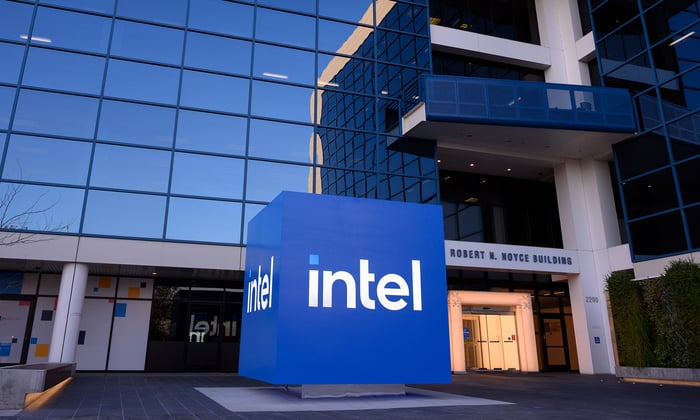
Image source: Intel.
The foundry opportunity
Citigroup analyst Atif Malik dropped his "sell" rating on Intel stock by upgrading it to "hold." Malik also set a $50 price target, which is slightly above the current stock price.
Malik isn't as optimistic about Intel's prospects compared to the KeyBanc analyst, but he sees a significant opportunity for the company to win business for its foundry segment. There are three components to Malik's overall thesis. First, Intel should benefit from a shortage of advanced packaging capacity at TSMC. Second, the U.S. government's investment creates an incentive for companies to consider Intel for manufacturing. And third, companies designing custom AI chips unable to secure manufacturing capacity at TSMC will opt for Intel instead.
The Intel 18A process is in production, with Intel's own Panther Lake chips set to debut in laptops shipping later this month. The KeyBanc analyst believes that Intel has reached yields of around 60% for Intel 18A, and the company has noted that yields are now improving at industry-standard rates. This points to a successful process node that should be compelling for chip designers struggling to secure manufacturing capacity.
Specifically, Malik expects AI ASICs, which are specialized chips designed at the hardware level for AI workloads, to find their way to Intel Foundry. Many companies, including Alphabet, Amazon, and Microsoft, design their own custom AI chips. As AI finds more use cases, demand for AI inference capacity could drive significant AI chip business to Intel Foundry.
There are still risks
One thing preventing Malik from jumping to a "buy" rating is some pessimism around Intel's CPU business. While Intel's Panther Lake turned heads at CES, the chips won't find their way into desktop PCs. Intel's Arrow Lake and its upcoming Arrow Lake refresh will attempt to hold down the desktop CPU market until the next-generation Nova Lake launches, likely in late 2026.
Arrow Lake has some issues, namely lackluster gaming performance, and the refresh isn't going to solve them. Malik worries that Intel will continue to lose CPU market share to both AMD and Arm-based devices. Qualcomm has been making a push into the PC CPU market with Arm-based chips, although compatibility issues have slowed adoption.
On top of potential market-share losses, Malik notes that rising memory chip prices could hurt overall PC demand. AI data centers consume incredible amounts of memory chips, and memory chip manufacturers have been shifting capacity to HBM used in AI accelerators. Higher PC prices could shrink PC sales temporarily, making Intel's comeback in the PC business more difficult this year.
While Malik is more balanced in his view compared to the KeyBanc analyst, Intel and its comeback story are clearly starting to win over Wall Street after years of disappointing results. Some positive foundry news this year could propel Intel stock well past Citi's $50 price target, and in the long run, the company has the potential to become a major player in the foundry industry.
Should you buy stock in Intel right now?
Before you buy stock in Intel, consider this:
The Motley Fool Stock Advisor analyst team just identified what they believe are the 10 best stocks for investors to buy now… and Intel wasn’t one of them. The 10 stocks that made the cut could produce monster returns in the coming years.
Consider when Netflix made this list on December 17, 2004... if you invested $1,000 at the time of our recommendation, you’d have $474,578!* Or when Nvidia made this list on April 15, 2005... if you invested $1,000 at the time of our recommendation, you’d have $1,141,628!*
Now, it’s worth noting Stock Advisor’s total average return is 955% — a market-crushing outperformance compared to 196% for the S&P 500. Don't miss the latest top 10 list, available with Stock Advisor, and join an investing community built by individual investors for individual investors.
See the 10 stocks »
*Stock Advisor returns as of January 17, 2026.
Citigroup is an advertising partner of Motley Fool Money. Timothy Green has positions in Intel. The Motley Fool has positions in and recommends Advanced Micro Devices, Alphabet, Amazon, Apple, Intel, Microsoft, Nvidia, Qualcomm, and Taiwan Semiconductor Manufacturing. The Motley Fool recommends the following options: long January 2026 $395 calls on Microsoft and short January 2026 $405 calls on Microsoft. The Motley Fool has a disclosure policy.
Recommended Articles


