




Why Macy's Stock Crushed it in 2025
Key Points
It's ambitious, transformational strategy was implemented well.
The retailer is becoming notably slimmer by divesting assets and closing underperforming stores.
- 10 stocks we like better than Macy's ›
What a difference a few years can make. Macy's (NYSE: M), a one-time poster boy for the retail apocalypse, saw its share price not only grow across 2025 (by over 30%) but also convincingly outperform the broader market as the bellwether S&P 500 index increased at a 16% clip. That was the first year since 2022 that the stock has achieved either feat.
Macy's was something of a cautionary tale for much of this decade. What went right for the famous retailer in 2025 to turn investor sentiment around so dramatically? Let's explore.
Where to invest $1,000 right now? Our analyst team just revealed what they believe are the 10 best stocks to buy right now, when you join Stock Advisor. See the stocks »
Apocalypse avoided
For a time in 2024, it appeared as if Macy's would be sold. Two strategic investors, Arkhouse Management and Brigade Capital Management, teamed up and began accumulating Macy's shares in late 2023. Drawn by Macy's considerable real estate holdings, the pair subsequently made increasingly pricey bids to buy the company. All were effectively rejected.

Image source: Getty Images.
Instead, Macy's management decided to move forward with its "bold new chapter" strategy, which involved selling off assets like that real estate and reducing the company's still considerable brick-and-mortar presence. The retail apocalypse, after all, had claimed numerous retail peers that retained large networks of physical stores.
To its credit, throughout 2025, Macy's largely succeeded in these tough-love goals. It's not far from its aim of shuttering 150 stores by the end of the current fiscal year, leaving the most productive locations. It also actively divested unwanted holdings, especially land, to hungry buyers like shopping mall real estate investment trusts (REITs).
Macy's was anticipating it would earn $150 million from property sales this year under the strategy. That would add to the approximately $275 million it collected from the activity in 2024.
Although revenue has generally been waning lately, due in no small measure to those store closures, Macy's bottom line has landed in the black -- if not always impressively so -- in recent quarters.
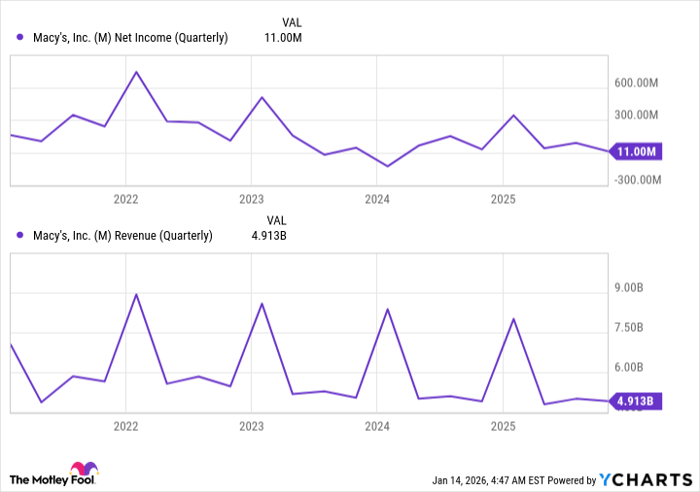
M Net Income (Quarterly) data by YCharts
There are some luminous bright spots within these results, particularly Bloomingdale's 9% year-over-year increase in comparable sales in last year's third quarter. Meanwhile, in the same period, Macy's Bluemercury cosmetics retail brand posted its 19th consecutive rise in "comps."
On the right track, at least
I like the direction in which Macy's is heading. That slimming-down strategy of bold new chapter is sensible, and management has done a solid job of implementing it. The company is effectively transforming into a more exclusive and efficient retailer, and it seems customers are responding positively to the shift.
Yet I'm not convinced that Macy's can return to its glory days as a retail powerhouse with a commanding presence in every major American market. The consistent profitability of recent times is encouraging, sure. However, I think the company will need to show reliable growth in both that metric and on the top line for this stock to really pop with investors.
Should you buy stock in Macy's right now?
Before you buy stock in Macy's, consider this:
The Motley Fool Stock Advisor analyst team just identified what they believe are the 10 best stocks for investors to buy now… and Macy's wasn’t one of them. The 10 stocks that made the cut could produce monster returns in the coming years.
Consider when Netflix made this list on December 17, 2004... if you invested $1,000 at the time of our recommendation, you’d have $487,089!* Or when Nvidia made this list on April 15, 2005... if you invested $1,000 at the time of our recommendation, you’d have $1,139,053!*
Now, it’s worth noting Stock Advisor’s total average return is 970% — a market-crushing outperformance compared to 197% for the S&P 500. Don't miss the latest top 10 list, available with Stock Advisor, and join an investing community built by individual investors for individual investors.
See the 10 stocks »
*Stock Advisor returns as of January 14, 2026.
Eric Volkman has no position in any of the stocks mentioned. The Motley Fool has no position in any of the stocks mentioned. The Motley Fool has a disclosure policy.
Recommended Articles


