




1 Magnificent Growth Stock Down 67% You'll Regret Not Buying on the Dip in 2026, According to Wall Street
Key Points
Duolingo operates the world's largest digital language-education platform, with 135 million monthly active users.
The company is using artificial intelligence to enhance the learning experience and create new revenue streams.
Duolingo stock is currently trading near the cheapest level since it went public in 2021, as measured by one popular valuation metric.
- 10 stocks we like better than Duolingo ›
The benchmark S&P 500 (SNPINDEX: ^GSPC) index entered 2026 near an all-time high, driven by spectacular gains in some of America's largest artificial intelligence (AI) stocks throughout last year. However, investors can still find attractive opportunities in the AI space if they're willing to venture off the beaten path.
Duolingo (NASDAQ: DUOL) operates the world's largest digital language-education platform and is using AI to enhance the learning experience, which is creating new opportunities to generate revenue. The company is growing rapidly, but its stock was trading at a sky-high valuation in mid-2025, so it was very hard to make the case for investing back then.
Where to invest $1,000 right now? Our analyst team just revealed what they believe are the 10 best stocks to buy right now, when you join Stock Advisor. See the stocks »
However, Duolingo stock is now down 67% from its record high and near the cheapest level it has ever been since going public in 2021. In fact, Wall Street is forecasting solid upside from here, with most of the analysts tracked by The Wall Street Journal assigning a bullish rating to the stock. Here's why investors might regret not buying the recent dip.

Image source: Getty Images.
AI is transforming the learning experience
Duolingo takes a mobile-first approach to learning, which places advanced digital lessons at the fingertips of anyone with a smartphone. Its app also gamifies the entire experience and rewards consistent effort, which keeps users engaged. During the third quarter of 2025 (ended Sept. 30), the platform had 135.3 million monthly active users, which was a 20% increase from the year-ago period.
The company makes money in two ways: It shows ads to its free users and offers a series of paid subscription options to users who want to accelerate their learning by unlocking additional features. At the end of the third quarter, the platform's paying subscriber base soared by 34% year over year to a record 11.5 million users.
Duolingo's most expensive subscription tier is called Max and offers an expanding list of AI-powered features. There's Roleplay, which uses a chatbot-style interface to help users practice their conversational skills, and also Explain My Answer, which provides users with personalized advice based on their mistakes in each lesson.
Users were also introduced to a new Max feature in late 2024 called Video Call. It enables them to practice their foreign-language speaking skills with an AI-powered digital avatar named Lily, making it an incredibly powerful learning tool.
Duolingo's long-term goal is to provide a learning experience that rivals a human tutor, and the Max feature set is a huge leap forward. It only accounted for 9% of the platform's total subscriber base in the third quarter, but that number is growing as more users realize the power of AI.
Revenue and profits continue to soar
During the first three quarters of 2025, Duolingo generated $754.7 million in revenue, which was up by a whopping 40% from the year-ago period. The company will report its fourth-quarter results in early February and is expected to take its total revenue for 2025 to a record $1.031 billion.
Thanks to careful cost management, Duolingo's net income (profit) also rocketed by almost 400% to $372.1 million in the first three quarters of 2025. It benefited from a one-off tax benefit worth $244.2 million, so the result wasn't completely on merit.
However, even if we exclude the tax benefit, the company's adjusted (non-GAAP) earnings before interest, taxes, depreciation, and amortization (EBITDA) still came in at $221.5 million, which was up 58%. In short, Duolingo has become a cash-generating machine.
Wall Street predicts solid upside for Duolingo stock in 2026
The Wall Street Journal tracks 26 analysts who cover Duolingo stock, and 13 have given it a buy rating. Two other analysts are in the overweight (bullish) camp, while 10 recommend holding. Only one analyst recommends selling.
The analysts have an average price target of $266.22, which suggests the stock could climb by 55% over the next 12 to 18 months. The Street-high target of $347 implies an even juicer potential upside of 103%.
I think both of those targets are realistic, based on Duolingo's valuation. Its stock trades at a price-to-sales ratio (P/S) of 8.8, which is a 46% discount to its average of 16.6 since going public in 2021. It's also close to Duolingo's cheapest price-to-sales ratio over the same period.
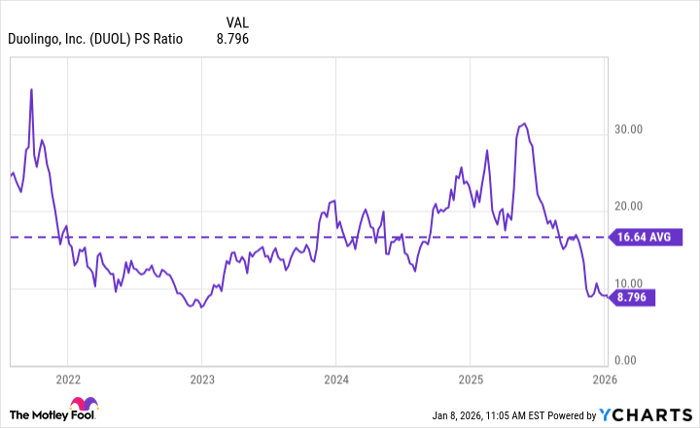
DUOL P/S Ratio data by YCharts
In summary, the recent 67% decline in Duolingo stock could be a buying opportunity for investors. It might be particularly attractive for those who are looking for less conventional ways to expose their portfolios to the AI boom.
Should you buy stock in Duolingo right now?
Before you buy stock in Duolingo, consider this:
The Motley Fool Stock Advisor analyst team just identified what they believe are the 10 best stocks for investors to buy now… and Duolingo wasn’t one of them. The 10 stocks that made the cut could produce monster returns in the coming years.
Consider when Netflix made this list on December 17, 2004... if you invested $1,000 at the time of our recommendation, you’d have $482,451!* Or when Nvidia made this list on April 15, 2005... if you invested $1,000 at the time of our recommendation, you’d have $1,133,229!*
Now, it’s worth noting Stock Advisor’s total average return is 968% — a market-crushing outperformance compared to 197% for the S&P 500. Don't miss the latest top 10 list, available with Stock Advisor, and join an investing community built by individual investors for individual investors.
See the 10 stocks »
*Stock Advisor returns as of January 12, 2026.
Anthony Di Pizio has no position in any of the stocks mentioned. The Motley Fool has positions in and recommends Duolingo. The Motley Fool has a disclosure policy.
Recommended Articles


