

The Ultimate High-Yield Dividend Stock to Buy Right Now for 2026
Key Points
Nomad Foods generates consist free cash flow annually and is an industry leader in Europe.
Despite the high-yield dividend, its payouts are easily covered by its cash generation.
Besides the dividend, the stock's share count has declined by 4% annually over the last five years.
- 10 stocks we like better than Nomad Foods ›
The stock I'll be looking at in this article probably won't become a multibagger anytime soon, nor will it be mistaken for a growth stock. However, as the broader market has shifted toward the allure of high-growth stocks -- such as artificial intelligence, quantum computing, and other next-gen technologies -- many steady-Eddie (perhaps even boring) high-yield dividend stocks have been left in their wake.
I'll highlight one of these castaway high-yield stocks and explain why it is one of my favorite buys for 2026 -- especially after it declined 63% from its all-time high.
Where to invest $1,000 right now? Our analyst team just revealed what they believe are the 10 best stocks to buy right now. Continue »
Nomad Foods: Europe's leader in frozen foods
UK-based Nomad Foods (NYSE: NOMD) is the largest frozen foods manufacturer and distributor in Europe. It is the No. 1 brand in 13 of the 15 countries it serves and occupies the No. 2 spot in the other two countries.
With its Birds Eye, iglo, and Findus brands, among others, Nomad generates roughly two-thirds of its revenue from protein and vegetables. This makes it an interesting turnaround stock because its focus on healthier foods -- especially its recently revamped chicken and protein-focused meals -- positions the company well to capitalize on a broader shift toward cleaner eating.
Despite serving a frozen food industry that typically grows by around 5% annually, Nomad has seen its stock plummet over 60% as it has battled inflation, inventory issues, weather disruptions in Europe, and a CEO change. While I strongly dislike management blaming the weather for any challenges, I still believe Nomad is primed for a turnaround thanks to its leadership advantage and the following five reasons.

Image source: Getty Images.
1. Optimizing capacity
After making five acquisitions since 2015, Nomad is shifting its focus from growing revenue to streamlining its operations. Management aims to save $200 million between 2026 and 2028 by reducing the number of depots in its logistical chain, transforming its procurement process, and increasing its use of its production capacity, which currently stands at a meager 66%.
And management expects capital expenditures to be cut in half from their three-year average between 2023 to 2025, which should also help to boost free cash flow (FCF). Compared to the company's enterprise value of $4 billion, $200 million in potential cost savings would be highly beneficial.
2. Share buybacks
If these cost savings come to fruition, management should have excess FCF to continue spending on buying back shares. Nomad repurchased roughly $175 million of its own shares through the first three quarters of 2025 and has lowered its shares outstanding by 4% annually since 2021.
With the company's valuation near a once-in-a-decade low, these share repurchases pack a powerful punch, simultaneously boosting Nomad's financial figures while demonstrating confidence in the stock over the long term.
3. A once-in-a-decade valuation
By almost any valuation metric, Nomad Foods appears to trade at a decade-long low.
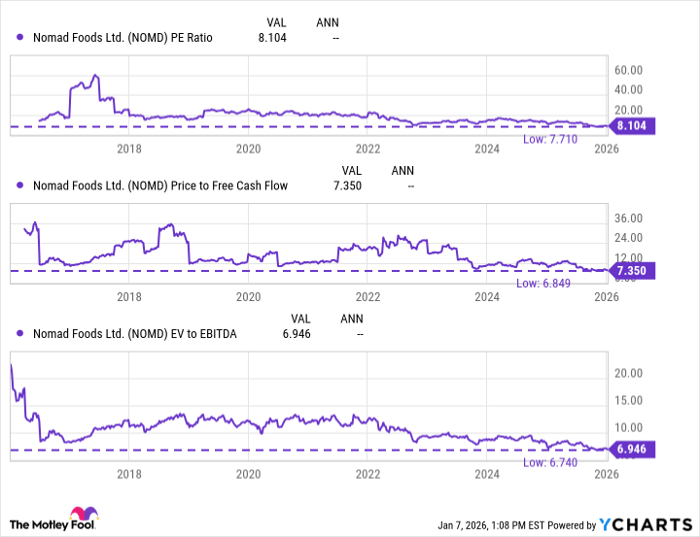
NOMD PE, P/FCF, and EV/EBITDA Ratios, data by YCharts. PE = price to earnings; EV = enterprise value; EBITDA = earnings before interest, taxes, depreciation, and amortization.
At these valuations, the company is essentially priced as a dying business, rather than one that grew sales by 6% annually over the last five years. Yes, Nomad has a lot to prove between its cost-savings ambitions, innovating across its product lines, and integrating a new chief executive officer, Dominic Brisby. Still, these risks seem to be more than priced into the stock's valuation.
4. Even management is buying the stock
If you don't want to take my word for the stock being oversold, co-founder Martin Franklin also believes the stock's valuation is unusually cheap. During the company's third-quarter earnings call, he said:
Because of this dislocation, we have been prioritizing share repurchases as the primary use of Nomad's cash flow after dividends are paid. This will remain our priority for capital allocation as long as our stock remains so undervalued.
Further reinforcing this notion, chief financial officer Ruben Baldew announced during the earnings call that he had bought $1 million in Nomad stock with his own money. Insider buying, alongside increasing stock buybacks -- all at a once-in-a-decade low valuation -- combine for an interesting buying opportunity, in my opinion. And that's not all.
5. An ultra-high-yield dividend
Following the stock's recent decline, Nomad Foods' dividend yield has spiked to 5.8%. But despite this high yield, its payments to shareholders use only 46% of the company's net income, leaving ample room for continued share repurchases.
Investors will also want to watch if Nomad raises its dividend again this year after bumping it 13% higher from 2024 levels. With consistent net income and FCF each year over the last decade, the dividend should remain relatively safe, even as management weighs whether to continue buying back shares or paying down its manageable debt load.
A patient buy for me
Thanks to these reasons, I'll be looking to add to my Nomad Foods position throughout the year. I plan to hold the stock for at least three to five years, with the hope of many more years beyond that, allowing compounding to work its magic.
As we wait for the company's cost optimizations and product innovations to take hold, I'm more than happy to collect a 5.8% dividend yield while management buys back shares hand over fist at a decade-low valuation.
Should you buy stock in Nomad Foods right now?
Before you buy stock in Nomad Foods, consider this:
The Motley Fool Stock Advisor analyst team just identified what they believe are the 10 best stocks for investors to buy now… and Nomad Foods wasn’t one of them. The 10 stocks that made the cut could produce monster returns in the coming years.
Consider when Netflix made this list on December 17, 2004... if you invested $1,000 at the time of our recommendation, you’d have $482,326!* Or when Nvidia made this list on April 15, 2005... if you invested $1,000 at the time of our recommendation, you’d have $1,133,015!*
Now, it’s worth noting Stock Advisor’s total average return is 968% — a market-crushing outperformance compared to 197% for the S&P 500. Don't miss the latest top 10 list, available with Stock Advisor, and join an investing community built by individual investors for individual investors.
See the 10 stocks »
*Stock Advisor returns as of January 10, 2026.
Josh Kohn-Lindquist has positions in Nomad Foods. The Motley Fool has no position in any of the stocks mentioned. The Motley Fool has a disclosure policy.
Recommended Articles


