




Prediction: Tesla's EV Sales Will Return to Growth in 2026
Key Points
The Model Y refresh played a significant role in the decline in deliveries during the first half of 2025.
The second-half sales recovery, although weaker than hoped, puts Tesla on track to improve EV deliveries in 2026.
- These 10 stocks could mint the next wave of millionaires ›
There's no way to sugarcoat matters. Tesla's (NASDAQ: TSLA) recent fourth-quarter production and deliveries report wasn't great, and it concluded the year with an 8.5% drop in full-year electric vehicle (EV) deliveries for the company. The decline in EV sales does matter, but there are several reasons to believe the company's EV sales will rebound in 2026. Here are a few of them.
The Model Y refresh significantly impacted sales in 2025
Not all Teslas are made equal. In fact, the Tesla story is really a Model Y (midsize SUV) and, to a slightly lesser extent, a Model 3 (sports sedan) story. The Model X (luxury SUV) and Model S (luxury sedan) are bit part players -- a fact that illustrates the desire for affordable EVs.
Where to invest $1,000 right now? Our analyst team just revealed what they believe are the 10 best stocks to buy right now. Continue »
As such, when Tesla decided to refresh the Y, it was clear that there would be a noisy quarter or two as production shifted to the new Model Y (known as Juniper) and buyers waited for the latest model to be released.
That's precisely what happened, and as you can see below, Tesla had a very weak first and second quarter as a result. For an idea of how essential the Model Y is, industry analysts estimate it's responsible for more than a quarter of total EV sales in the U.S.
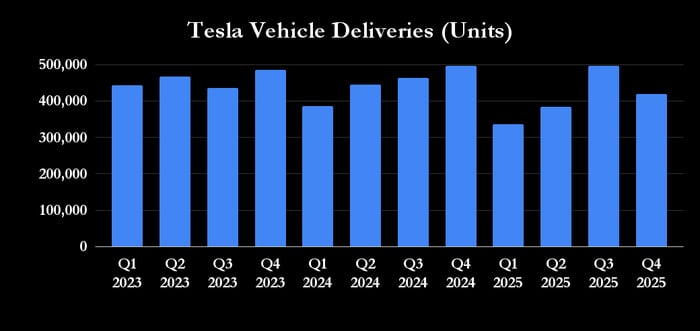
Data source: Tesla presentations. Chart by author.
Moreover, for those attributing Tesla's EV sales decline in 2025 to its high-profile CEO Elon Musk's political involvements, it's worth noting that, according to Cox Automotive, Model 3 sales rose by 17.6% in the first nine months of 2025 in the U.S. This isn't a Tesla or Musk problem, at least not in the U.S., it's a Model Y problem.
Furthermore, the rollout of the Juniper was phased regionally, as is the issue of newer standard, more affordable versions of the Model Y that Tesla is selling to better compete on price. With an easier comparison to the first half coming up and the Juniper rollout now global, Tesla's Model Y sales are expected to improve in 2026.
Tesla's sales recovered in the second half
In addition to the Model Y's impact, there's also the pull-forward of sales in the U.S. to the third quarter, caused by the expiration of U.S. federal EV tax credits at the end of September. This contributed to the sales increase observed in the third quarter, followed by a decline in the fourth quarter.
But here's the thing. If you annualize the fourth-quarter deliveries, it comes to 1.67 million deliveries. If you annualize the second half (to adjust for the tax credit expiry issue), it comes to 1.83 million deliveries. For reference, Tesla published the Wall Street analyst consensus for deliveries in 2026, which is 1.75 million deliveries, a figure in the middle of the two figures I calculated above.
Image source: Tesla.
Robotaxis and lower rates will help, too
The advent of robotaxis, led by regulatory approval and, hopefully, the production of Cybercabs, will highlight a key value-added feature of Tesla EVs. Specifically, Tesla's Full Self-Driving (FSD) software.
While Tesla's unsupervised robotaxis haven't been approved anywhere yet, Musk believes that regulatory approvals will flow in 2026 (such that Cybercab commercial production is planned to begin in April), and so will European approval of FSD -- Musk believes it will be granted in the Netherlands in early 2026.
These actions will significantly raise the profile of Tesla's FSD solutions and add perceived value to Tesla's EVs. In addition, all vehicle sales will benefit from a lower interest rate environment for investors.
Image source: Tesla.
What it means for Tesla investors
While the most critical catalysts for Tesla's stock in 2026 will be the advent of robotaxis, Cybercab production, and ongoing regulatory approvals, a return to growth in EV sales also matters, not least from a narrative perspective, as Tesla's declining EV sales have been a stick for the bears to beat the stock with. In addition, building production volume is a key factor in generating margin expansion and lowering the cost of EV production, ensuring that Tesla can make EVs more affordable.
Don’t miss this second chance at a potentially lucrative opportunity
Ever feel like you missed the boat in buying the most successful stocks? Then you’ll want to hear this.
On rare occasions, our expert team of analysts issues a “Double Down” stock recommendation for companies that they think are about to pop. If you’re worried you’ve already missed your chance to invest, now is the best time to buy before it’s too late. And the numbers speak for themselves:
- Nvidia: if you invested $1,000 when we doubled down in 2009, you’d have $479,943!*
- Apple: if you invested $1,000 when we doubled down in 2008, you’d have $49,280!*
- Netflix: if you invested $1,000 when we doubled down in 2004, you’d have $488,222!*
Right now, we’re issuing “Double Down” alerts for three incredible companies, available when you join Stock Advisor, and there may not be another chance like this anytime soon.
See the 3 stocks »
*Stock Advisor returns as of January 10, 2026.
Lee Samaha has no position in any of the stocks mentioned. The Motley Fool has positions in and recommends Tesla. The Motley Fool has a disclosure policy.
Recommended Articles


