

From Chips to Data Centers, AI Investors See the Next Breakout in This Stock
Key Points
Micron is a leading maker of computer memory products that are vital to the efficient operation of AI data center servers.
Its revenue, net income, and free cash flow are growing at incredible rates due to a shortage in computer memory.
It trades at a low P/E ratio relative to other AI hardware stocks.
- 10 stocks we like better than Micron Technology ›
Fears abound that the market is in an artificial intelligence (AI) bubble. But despite what the talking heads are saying, a full 90% of respondents surveyed for The Motley Fool’s 2026 AI Investor Outlook Report who identified themselves as AI investors said they either plan to hold or grow their positions in AI stocks this year.
That paints a rosy picture of retail investors' views of the industry, but even so, it's clear that a lot of AI stocks have become expensive relative to their earnings. However, for investors who are looking for new opportunities to buy now, there's one company that sits at the nexus of the AI infrastructure buildout that's trading at an absolute bargain level: Micron Technology (NASDAQ: MU).
Where to invest $1,000 right now? Our analyst team just revealed what they believe are the 10 best stocks to buy right now, when you join Stock Advisor. See the stocks »
Thanks for the memories
Micron designs and produces memory hardware for all types of computer systems -- including data center servers.
What's important to recognize here is that AI systems operate by processing enormous amounts of data. And whether those servers are getting their processing power from clusters of GPUs from Nvidia or Advanced Micro Devices, or from application-specific integrated chips (ASICs) from Broadcom and its hyperscaler clients, they all still need rapid access to that data -- which means it must be stored on chips like those Micron produces.
According to data from TrendForce, the current level of demand for random access memory (RAM) chips exceeds supply by 10%. And speaking to NPR, a senior TrendForce research exec said last month that prices for dynamic random access memory (DRAM) -- the most common type of RAM -- are 50% higher than they were a quarter ago. Moreover, she expects prices to rise by another 40% during the current quarter and stay elevated for the foreseeable future.
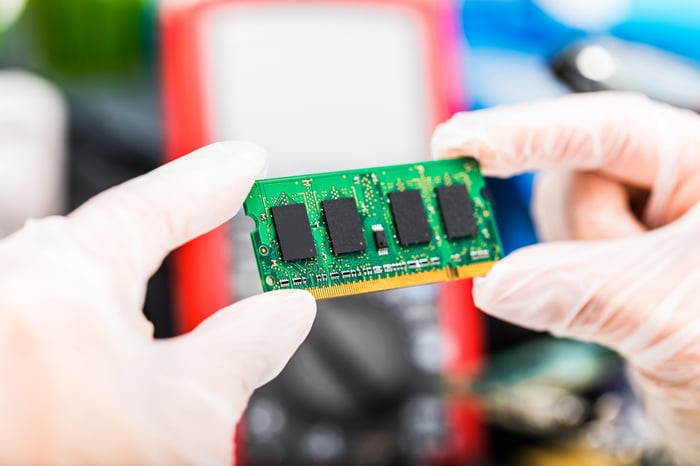
Image source: Getty Images.
Micron produces the DRAM, RAM, and data center memory hardware that AI programs need. In particular, Micron has a portfolio of high bandwidth memory (HBM) products that feature high performance and power efficiency. The surging demand for memory to support AI servers, combined with Micron's bevy of high-quality products, has created a perfect storm, accelerating the company's growth.
In its fiscal 2026 first quarter, which ended Nov. 27, Micron's revenue rose 56% year over year to $13.6 billion. Net income saw even more impressive growth, surging 178% from $1.87 billion in the prior-year period to $5.2 billion, while operating cash flow rose by 159.5% year over year to $8.41 billion. Over the past four reported quarters, it has achieved a net income margin of 28.2%. Finally, the company's cash reserves stand at $9.7 billion -- funds it can use to expand its operation.
And it does plan to expand. On Dec. 3, Micron announced it was exiting from the consumer memory market to focus on its production of AI hardware.
Despite all that good news, Micron only trades at a forward price-to-earnings ratio (P/E) of 11. That's an absolute bargain compared to fellow AI hardware producers like Advanced Micro Devices, which has a forward P/E of 85.7, Taiwan Semiconductor Manufacturing, which trades at a ratio of 31, or Nvidia, with a forward P/E ratio of 40.7.
In sum, Micron is one of the best value plays in AI hardware right now. Even though the stock is up by 247% over the last year -- 15 times the S&P 500's return -- based on its value and growth figures, it has plenty of runway left.
A rosy outlook for AI stocks, indeed.
Should you buy stock in Micron Technology right now?
Before you buy stock in Micron Technology, consider this:
The Motley Fool Stock Advisor analyst team just identified what they believe are the 10 best stocks for investors to buy now… and Micron Technology wasn’t one of them. The 10 stocks that made the cut could produce monster returns in the coming years.
Consider when Netflix made this list on December 17, 2004... if you invested $1,000 at the time of our recommendation, you’d have $488,222!* Or when Nvidia made this list on April 15, 2005... if you invested $1,000 at the time of our recommendation, you’d have $1,134,333!*
Now, it’s worth noting Stock Advisor’s total average return is 969% — a market-crushing outperformance compared to 196% for the S&P 500. Don't miss the latest top 10 list, available with Stock Advisor, and join an investing community built by individual investors for individual investors.
See the 10 stocks »
*Stock Advisor returns as of January 9, 2026.
James Hires has no position in any of the stocks mentioned. The Motley Fool has positions in and recommends Advanced Micro Devices, Nvidia, and Taiwan Semiconductor Manufacturing. The Motley Fool recommends Broadcom. The Motley Fool has a disclosure policy.
Recommended Articles


