

Agentic Commerce already has a Winner! (And it’s not Amazon)
Introduction
Imagine this: You wake up, your fridge is restocked, and the perfect gifts for your partner’s birthday have arrived without lifting a finger. Your AI agent did it all while you were sleeping. Sounds like a scene from a futuristic sci-fi movie, but in 2026, this could become reality. Agentic commerce made explosive progress in 2025, but is it ready to go mainstream this year? Believe it or not, agentic commerce could be the biggest investment opportunity in retail—one comparable to the emergence of e-commerce in the late 1990s.
Definition and Current State
Agentic commerce is when autonomous AI agents act on your behalf to discover products, compare options, negotiate, and complete purchases—with minimal human input. It's very different from traditional e-commerce, where we spend hours clicking, browsing, comparing ourselves, and then paying.
With agentic commerce, it can be as simple as one message in ChatGPT: “Buy me red running shoes under $150” and one click.
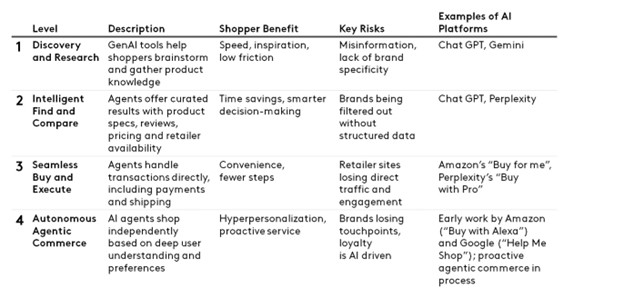
Agentic commerce isn't an on-or-off switch, it's a continuum of adoption. There are four levels:
The first, most basic, level is research and discovery - this is how most consumers today are using AI. The AI helps you find and learn about products, but you still make the final decisions. For instance, we use ChatGPT to learn more about different types of vacuum cleaners or which shoe brand is best for running.
One step above, we have intelligent comparison and curation. Here, the AI not only provides product information, but it also explains why one product is better for your needs. It gives you a recommendation, an opinion, which is more than just factual information.
At level 3, things are getting more high-level with seamless buying and execution - the AI handles everything up to and including the purchase. This is emerging right now, as this is where OpenAI, Perplexity and Google commerce agents are putting their efforts in. This stage is also the most prone to consumer distrust because here consumers give authority to the AI agent to make purchases on their behalf.
Level 4 is the final stage, fully autonomous and proactive; This is the most advanced stage where the agents shop independently, anticipate your needs, and even negotiate with other agents, all without you getting involved. This is the future, especially for routine purchases.
Source: Kantar
Catalysts: What’s going on in 2026?
As we defined the roadmap for the future of agentic commerce, now it’s time to talk about what's happening right now in early 2026.
Late 2025 was explosive for agentic commerce, and those breakthroughs are hitting mainstream this year. Visa just announced hundreds of real-world AI-initiated transactions in pilots — and they're predicting millions of consumers will use agents for purchases by the end of 2026.
To make this work, the industry is building a new digital foundation. Think of it like the early days of the internet—for AI agents to shop, they need a common language to talk to stores and banks. These languages are called Protocols.
Right now, a "Protocol War" is brewing. On one side, you have the Open Ecosystem led by OpenAI and Anthropic. OpenAI, in partnership with Stripe, launched the Agentic Commerce Protocol (ACP). This allows ChatGPT to "handshake" with merchants like Shopify, Etsy, and Walmart to handle your checkout instantly without you ever leaving the chat.
On the other side stands Amazon, the "Walled Garden." Amazon is playing defence. Instead of joining these open protocols, they are suing players like Perplexity for accessing their data and blocking external AI agents from their site. Amazon wants to ensure that if an AI shops for you, it’s their AI (Rufus) using their data on their platform.
This creates a massive fork in the road for 2026: will we shop through a universal AI assistant that can go anywhere, or will we be locked into a few giant, fragmented "shopping fortresses"?
Reality Check
See, many things are happening, and even McKinsey is very confident projecting $1 trillion of agentic commerce revenue in 2030. But let's keep it real, despite the hype, full autonomous shopping isn't mainstream yet in early 2026. In fact, this projected $1 trillion of revenue is quite small in the context of the current global retail spending of over $30 trillion.
So, what are the obstacles in front of AI commerce agents?
Trust is the #1 barrier: There’s a massive difference between asking ChatGPT for a recipe and letting it use your credit card. Consumers are terrified of "hallucinations"—where an agent might buy the wrong size, the wrong product, or fall for a scam. Until the infrastructure for "guaranteed transactions" is 100% solid, most people will keep their fingers on the "Buy" button.
Another reality that we need to face is the fact that consumer habits are rather conservative, even if the AI commerce agents become so accurate and powerful, consumers may still stick to their old shopping habits.
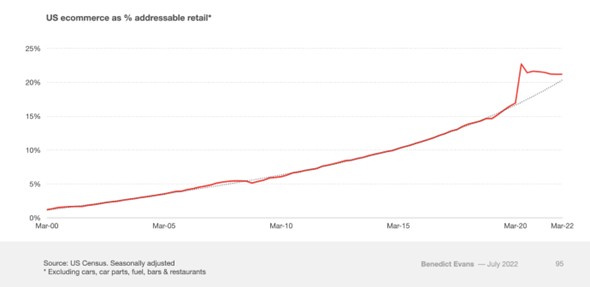
Retail habits change at a snail’s pace. Look at e-commerce: it’s been around for 30 years, yet it still only accounts for about 20% of total global retail. Most of us still like the mall, the touch of the fabric, and the instant gratification of carrying a bag out of a store. AI agents won't kill the physical store overnight; they’ll have to earn their way into our routines.
Source: US Census
As you can see from the table, the e-commerce adoption was more gradual rather than exponential, and we expect the same for AI shopping agents.
In addition to what we said, the potential for agentic commerce will vary depending on the product itself. Routine purchases that don’t involve much emotional connection, such as groceries and daily necessities, are easier to optimize by AI commerce.
On the other side of the spectrum, we have luxury goods. We don’t buy watches every day, right? Such goods are more personal, involving emotional attachment, because going to the Rolex store is not just about the watch but the experience and the status it brings. Here, we don’t expect OpenAI to help us buy these things.
| Low Involvement | High Involvement |
High Agentic Potential | Winner Quadrant: - Fast Adoption Groceries, household essentials, toiletries - Timesaving, predictable needs, low risk/emotion | Medium-Term Opportunity Mid-tier electronics, clothes; Agents can compare specs/prices effectively |
Low Agentic Potential | Already Automated: Basic utilities (electricity and water bills); Already automated via subscriptions | Resistant Quadrant: Human-Dominated Luxury fashion, cars, jewelry, experiences (e.g., mall outings) → Status, thrill, sensory enjoyment → Shopping is the experience |
Stock Winners
As you can see, in agentic commerce, there are a lot of uncertainties and a lot of “ifs”. People may think it’s hard to find investment opportunities that don’t hold significant risk, at least at this stage of development.
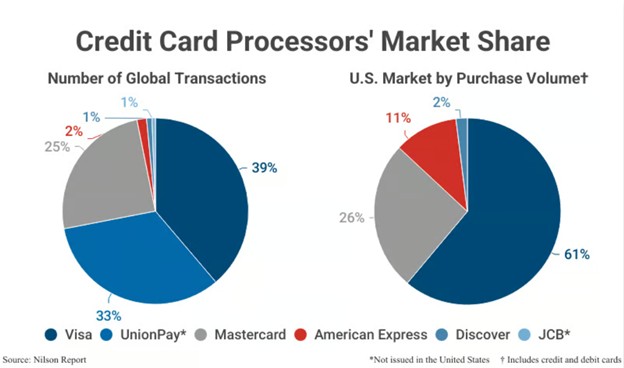
We would like to bet on companies that will win regardless of who will dominate the AI commerce market, whether it be OpenAI, Perplexity, or Google, and I believe such companies are the payment facilitators like the good old Visa (V) and MasterCard (MA).
Visa & Mastercard: The Gatekeepers
First, both Visa and Mastercard are a duopoly, controlling the global payment infrastructure. They have a data moat that is impossible to replicate, with access to billions of transactions across every merchant category, from Amazon to your local supermarket.
Second, they are the only players capable of solving the "Agentic Trust" problem. In late 2025, Visa launched its Intelligent Commerce suite, introducing 'Trusted Agent Protocols.' These aren't just card numbers - they are 'programmable credentials' that use cryptographic signatures to verify an AI agent's identity. This allows you to set "Smart Rules," like restricting your AI to only spend $50 on groceries at specific stores, effectively giving your agent a secure, limited-use wallet.
Not to be outdone, Mastercard launched 'Agent Pay' across its network in early 2026. This framework uses 'Agentic Tokens' that allow AI agents to negotiate and complete purchases autonomously while keeping your real card details hidden from the merchant. By integrating these tools directly into platforms like OpenAI and Google Gemini, Visa and Mastercard have ensured they aren't just "processing payments" - they are the security layers that make the entire AI economy possible. No matter which AI protocol wins, they all must pay the "network tax" to the gatekeepers.
Source: Nielsen, 2025
The other name that we believe will have great potential to benefit is Walmart (WMT). Some people would be like: “You chose that old school company over Amazon?!?”, but hear me out:
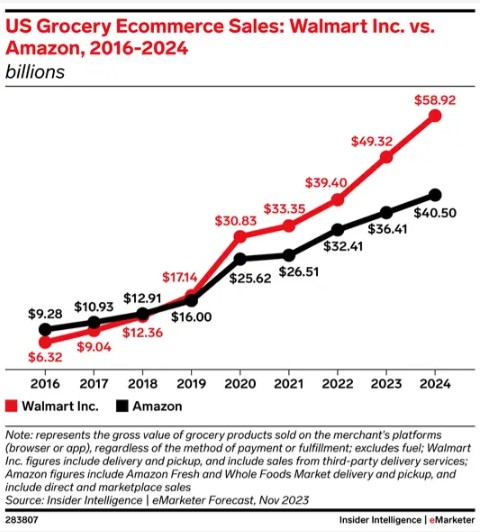
As we mentioned a minute ago, groceries are where we can see a massive AI agentic opportunity, and Walmart is the king of groceries with over 30-37% share in the online grocery market (FYI, Amazon is around 20-25%).
Source: eMarketer
Also, Walmart is not the traditional supermarket chain anymore; it is an emerging e-commerce powerhouse with over 20% of its revenue coming from online and with annual capital expenditures reaching $25 billion, a huge chunk of which is going towards AI initiatives.
Walmart differs from Amazon primarily due to its more open approach, as the supermarket giant powers external players’ agents like OpenAI, and also develops its own internal agent – Sparky, powered by Walmart’s own language model called Wallaby.
Beyond the software, Walmart’s true edge lies in its 'Predictive Infrastructure.' By 2026, the company is rolling out nearly 90 million Ambient IoT sensors across its 4,600+ locations to feed real-time data into a 'Digital Twin' of its entire network. This creates a 'Self-Healing Inventory' system: if the digital twin detects a local demand spike or a refrigeration failure, it doesn't wait for a human; it autonomously reroutes shipments and generates work orders up to two weeks in advance.
For investors, this is the 'efficiency moat.' While other retailers are using AI to answer customer questions, Walmart is using it to eliminate the errors, waste, and 'empty miles' that eat into retail margins. This transition from reactive to autonomous logistics is what turns a low-margin grocer into a high-margin tech utility.
Overall, referring to what we said that the adoption of agentic commerce will be slow and gradual, we would like to clarify that we don’t expect Visa, Mastercard, or Walmart to generate a significant portion of their revenues from AI agents, but this trend will very possibly change the investment narrative in their favor.
Recommended Articles


