

Is the Red-Hot D-Wave Quantum (QBTS) Stock Headed for a Crash by 2026?
Quantum computing concept stocks like D-Wave have been among the hottest tech investments this year. D-Wave's stock price has skyrocketed 256% year-to-date, far outpacing the S&P 500 and the biggest tech giants.
But here's the million-dollar question:
Can D-Wave sustain this momentum through 2026? Or are we looking at a quantum bubble ready to burst?
Let's take a step back. While regular computers use bits (0s or 1s) to process information, quantum computers harness the power of qubits. Thanks to a phenomenon called superposition, qubits can exist in multiple states simultaneously. This allows them to tackle incredibly complex problems that even the fastest conventional computers can't handle.
Now, there are various approaches to creating qubits. IonQ uses electromagnetic fields and laser cooling to trap charged atoms. Rigetti employs special circuits cooled to near absolute zero. And then there's D-Wave, pioneering a technique called quantum annealing.
Unlike traditional algorithms that execute step by step, D-Wave's system treats qubits like pieces of a puzzle. The machine sifts through all possible options until it finds the optimal solution. While quantum annealing may have narrower applications compared to other quantum computing methods, it could be a game-changer in areas like logistics, manufacturing, route planning, and inventory management.
Sounds cool, but is D-Wave really worth $10.5 billion?
The company's price-to-sales ratio is a staggering 363. Last year, they generated a mere $24 million in revenue while losing nearly $400 million.
Sure, it's great news that D-Wave's technology is finding real-world applications. But their financials paint a grim picture, with losses piling up. Oddly enough, despite D-Wave's slow revenue growth and deepening losses, the market has assigned it an even higher valuation.
Given the massive disconnect between the company's business and its perceived value, I believe the hype around QBTS stock among day traders and retail investors is driven more by speculation than actual data. Some tout this company as the next big thing in AI, but that's far from certain.
We saw a similar scenario play out during the dot-com bubble of the late 1990s. Once the frenzy subsided, companies like Cisco saw their market cap plummet by nearly 80%.
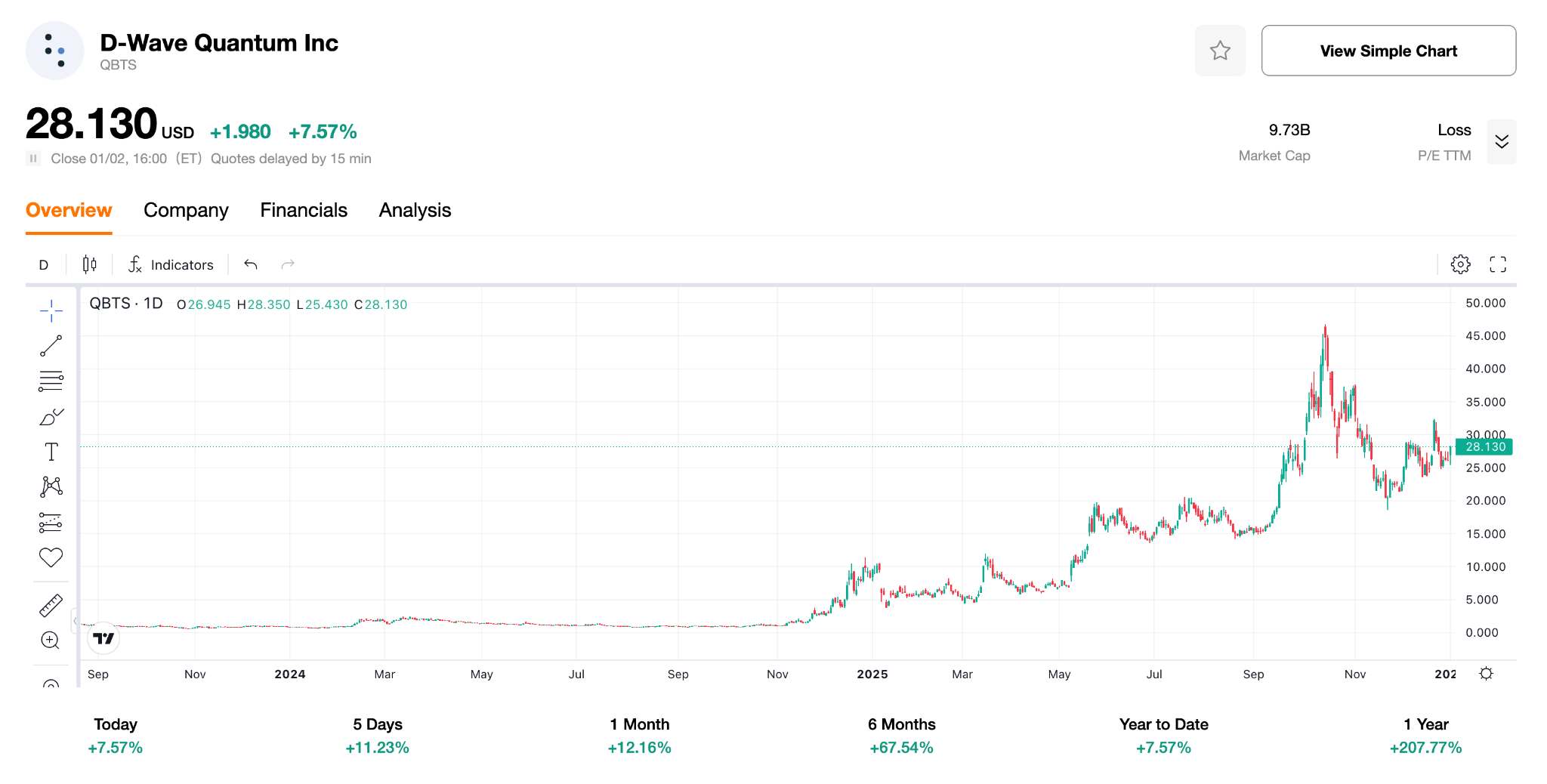
[D-Wave stock price chart, source: TradingKey]
In my view, by 2026, more investors will realize that the quantum computing stock craze was a bubble. If D-Wave follows in Cisco's early 2000s footsteps, its market cap could plunge by almost 75% within a year, with the stock potentially dropping to around $7 per share (from roughly $28 currently).
While history may not repeat itself exactly, I believe there's a strong chance D-Wave stock will come crashing down by 2026. Investors might be better off watching from the sidelines to avoid getting burned.
Recommended Articles


