

Here's the Average Social Security Retired Worker, Survivor, and Disability Benefit Check for 2026 -- How Do You Compare?
Key Points
For between 80% and 90% of retirees, Social Security income is a necessity, in some capacity, to make ends meet.
A history-making cost-of-living adjustment (COLA) is on the way for Social Security's more than 70 million traditional beneficiaries (retired workers, survivors, and workers with disabilities) in 2026.
However, Social Security's near-annual raises often come up short for most recipients.
- The $23,760 Social Security bonus most retirees completely overlook ›
For most retirees, Social Security is more than just a monthly check. It represents a financial foundation that many would likely struggle to make do without.
We know this because national pollster Gallup has been surveying retirees annually for the last 24 years to gauge the importance of Social Security income to their financial well-being. Consistently, 80% to 90% of retirees have noted that their Social Security check is necessary, in some capacity, to cover their expenses.
Where to invest $1,000 right now? Our analyst team just revealed what they believe are the 10 best stocks to buy right now. Continue »
With this being said, few announcements are more anticipated than Social Security's cost-of-living adjustment (COLA) reveal in October. With a history-making COLA on the way for the program's more than 70 million traditional beneficiaries (retired workers, survivors, and workers with disabilities), let's take a closer look at how much the average Social Security check will total in 2026.

Image source: Getty Images.
Social Security's COLA plays a vital role for beneficiaries
Social Security's cost-of-living adjustment is effectively the "raise" passed along to program beneficiaries on a near-annual basis that helps them combat the effects of inflation (rising prices).
Hypothetically, if the cost to purchase a large basket of goods and services rises by 3% from one year to the next, Social Security benefits would need to climb by the same percentage; otherwise, recipients would see the buying power of their Social Security income decline.
Since 1975, the Consumer Price Index for Urban Wage Earners and Clerical Workers (CPI-W) has served as Social Security's measure of inflation. The CPI-W is comprised of more than 200 spending categories, each with its own unique percentage weightings. These weightings enable this inflationary index to be condensed into a single figure each month, making it easy to determine whether prices are collectively rising (inflation) or falling (deflation).
But Social Security's COLA has a quirk. Even though CPI-W readings are based on the trailing 12-month period and reported monthly, only readings ending in July, August, and September (the third quarter) are factored into the COLA calculation. This is why COLA announcements occur in October, as we must wait until the Bureau of Labor Statistics releases the September inflation report (typically during the second week of October) before the upcoming year's raise can be calculated.
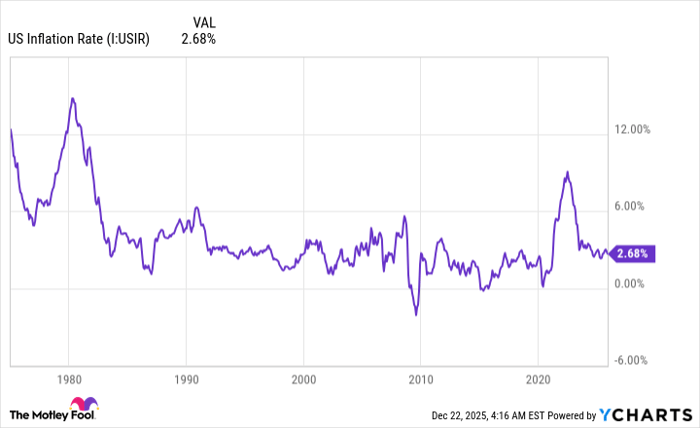
An uptick in the U.S. inflation rate has led to a corresponding increase in Social Security COLAs for five consecutive years. US Inflation Rate data by YCharts.
Here's the average benefit for retired workers, survivors, and workers with disabilities in 2026
On Oct. 24, following a nine-day delay due to the longest-ever federal government shutdown, the Social Security Administration (SSA) announced a 2.8% COLA for 2026.
To put this figure into perspective, it represents a slightly higher raise than the 2.3% annual boost beneficiaries have received, on average, since 2010.
Perhaps more importantly, the 2.8% increase to Social Security checks in the new year will mark the fifth consecutive COLA of at least 2.5%, following raises of 5.9%, 8.7%, 3.2%, and 2.5% from 2022 through 2025, respectively. The last time we observed at least five consecutive COLAs of 2.5% (or more) was 1988 through 1997. Thus, the 2026 COLA truly is a first-of-the-century raise for the program's more than 70 million traditional beneficiaries.
But it's one thing to discuss percentages and an entirely different matter to put pen to paper and figure out how much a 2.8% cost-of-living adjustment will increase Social Security checks in nominal-dollar terms.
According to the SSA's 2026 COLA Fact Sheet, the average retired-worker beneficiary is expected to see their monthly payout climb by $56 to $2,071. This means the average retired worker should bring home in the neighborhood of $24,850 for the full year.
The SSA's Fact Sheet also breaks down expectations for workers with disabilities. Based on projections, the 2.8% COLA for 2026 will increase the average monthly payout for more than 7.1 million disabled workers (as of November 2025) by $44 to $1,630.
Although the SSA didn't break out an estimate for survivor beneficiaries, it's expected to look almost identical to that of workers with disabilities. With the average survivor beneficiary receiving $1,576.20 as of November, a 2.8% COLA would translate into a $44 monthly boost to $1,618 in the new year.

Image source: Getty Images.
A beefier payout still won't cut it for most Social Security beneficiaries
While a monthly Social Security check with a notably larger payout figure attached to it is often welcome news for the program's more than 70 million beneficiaries, the fact of the matter is that Social Security's COLA often comes up short for those who rely on America's leading retirement program the most.
According to an analysis from nonpartisan senior advocacy group The Senior Citizens League (TSCL), the purchasing power of Social Security income declined by 36% from January 2000 to February 2023, when examining a large basket of goods and services regularly purchased by seniors. A separate study from TSCL, published in July 2024, found a 20% decline in the buying power of Social Security income since 2010.
In simpler terms, TSCL's studies have shown that Social Security's annual raises haven't been sufficient to keep up with the inflationary pressures retired workers have been facing.
One reason Social Security's COLA provides retirees with the short end of the stick more often than not is that the CPI-W is inherently flawed. As its full name indicates, the CPI-W tracks the costs relevant to "urban wage earners and clerical workers," who, in many cases, aren't over the age of 62 or currently receiving a Social Security retirement benefit.
Compared to urban wage earners and clerical workers, retirees spend a higher percentage of their monthly budget on shelter and medical care services. However, these important expenses are not given added weighting in the CPI-W.
To make matters worse, the trailing 12-month inflation rate for shelter and medical care services, as determined by the Consumer Price Index for All Urban Consumers (CPI-U), has consistently been higher than the COLAs retired workers have been receiving. This further erodes the purchasing power of Social Security income.
Dual enrollees -- Social Security's retired-worker beneficiaries who are enrolled in traditional Medicare -- will also face a double whammy in 2026. The Centers for Medicare and Medicaid Services recently announced that the base premium for Part B (the segment of Medicare responsible for outpatient services) would rise 9.7% to $202.90 per month in the new year.
For lifetime low-earning workers, a 9.7% increase in Medicare's Part B premium could gobble up most or all next year's COLA.
Although average nominal-dollar Social Security payouts are rising substantially in 2026, most beneficiaries remain worse for the wear.
The $23,760 Social Security bonus most retirees completely overlook
If you're like most Americans, you're a few years (or more) behind on your retirement savings. But a handful of little-known "Social Security secrets" could help ensure a boost in your retirement income.
One easy trick could pay you as much as $23,760 more... each year! Once you learn how to maximize your Social Security benefits, we think you could retire confidently with the peace of mind we're all after. Join Stock Advisor to learn more about these strategies.
View the "Social Security secrets" »
The Motley Fool has a disclosure policy.
Recommended Articles


