

What to Consider Before Adding This Emerging Markets ETF to Your Portfolio
Key Points
Emerging markets stocks roared back to life in 2025, putting this Vanguard ETF in the spotlight.
It's an effective tool for investors looking for exposure to a slew of stocks hailing from developing economies.
In this ETF, three countries loom large.
- 10 stocks we like better than Vanguard International Equity Index Funds - Vanguard Ftse Emerging Markets ETF ›
This year marks just the second time since 2019 that the MSCI Emerging Markets Index has beaten the performance of the S&P 500 on an annual basis. The last time, in 2022, wasn't anything to brag about, as the developing world gauge performed less poorly than its domestic counterpart in a recession-plagued year.
Investors are putting years of disappointment with emerging market stocks behind them in 2025, as highlighted by $6.88 billion in inflows to the Vanguard FTSE Emerging Markets ETF (NYSEMKT: VWO). Chances are that many investors are somewhat familiar with this exchange-traded fund (ETF), as it's the second-largest product in its category.
Where to invest $1,000 right now? Our analyst team just revealed what they believe are the 10 best stocks to buy right now, when you join Stock Advisor. See the stocks »

Image source: Getty Images.
Even with that popularity, investors need to examine the details. Case in point: Emerging markets stocks are viewed as more volatile than U.S. equivalents, but over the past three years, this international ETF has been slightly less bumpy than basic S&P 500 index funds. That's one of several key points market participants should consider before investing in this ETF.
Know your ETF
This Vanguard ETF, which turns 21 years old in March, follows the FTSE Emerging Markets All Cap China A Inclusion Index. That's an essential distinction between this fund and rivals that track the MSCI Emerging Markets Index, because when it comes to international stocks, different index providers classify some markets differently.
Specific to the ETF we're discussing here, FTSE Russell classifies South Korea as a developed market. However, it is classified as "emerging" in ETFs that follow MSCI's developing world gauges. So there are no South Korean stocks in this Vanguard fund. That omission has been advantageous for investors owning the Vanguard fund over the past decade, but when South Korean stocks rally, owners of this ETF don't participate.
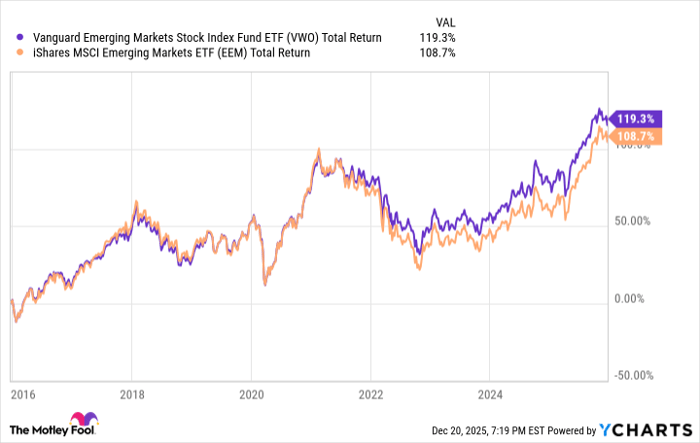
Data by YCharts.
The result of omitting South Korean stocks is that the Vanguard Emerging Markets ETF tilts more toward China, Taiwan, and India. Those three countries combine for 74.5% of this ETF's geographic exposure, compared to approximately 64% in an ETF following the MSCI Emerging Markets Index.
For what it lacks in geographic diversification, this emerging markets fund compensates by positioning investors to capitalize on potential sector-level growth opportunities. Nearly 36% of this ETF's 6,146 holdings hail from the technology and consumer discretionary sectors, confirming that the emerging markets investing proposition has been refreshed to be less commodities-dependent.
Additionally, this Vanguard fund's 10.34% weight to Taiwan Semiconductor Manufacturing and its exposure to Chinese technology names position it as a potential beneficiary of the artificial intelligence (AI) trade.
This ETF has a helpful expense ratio
In emerging markets, stock picking is difficult, if not potentially dangerous, underscoring the benefits of the ETF wrapper. Plus, it's not as though this Vanguard ETF is small in terms of components. Its 6,146 holdings confirm as much.
Fortunately, that benefit comes at a low cost. This ETF's annual expense ratio is just 0.07%, or $7 on a $10,000 investment, placing it in the category's cheapest quintile while fueling a long-term performance advantage over pricier counterparts.
Should you buy stock in Vanguard International Equity Index Funds - Vanguard Ftse Emerging Markets ETF right now?
Before you buy stock in Vanguard International Equity Index Funds - Vanguard Ftse Emerging Markets ETF, consider this:
The Motley Fool Stock Advisor analyst team just identified what they believe are the 10 best stocks for investors to buy now… and Vanguard International Equity Index Funds - Vanguard Ftse Emerging Markets ETF wasn’t one of them. The 10 stocks that made the cut could produce monster returns in the coming years.
Consider when Netflix made this list on December 17, 2004... if you invested $1,000 at the time of our recommendation, you’d have $504,239!* Or when Nvidia made this list on April 15, 2005... if you invested $1,000 at the time of our recommendation, you’d have $1,159,896!*
Now, it’s worth noting Stock Advisor’s total average return is 985% — a market-crushing outperformance compared to 195% for the S&P 500. Don't miss the latest top 10 list, available with Stock Advisor, and join an investing community built by individual investors for individual investors.
See the 10 stocks »
*Stock Advisor returns as of December 24, 2025.
Todd Shriber has no position in any of the stocks mentioned. The Motley Fool has positions in and recommends Taiwan Semiconductor Manufacturing and Vanguard International Equity Index Funds - Vanguard Ftse Emerging Markets ETF. The Motley Fool has a disclosure policy.
Recommended Articles


