

Is AutoNation's Move Proof Toyota Was Right All Along?
Key Points
The car dealer chain made an unusual move when it purchased a Toyota franchise.
Toyota is taking a different strategic route with its more balanced approach to hybrids and EVs.
Hybrids are more profitable than EVs, and sometimes even more than gasoline-powered counterparts.
- 10 stocks we like better than Toyota Motor ›
Massive decisions have been made throughout the automotive industry recently. Automakers are judging when and how they want to dive into electric vehicles (EVs), while simultaneously deciding whether to increase U.S. production capacity to offset tariffs.
There are always signals and hints littered throughout the market about how these decisions are going, and recently there was a signal from AutoNation (NYSE: AN) about a big Toyota Motor (NYSE: TM) strategy that is largely positive.
Where to invest $1,000 right now? Our analyst team just revealed what they believe are the 10 best stocks to buy right now. Continue »
What's going on?
CarMax and Carvana may be memorable vehicle retailers, but AutoNation is a powerhouse that generally finds itself No. 2 in units sold in the U.S. It's a revenue leader -- though it can fluctuate. Recently, the large vehicle retailer bought a Toyota franchise, a move it hadn't made in a decade. It's a small move, considering it's one store and the total value of the acquisition was roughly $120 million -- chump change for these companies.
But the move signals something much larger -- that Toyota might have been on to something regarding decisions for EVs. At a time when companies near and far were quick to jump on the bandwagon for full electric vehicles, and the media headlines touted big investment figures for EVs, Toyota was almost ostracized for its strategy to largely avoid the big jump into EVs and instead focus more on hybrids and other methods as a more diverse and balanced approach.
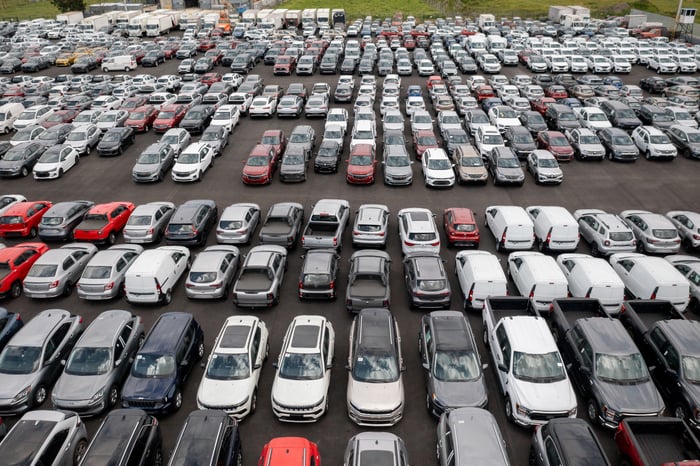
Image source: Getty Images.
Investors might remember Toyota Chairman Akio Toyoda, saying he believed global share of EVs would top out at just 30%, while promoting Toyota's "multi-pathway" strategy. "Toyota's stubborn focus on hybrids over EVs is part of a broader challenge by the world's biggest automaker to the prevailing industry and regulatory orthodoxy that all cars will be electric in the near future," according to Reuters' Norihiko Shirouzu.
Pretty soon, however, more consumers will realize just how far Toyota has strategized toward hybrids, making them the standard or primary option for hugely popular models such as the Camry, RAV4, Sienna, and Sequoia. A handful of models are exclusively hybrid only, and the automaker plans to have a hybrid option for almost every model in its U.S. lineup by the end of this decade.
There was always logic to Toyota's methodical approach, and hybrids seem like the no-brainer step before committing to full EVs. Hybrids offer similar practicality and efficiency, with great fuel economy, lower emissions, and no range anxiety or reliance on an improving, but sometimes frustrating, charging infrastructure. There's strong market demand for hybrids, which are increasingly making up a large chunk of sales, while demand for EVs has slowed after the expiration of the federal $7,500 tax credit in September.
Here's another huge kicker. Not only are hybrids more profitable than the heavy losses incurred from selling EVs, they're sometimes more profitable than their gasoline-powered counterparts. That hybrids are so profitable shouldn't be underestimated by investors -- and it's not just Toyota touting this fact. "A year ago, we weren't covering the cost premium for hybrids with the price that customers paid us. We are now," said Ford Motor Company CEO Jim Farley, according to Automotive News. "Customers are voting. They like these in-between solutions."
Is Toyota a buy?
Toyota is an incredibly strong automaker and is in excellent financial shape with one of the best balance sheets in the auto sector. It has little debt and substantial cash, giving it flexibility to zig with hybrids while the industry zagged -- and now we're seeing small signs this is paying off. If you're looking for a large stable company, with a respectable dividend yield around 3%, and a well-established path into the future of hybrids and eventually EVs, Toyota is an excellent investment option to explore.
Should you buy stock in Toyota Motor right now?
Before you buy stock in Toyota Motor, consider this:
The Motley Fool Stock Advisor analyst team just identified what they believe are the 10 best stocks for investors to buy now… and Toyota Motor wasn’t one of them. The 10 stocks that made the cut could produce monster returns in the coming years.
Consider when Netflix made this list on December 17, 2004... if you invested $1,000 at the time of our recommendation, you’d have $509,955!* Or when Nvidia made this list on April 15, 2005... if you invested $1,000 at the time of our recommendation, you’d have $1,089,460!*
Now, it’s worth noting Stock Advisor’s total average return is 968% — a market-crushing outperformance compared to 193% for the S&P 500. Don't miss the latest top 10 list, available with Stock Advisor, and join an investing community built by individual investors for individual investors.
See the 10 stocks »
*Stock Advisor returns as of December 18, 2025.
Daniel Miller has positions in Ford Motor Company. The Motley Fool has positions in and recommends CarMax. The Motley Fool has a disclosure policy.
Recommended Articles


