

The Stock Market Sounds an Alarm as Investors Get Bad News About President Trump's Tariffs. History Says This May Happen in 2026.
Key Points
President Trump says tariffs will strengthen the U.S. economy and protect jobs, but hiring has slowed sharply and unemployment recently reached a four-year high.
Meanwhile, U.S. manufacturing activity has declined in nine straight months and the Michigan Consumer Sentiment Index currently shows its lowest annual average in history.
The S&P 500's CAPE ratio recently topped 39; the index has historically declined by 4% during the next year after achieving such an expensive valuation.
- 10 stocks we like better than S&P 500 Index ›
The S&P 500 (SNPINDEX: ^GSPC) has advanced 15% year to date, a particularly surprising performance given the economic uncertainty sown by President Trump's tariffs. On that topic, investors have received plenty of bad news. Here are a few highlights:
- President Trump has frequently and incorrectly said foreign exporters will absorb the tariffs for the privilege of doing business in the United States. In reality, research from Goldman Sachs shows U.S. companies and consumers are collectively paying 82% of the duties.
- President Trump has dismissed concerns about affordability as a "hoax" and erroneously claimed that "we have no inflation." In reality, inflation has accelerated in each month since the baseline tariff took effect in April.
- President Trump has asserted that tariffs will strengthen the U.S. economy. But countless experts say tariffs will slow economic growth. JPMorgan Chase recently reduced its long-term economic growth forecast by 0.2 percentage points to account for new trade policies.
Investors got more bad news about President Trump's trade policies this week, and it came at a particularly bad time. The S&P 500 was already sounding an alarm related to its abnormally high valuation. Here are the important details.
Where to invest $1,000 right now? Our analyst team just revealed what they believe are the 10 best stocks to buy right now. Continue »
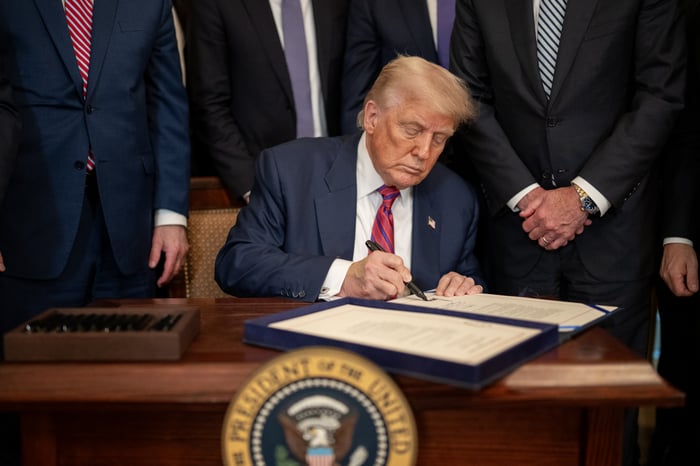
Image source: Official White House Photo.
President Trump's tariffs have coincided with increased unemployment and record-low consumer sentiment
In February, the White House published a "fact sheet" crafted to ease concerns about President Trump's trade policies. It stated: "A 2024 economic analysis found that a global tariff of 10% would grow the economy by $728 billion, create 2.8 million jobs, and increase real household income by 5.7%."
However, the study in question came from the Coalition for a Prosperous America (CPA), an advocacy group whose representation of U.S. manufacturers gives it a clear reason to favor protectionist trade policies. The World Trade Institute, an academic research group, said the CPA study used "highly unusual and empirically unsupported" methods to generate the result the authors desired. In other words, the study lacks credibility.
Indeed, despite President Trump's claims that tariffs will revitalize U.S. manufacturing and create American jobs, data released this week shows the opposite: The economy added an average of 17,000 jobs per month in the last six months, the slowest growth since 2010 excluding the pandemic. Also, the unemployment rate hit 4.6% in November, the highest level in more than four years.
Meanwhile, the Institute for Supply Management (ISM) said U.S. manufacturing activity has now fallen in nine straight months, and executives attribute the decline to tariffs. "For every positive comment about new orders, there were 1.2 comments expressing concern about near-term demand, driven primarily by tariff costs and uncertainty," said Susan Spence, Chair of the ISM Manufacturing Business Survey Committee.
Not surprisingly, consumers are quite unhappy. The Michigan Consumer Sentiment Index has averaged 57.6 year to date, the lowest annual average since monthly surveys began in 1978. That means consumer are more pessimistic today than at any other point in nearly five decades. That is concerning because consumer spending accounts for about two-thirds of GDP, and downbeat consumers are likely to spend less.
The S&P 500 sound an alarm seen just once in history, and it may signal a decline in 2026
The S&P 500 recorded an average cyclically adjusted price-to-earnings (CAPE) ratio of 39.1 in November, the second straight month in which the multiple exceeded 39. That is one of the most expensive valuations in history.
The S&P 500's monthly CAPE ratio has only topped 39 during one other period since it was created in 1957. It happened between January 1999 and October 2000 during the dot-com bubble, and that situation ended badly for investors. The following chart details the S&P 500's average return over different periods after achieving a monthly CAPE ratio above 39.
|
Time Period |
S&P 500 Average Return (CAPE Ratio 39+) |
|---|---|
|
1 Year |
(4%) |
|
2 Years |
(20%) |
|
3 Years |
(30%) |
Data source: Robert Shiller.
As shown, after recording a monthly CAPE ratio above 39, the S&P 500 has typically declined during the next one, two, and three years. Specifically, if its performance matches the historical average, the S&P 500 will fall 4% in the next year and 30% by December 2028.
Of course, past performance is never a guarantee of future returns. In this case, investors may be comfortable with higher valuations because they expect artificial intelligence to boost earnings growth in the years ahead. Regardless, it would be foolish to ignore the data, especially when the U.S. economy is trying to adapt to Trump's tariffs.
In my opinion, the current market environment warrants caution. Investors should only buy high-conviction stocks, and only if the valuation is sensible. They should also accumulate more cash than normal in their portfolios. Doing so will make it easier to capitalize on the next drawdown when it eventually arrives.
Should you buy stock in S&P 500 Index right now?
Before you buy stock in S&P 500 Index, consider this:
The Motley Fool Stock Advisor analyst team just identified what they believe are the 10 best stocks for investors to buy now… and S&P 500 Index wasn’t one of them. The 10 stocks that made the cut could produce monster returns in the coming years.
Consider when Netflix made this list on December 17, 2004... if you invested $1,000 at the time of our recommendation, you’d have $509,955!* Or when Nvidia made this list on April 15, 2005... if you invested $1,000 at the time of our recommendation, you’d have $1,089,460!*
Now, it’s worth noting Stock Advisor’s total average return is 968% — a market-crushing outperformance compared to 193% for the S&P 500. Don't miss the latest top 10 list, available with Stock Advisor, and join an investing community built by individual investors for individual investors.
See the 10 stocks »
*Stock Advisor returns as of December 18, 2025.
JPMorgan Chase is an advertising partner of Motley Fool Money. Trevor Jennewine has no position in any of the stocks mentioned. The Motley Fool has positions in and recommends Goldman Sachs Group and JPMorgan Chase. The Motley Fool has a disclosure policy.
Recommended Articles


