

Tesla's EV Business Isn't the Star Anymore -- but It's Still the Whole Stage
Key Points
Tesla’s EV business remains the financial backbone of the company.
EVs have shifted from growth engine to strategic infrastructure.
There's a new way to look at Tesla's long-term prospects.
- These 10 stocks could mint the next wave of millionaires ›
It's becoming fashionable to say that Tesla's (NASDAQ: TSLA) electric vehicle (EV) business is losing importance. Growth has slowed, competition has intensified, and investors increasingly talk about robotaxis and humanoid robots as the company's "real" future.
That framing is understandable, but it's also incomplete.
Where to invest $1,000 right now? Our analyst team just revealed what they believe are the 10 best stocks to buy right now, when you join Stock Advisor. See the stocks »
Tesla's EV business may no longer be the star of the story, but it remains the entire stage on which every other ambition is built.
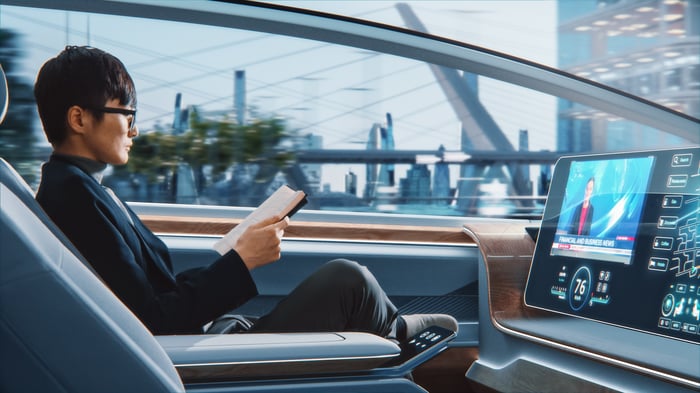
Image source: Getty Images.
The EV business still pays for everything.
In Tesla's early years, the EV business had to prove several things at once: Electric vehicles had mass-market demand, Tesla could manufacture at scale, and rapid growth justified a premium valuation.
By 2025, those questions were largely settled. EVs work. Tesla can build them efficiently. The debate has shifted away from whether electric vehicles are viable toward what they enable inside a much larger ecosystem.
To this end, Tesla's vehicle business continues to generate the cash that underwrites everything else the company is trying to build. Full self-driving development, early robotaxi pilots, Optimus research, and factory expansion all ultimately trace back to vehicle sales.
Neither autonomy nor robotics is self-funding today. They are long-dated options financed by the auto business, and without that cash engine, Tesla's most ambitious bets would slow dramatically or require shareholder dilution.
EVs are Tesla's distribution platform for autonomy.
Besides paying the bills, Tesla's EV fleet is becoming a global deployment platform for its autonomy ambition.
Millions of Teslas on the road run the company's software stack, receive over-the-air updates, and continuously generate real-world driving data. Just as importantly, they familiarize customers with Tesla's ecosystem and create a ready-made base for deploying autonomy at scale.
This is where robotaxi economics become viable. Autonomy only works as a business if it can be rolled out widely and cheaply. Tesla's existing vehicle fleet gives it a deployment advantage that few competitors can match.
Alphabet's Waymo may demonstrate strong autonomy performance in tightly constrained environments, but it lacks mass-manufacturing and consumer distribution. On the other hand, traditional automakers have scale, but not Tesla's vertically integrated software and data loop.
The right way to think about Tesla today
The perception that EVs matter less is largely psychological.
Yes, growth is slower. Competition is visible. And newer narratives around artificial intelligence (AI) and robotics are more compelling. Yet, while attention has shifted, importance has not.
For instance, during the company's EV hypergrowth phase, investors were willing to tolerate margin volatility in exchange for rapid volume expansion. Today, EV margins play a different role. They determine whether Tesla can fund long-cycle bets internally, preserve balance-sheet flexibility, and absorb regulatory or execution setbacks without dilution. In other words, a "good" EV margin profile may not excite investors, but it sustains optionality, and optionality now sits at the core of Tesla's long-term thesis.
So, the useful mental model is to view Tesla as a layered company.
At the base sits the EV business, providing cash flow, manufacturing scale, and a global software-enabled fleet. Built on top of that is autonomy, a potential high-margin mobility platform that leverages this fleet. Further out is robotics, a long-dated bet on labor and automation with asymmetric upside.
Remove the foundation, and the upper layers lose their footing.
What does it mean for investors?
Tesla's EV business is no longer the reason the stock excites people. But it remains the reason Tesla can afford to think bigger than anyone else in mobility and automation.
The real risk for investors is not overestimating robotaxis or Optimus. It is underestimating the quiet, unglamorous business that makes those bets possible.
Tesla's EV business may no longer steal the spotlight -- but without it, the show doesn't go on.
In other words, investors must keep a close eye on Tesla's EV business performance in 2026 and beyond.
Don’t miss this second chance at a potentially lucrative opportunity
Ever feel like you missed the boat in buying the most successful stocks? Then you’ll want to hear this.
On rare occasions, our expert team of analysts issues a “Double Down” stock recommendation for companies that they think are about to pop. If you’re worried you’ve already missed your chance to invest, now is the best time to buy before it’s too late. And the numbers speak for themselves:
- Nvidia: if you invested $1,000 when we doubled down in 2009, you’d have $457,248!*
- Apple: if you invested $1,000 when we doubled down in 2008, you’d have $52,147!*
- Netflix: if you invested $1,000 when we doubled down in 2004, you’d have $505,695!*
Right now, we’re issuing “Double Down” alerts for three incredible companies, available when you join Stock Advisor, and there may not be another chance like this anytime soon.
See the 3 stocks »
*Stock Advisor returns as of December 16, 2025.
Lawrence Nga has no position in any of the stocks mentioned. The Motley Fool has positions in and recommends Alphabet and Tesla. The Motley Fool has a disclosure policy.
Recommended Articles


