

Warren Buffett Has Dumped This ETF He Historically Recommends for Investors. Should Investors Take This as a Warning Sign Going Into 2026?
Key Points
Berkshire Hathaway sold all of its S&P 500 shares, which it had owned quite a while.
This doesn't negate Buffett's advice regarding what's best for the average investor.
The S&P 500 provides investors with diversification, blue chip stocks, and a low cost.
- 10 stocks we like better than Vanguard S&P 500 ETF ›
Few investors and companies have their moves as closely monitored as Warren Buffett and Berkshire Hathaway (NYSE: BRK.A)(NYSE: BRK.B), but I guess that's what happens when you've grown your net worth to nine figures and built a trillion-dollar company along the way.
Despite his personal success and seemingly mythical-like figure, Buffett has never shied away from passing on wisdom that the average investor can digest and apply to their own investment journey. Over the decades, one piece of Buffett advice has remained constant: The average investor's best approach to the stock market is simply to invest in an S&P 500 ETF.
Where to invest $1,000 right now? Our analyst team just revealed what they believe are the 10 best stocks to buy right now, when you join Stock Advisor. See the stocks »
Despite Buffett's consistent advice, Berkshire did something this year that could prompt investors to question whether that strategy remains. It sold all of its shares in the Vanguard S&P 500 ETF (NYSEMKT: VOO) and the SPDR S&P 500 ETF Trust (NYSEMKT: SPY). Given the recent echoes of how expensive the S&P 500 has become, is this Buffett and Berkshire's way of telling us what's potentially to come in the market?
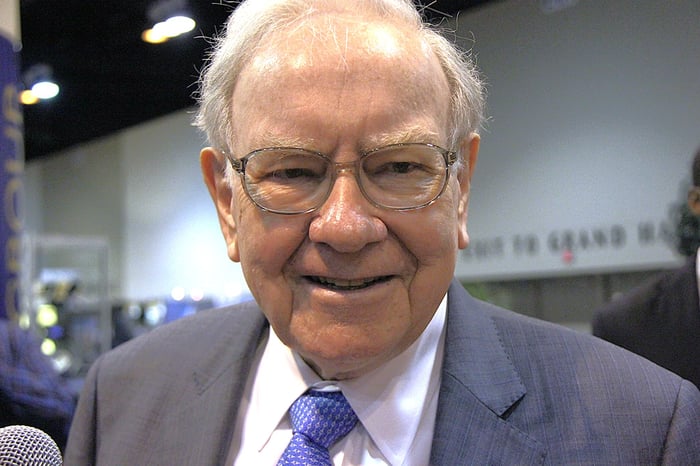
Image source: The Motley Fool.
Don't read too much into Berkshire's move
As with any investment move, it's important to remember that all investors -- whether individuals or corporations -- have different investment goals, risk tolerance, time horizons, and financial situations. This is why investments shouldn't just be a blanket copy-and-paste. What works for someone else may not work for you, and that's OK.
Although Berkshire hasn't explicitly said why it dumped its S&P 500 shares, this shouldn't be a warning sign. It's just what its decision makers thought was best for the company right now. In my opinion, it's a "do as I say, not as I do" situation.
For the average investor, the S&P 500 remains one of the better long-term investments that can be made. It's simple, straightforward, and cheap, and it removes much of the thinking and research that goes into picking the right individual stocks.
Berkshire has dedicated teams that spend hours doing deep dives into companies, weighing their risk and growth potential. That's just something the average investor realistically can't -- and doesn't want to -- do. This doesn't stop Berkshire from making missteps and making regrettable investments (Buffett himself will tell you as much), but with the S&P 500, you don't have to be "smarter" than the market to make money.
Embrace the S&P 500 with a focus on consistency
The S&P 500 is historically expensive, but that doesn't mean investors should avoid it completely. If anything, now is a good time to practice dollar-cost averaging, which helps protect investors from sudden corrections or pullbacks. When you dollar-cost average, you set a specific investment amount, put yourself on an investing schedule, and stick to it regardless of market conditions.
Personally, I plan to keep consistently adding to my stake in VOO, regardless of Berkshire's moves or the index's current valuation. My mindset is focused on the long term, not on hedging against any potential short-term downturns. That doesn't mean I'm not aware of the risks of the current environment; it just means I'm willing to ride out the volatility. If time is on your side, you should consider adopting that mindset as well.
VOO presents investors with a four-in-one bonus: Instant diversification, access to blue chip stocks, cheap fees (a 0.03% expense ratio), and proven historical results. Regarding the latter, VOO has averaged 12.7% annual returns since it hit the market in September 2010.
Past results don't guarantee future performance, but the bigger point is that VOO (and the S&P 500 in general) has shown it can be a great way to make money in the market, as long as you're patient and consistent. There will be inevitable volatility and down periods (in some cases, years), but you can count on the S&P 500's overall direction being upward over the long term.
Should you invest $1,000 in Vanguard S&P 500 ETF right now?
Before you buy stock in Vanguard S&P 500 ETF, consider this:
The Motley Fool Stock Advisor analyst team just identified what they believe are the 10 best stocks for investors to buy now… and Vanguard S&P 500 ETF wasn’t one of them. The 10 stocks that made the cut could produce monster returns in the coming years.
Consider when Netflix made this list on December 17, 2004... if you invested $1,000 at the time of our recommendation, you’d have $540,587!* Or when Nvidia made this list on April 15, 2005... if you invested $1,000 at the time of our recommendation, you’d have $1,118,210!*
Now, it’s worth noting Stock Advisor’s total average return is 991% — a market-crushing outperformance compared to 195% for the S&P 500. Don’t miss out on the latest top 10 list, available when you join Stock Advisor.
See the 10 stocks »
*Stock Advisor returns as of December 1, 2025
Stefon Walters has positions in Vanguard S&P 500 ETF. The Motley Fool has positions in and recommends Berkshire Hathaway and Vanguard S&P 500 ETF. The Motley Fool has a disclosure policy.
Recommended Articles


