

How Good Has PG Stock Actually Been?
Key Points
The safety offered by this consumer staples giant has come at a cost.
P&G hasn’t come close to keeping pace with the broader market or its sector over the past several years.
More recently, the stock price trailed bonds.
- 10 stocks we like better than Procter & Gamble ›
There was a time when consumer staples stocks, including Procter & Gamble (NYSE: PG), were considered portfolio bedrocks. Prized for steady dividend payments and lower drawdowns during market pullbacks, this sleepy sector has provided investors with shelter from storms such as bear markets and recessions.
For investors embracing individual stocks, Procter & Gamble has been a default staples option. After all, it's the company behind many famous brands, including Crest, Gillette, Tide, Pampers, Charmin, Dawn, Duracell, Vicks, and many more.
Where to invest $1,000 right now? Our analyst team just revealed what they believe are the 10 best stocks to buy right now, when you join Stock Advisor. See the stocks »
Yet those premium labels and their high market share haven't been enough to juice the stock. In fact, calling shares of the Head & Shoulders maker duds isn't mean. It's accurate.
Procter & Gamble is a reliable dividend payer, but the shares haven't done much to brag about. Image source: Getty Images.
Investors' tastes shifted, P&G didn't go along for the ride
Procter & Gamble is subject to consumer whims, but it's a public company, so it's also exposed to shifting tastes among investors. Said differently, many market participants have fallen in love with artificial intelligence (AI) and growth stocks in recent years, and they've been rewarded for that adulation.
What hasn't been rewarded are consumer staples stocks. For the five years spanning 2020 to 2024, the sector ranked among the top five just once -- in 2022, when stocks slipped into a bear market. That's not saying much because there are just 11 S&P 500 (SNPINDEX: ^GSPC) sectors. During that time, Procter & Gamble returned $1 for every $5 returned by the S&P 500.
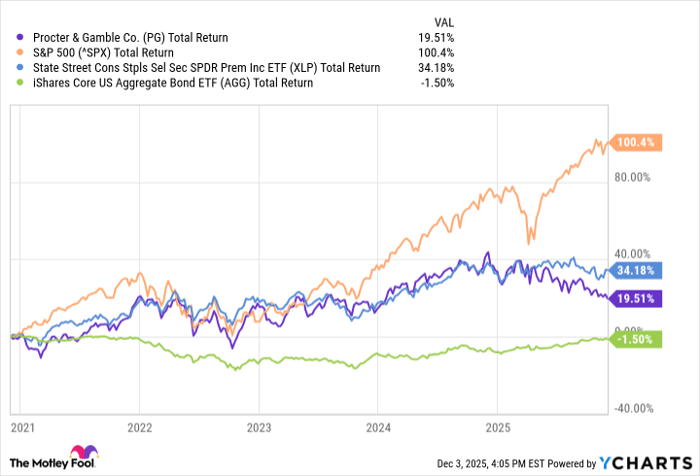
Data by YCharts.
Perhaps the most damning indictment of this staples stock is that over the past three years, investors could have done significantly better with less risk by holding a basic aggregate bond fund like the iShares Core Aggregate Bond ETF (NYSEMKT: AGG) or the State Street Consumer Staples Select Sector SPDR Fund (NYSEMKT: XLP).
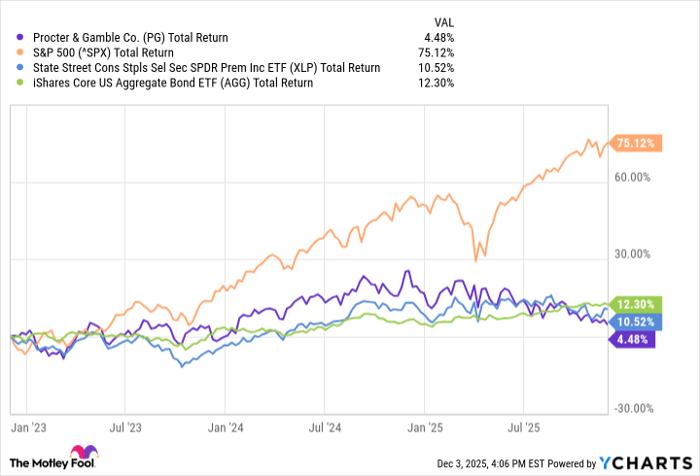
Data by YCharts.
Things aren't going to be much better for the stock when 2025 draws to a close. It's down almost 10% year to date. As of the end of the third quarter, staples was the second-worst performing sector in the S&P 500, defying expectations that 2025 would bring a return to normal for the group.
A bright spot with Procter & Gamble
The primary source of allure with this stock is the dividend. The Pampers maker has pampered investors with 135 straight years of dividends and 69 consecutive years of payout increases, making it a Dividend King (a company that has raised its dividend yearly for 50 years or more). Importantly, the company projects payout growth of 4% to 6% annually. In most years, that's good enough to outpace inflation.
Add to that, the dividend is sustainable because Procter & Gamble's operating and free cash flow surged in the third quarter, and earnings per share are expected to rise this year. In fiscal 2025, the company earned $6.51 a share, well ahead of the dividend obligation of $4.48 a share.
So what we have is a reliable dividend payer, not a story stock. Investors need to reconcile that and consider this stock against their personal levels of risk tolerance. In very simple terms, Procter & Gamble is suitable for retirees looking to de-risk their portfolios; for a 25-year-old looking to build wealth, not so much.
Should you invest $1,000 in Procter & Gamble right now?
Before you buy stock in Procter & Gamble, consider this:
The Motley Fool Stock Advisor analyst team just identified what they believe are the 10 best stocks for investors to buy now… and Procter & Gamble wasn’t one of them. The 10 stocks that made the cut could produce monster returns in the coming years.
Consider when Netflix made this list on December 17, 2004... if you invested $1,000 at the time of our recommendation, you’d have $540,587!* Or when Nvidia made this list on April 15, 2005... if you invested $1,000 at the time of our recommendation, you’d have $1,118,210!*
Now, it’s worth noting Stock Advisor’s total average return is 991% — a market-crushing outperformance compared to 195% for the S&P 500. Don’t miss out on the latest top 10 list, available when you join Stock Advisor.
See the 10 stocks »
*Stock Advisor returns as of December 1, 2025
Todd Shriber has no position in any of the stocks mentioned. The Motley Fool has no position in any of the stocks mentioned. The Motley Fool has a disclosure policy.
Recommended Articles


