

Here's Why You Might Not Want to Buy Into Michael Burry's Bet Against Palantir
Key Points
This popular, overperforming artificial intelligence stock is suddenly on the defensive.
A growing amount of talk about an AI bubble is easily convincing investors that this name brings too much risk to the table at this time.
Just take a step back and look at the bigger picture. Palantir’s longer-term future is still plenty promising enough to own a piece of the company.
- 10 stocks we like better than Palantir Technologies ›
The past month's been a rough one for Palantir Technologies (NASDAQ: PLTR) shareholders. Shares of the artificial intelligence (AI) software outfit trade down nearly 20% from their early November peak. With all the chatter suggesting AI stocks are in a bubble following this stock's 3,000% run-up since early 2023, investors are understandably nervous that this pullback is just the beginning.
That's not the big reason this stock's in a slump at this time, however. It's not even the risk it's being made out to be. There's a much more specific reason this ticker's tumbling, and it isn't likely to be a problem in the long run.
Where to invest $1,000 right now? Our analyst team just revealed what they believe are the 10 best stocks to buy right now. Continue »

Image source: Getty Images.
A high-profile bearish bet that others are following
Sometimes growth stocks trade at insanely high valuations. Many of them are still worth it, though, not because of where their underlying companies are but because of where those companies are going. The tricky part is figuring out when and if these organizations are going to become what the crowd expects them to become. Plenty of questionable assumptions pull these tickers around in the interim.
This dynamic is happening for a very specific reason. Nothing happening with Palantir Technologies stock right now is particularly unusual. It was a market darling for nearly three years, rallying from its late-2022 low in step with the company's enormous revenue and earnings growth. As is often the case, the stock may have gotten a bit ahead of itself. Some investors are starting to correct or even capitalize on the potential mistake.
Michael Burry is one of the stock pickers capitalizing on Palantir shares' big run-up by betting on a pullback in the foreseeable future.
If the name rings a bell, Burry is the chief of hedge fund Scion Capital. He reaped a windfall profit back in 2007 and 2008 by betting against the broad market shortly before the subprime mortgage meltdown (as explained in the 2015 film The Big Short). Now he's made a similar bearish bet against Palantir as well as Nvidia, citing valuation concerns.
It's the timing of his bet against Palantir stock that's so curious. He disclosed the bearish position in early November, right when both stocks began peeling back from their record highs. Mere coincidence? Maybe. But probably not. Right or wrong, professionals and amateur stock pickers alike often take cues from their peers, hoping to beat the very crowd they're also following. When Burry turned bearish, plenty of others immediately followed suit, suddenly citing worries that artificial intelligence stocks are in a bubble ... something that didn't seem to matter much until then. The worry has since taken on a life of its own, creating a self-fulfilling prophecy.
And that's why you don't want to read too much into the stock's recent bearish action.
The bull case is actually still quite strong
Yes, priced at 230 times this year's projected per-share profits of $0.72 and nearly 170 times next year's expected earnings of $0.99 per share, Palantir Technologies stock is wildly overvalued; that's never been in dispute.
Just take a step back and look where things seem to be going for the company. Last quarter's revenue grew 63% year over year to nearly $1.2 billion, extending a well-established trend. Of that top line, a hefty $393 million of it was turned into net operating income, more than tripling the year-earlier comparison.
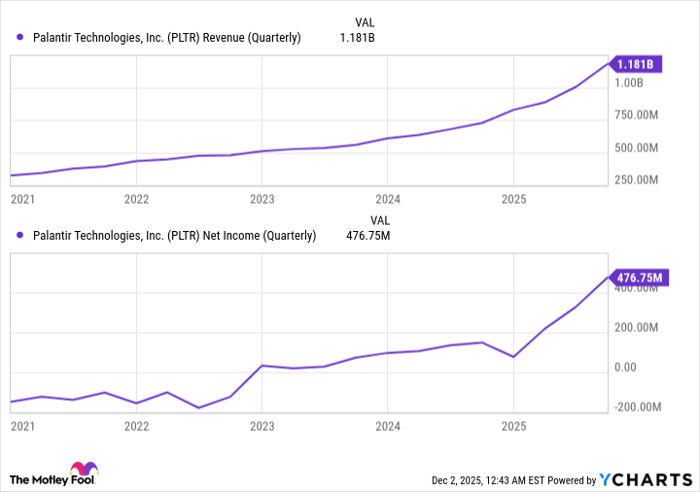
Data by YCharts.
Analysts expect more of this at least through 2027, although this growth is likely to persist far longer. An outlook from Straits Research suggests the worldwide decision-intelligence software market that Palantir serves is poised to grow by more than 20% per year through 2033, as the technology evolves and as more enterprises recognize the value of AI-powered planning. Already serving high-profile customers like the U.S. Department of Defense and the Centers for Disease Control and Prevention, along with private companies like Airbus and General Mills, Palantir Technologies is well-positioned to win at least its fair share of this growth. Indeed, Palantir's got no real hypercompetitive direct competition ... at least not yet.
Perhaps the big detail that Burry is glossing over and others are simply missing is how the software business itself works. While Palantir has coded several different kinds of decision-making platforms, the company's not reinventing the proverbial wheel every time it brings a new paying customer into the fold. Its cost of additional deployments is actually pretty low, meaning its business scales up easily and profitably. Look for Palantir's profit growth to dramatically outpace revenue growth for the foreseeable future.
Burry's not even convincingly bearish
None of this is to suggest Burry's worries aren't legitimate. Even if Palantir stock's steep valuation isn't a long-term concern, it can certainly add to any short-term volatility.
Just don't lose perspective here. Plenty of wildly expensive stocks have driven through frothy valuations to log long-term gains. Amazon, Meta Platforms, and Tesla come to mind. Each of these tickers was at times criticized for its steep price. They continued to march higher anyway, driven by their underlying company's raw growth. Palantir could easily follow a similar path.
It's also worth mentioning that Burry didn't actually commit to a highly risky short position in Palantir shares, which would have posed theoretically infinite risk if Palantir stock were to continue climbing. Rather, he only bought $9.2 million worth of put options on Palantir. They will gain in value if the stock ends up falling, but at worst, the trade could only suffer a loss of up to the $9.2 million risked (and that kind of complete wipeout isn't likely). That's a pittance for the Scion Asset Management fund, which, as of the latest look, held $155 million worth of investor assets.
This is a hedge fund that Burry has decided to shut down in the meantime, by the way, largely because his "estimation of values in securities is not now, and has not been for some time, in sync with the markets." Ironically, that's another reason to not follow his lead on Palantir.
Should you invest $1,000 in Palantir Technologies right now?
Before you buy stock in Palantir Technologies, consider this:
The Motley Fool Stock Advisor analyst team just identified what they believe are the 10 best stocks for investors to buy now… and Palantir Technologies wasn’t one of them. The 10 stocks that made the cut could produce monster returns in the coming years.
Consider when Netflix made this list on December 17, 2004... if you invested $1,000 at the time of our recommendation, you’d have $560,649!* Or when Nvidia made this list on April 15, 2005... if you invested $1,000 at the time of our recommendation, you’d have $1,100,862!*
Now, it’s worth noting Stock Advisor’s total average return is 999% — a market-crushing outperformance compared to 194% for the S&P 500. Don’t miss out on the latest top 10 list, available when you join Stock Advisor.
See the 10 stocks »
*Stock Advisor returns as of December 1, 2025
James Brumley has no position in any of the stocks mentioned. The Motley Fool has positions in and recommends Amazon, Meta Platforms, Nvidia, Palantir Technologies, and Tesla. The Motley Fool has a disclosure policy.
Recommended Articles


