


With 2025 Coming to an End, Here Are 3 Key Social Security Changes to Know Heading Into the New Year
Key Points
The 2026 Social Security cost-of-living adjustment is 2.8%.
The wage base limit will increase by over $8,000 in 2026.
The retirement earnings test threshold will also increase.
- The $23,760 Social Security bonus most retirees completely overlook ›
The end of the year is a time when many people begin to get different areas of their lives in order, especially finances. This could mean anything from budgeting to adjusting investments, but for Social Security recipients, it could (and probably should) mean making sure you're aware of changes for the upcoming year, so you can avoid surprises and adjust your finances accordingly.
Social Security is a program with no shortage of changes for better or worse. However, if you're currently receiving Social Security or will begin taking benefits next year, here are three key changes you should be aware of if you're trying to cut through the noise.
Where to invest $1,000 right now? Our analyst team just revealed what they believe are the 10 best stocks to buy right now. Continue »

Image source: Getty Images.
1. Monthly benefits will receive a bigger boost than in 2025
The most anticipated (and arguably important) change is the annual cost-of-living adjustment (COLA). It's a change that affects every Social Security recipient, and for the better, in most cases. Beginning in January, Social Security recipients can expect a 2.8% boost to their monthly benefits.
The Social Security Administration (SSA) determines the annual COLA by examining changes in the Consumer Price Index for Urban Wage Earners and Clerical Workers (CPI-W). It looks at the CPI-W average for the third quarter (Q3) of the current year, compares it to the Q3 average from the previous year, and sets the COLA to the percentage increase, rounded up to the nearest tenth percentage.
For instance, the Q3 CPI-W average for 2025 was 2.76% higher than 2024, which is how we ended up with the 2.8% COLA. It's higher than 2025's COLA (2.5%), but many may still find it insufficient. In either case, that's the COLA, so Social Security recipients should begin preparing accordingly.
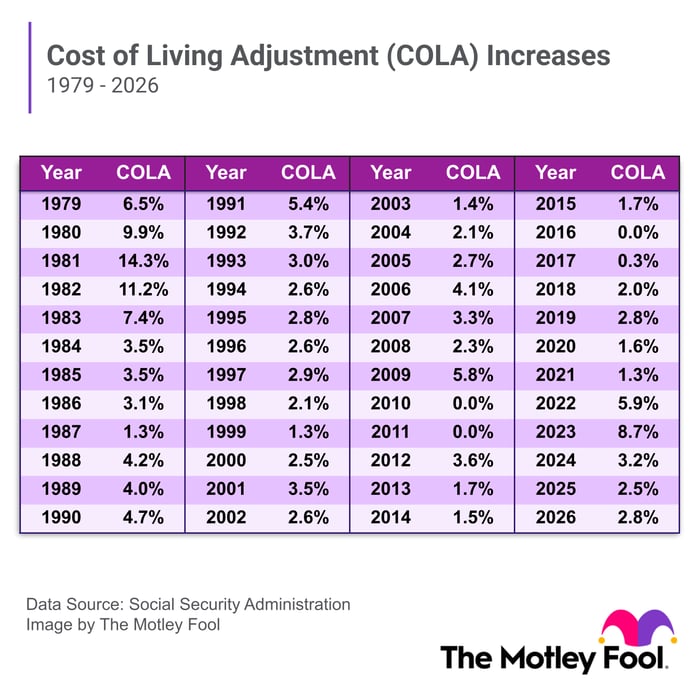
Image source: The Motley Fool.
2. The wage base limit is increasing
In Social Security, the wage base limit is the maximum amount of your income that's subject to the Social Security payroll tax. In most cases, the 12.4% Social Security payroll tax is split evenly between you and your employer (unless you're self-employed, in which case, you pay the full amount), but income above the wage base limit is exempt.
Starting in 2026, the new wage base limit is $184,500, up from $176,100 in 2025. A higher wage base limit has two main implications. On one end, it could mean some people paying more in Social Security payroll taxes because more of their income falls below the limit. For example, if you earned $180,000 in 2025, $3,900 would be exempt from the tax. In 2026, all $180,000 would be subject to the tax.
The other implication is for people who are aiming to receive the maximum monthly benefit whenever they claim benefits. To be eligible for the maximum benefit, someone would need to claim benefits at 70 (the latest age you can claim and still have your benefit increased) and earn above the wage base limit in the 35 years that Social Security uses to calculate your benefit. If the higher wage base limit is above someone's earnings, this would disqualify them from receiving the maximum benefit.
3. The retirement earnings test threshold has increased
If you claim Social Security before your full retirement age and earn above a certain amount, you'll be subjected to Social Security's retirement earnings test (RET). The RET will temporarily reduce your benefits based on how much you exceed the RET limit.
If you won't reach your full retirement age in 2026, the earnings limit is $24,480, up from $23,400 in 2025. Earning above that amount will reduce benefits by $1 for every $2 over that amount.
If you hit your full retirement age in 2026, the limit is $65,160, up from $62,160 in 2025. Earning above that amount will reduce your benefits by $1 for every $3 over.
Thankfully, these benefits aren't permanently lost. Social Security just withholds them and then recalculates your benefits once you hit your full retirement age, gradually adding them back over your lifespan based on your life expectancy at that point (Social Security uses its own calculations to determine that).
If you claim benefits at or after your full retirement age, you won't be subjected to the RET regardless of how much you earn. It only applies to people who claim benefits early.
The $23,760 Social Security bonus most retirees completely overlook
If you're like most Americans, you're a few years (or more) behind on your retirement savings. But a handful of little-known "Social Security secrets" could help ensure a boost in your retirement income.
One easy trick could pay you as much as $23,760 more... each year! Once you learn how to maximize your Social Security benefits, we think you could retire confidently with the peace of mind we're all after. Join Stock Advisor to learn more about these strategies.
View the "Social Security secrets" »
The Motley Fool has a disclosure policy.
Recommended Articles


