

Do You Qualify for Spousal Social Security Benefits?
Key Points
If you're married, or divorced after being married for a decade, you can receive spousal benefits.
Claiming these benefits allows you to receive up to 50% of your partner's primary insurance amount.
Note that claiming before your full retirement age will reduce your monthly benefit amount.
- The $23,760 Social Security bonus most retirees completely overlook ›
For millions of Americans, Social Security is a large chunk -- or all -- of their retirement income. That's why their retirement plans depend heavily on how much they receive in benefits. Generally speaking, the amount of your Social Security benefits comes down to your lifetime earnings and when you claim benefits.
The problem with the former is that not everyone has a consistent or lengthy work history. For some, it's because they were stay-at-home parents. Some may have had health issues that restricted their work, or held part-time jobs that didn't contribute much to Social Security. Whatever the case, the broader point is that they wouldn't qualify for a sufficient Social Security benefit.
Where to invest $1,000 right now? Our analyst team just revealed what they believe are the 10 best stocks to buy right now. Continue »
Thankfully, for people who fall into those categories, Social Security offers spousal benefits, which allow someone to claim benefits based on their partner's earnings record and receive up to 50% of their primary insurance amount (PIA). This is their base benefit they receive by claiming benefits at their full retirement age.

Image source: Getty Images.
Spousal benefits are a great way to help couples maximize one partner's earnings. However, certain criteria must be met to be eligible for spousal benefits. Read on to see what those are, and how you could potentially join the more than 2 million recipients already receiving spousal benefits.
Who qualifies for spousal benefits
Below are three main requirements that must be met to be eligible for spousal benefits:
- The primary claiming spouse must currently be receiving benefits. However, it's worth noting that if you're receiving spousal benefits and your spouse suspends their benefits (which people may do to receive delayed retirement credits), your spousal benefits will also be suspended.
- You must be married for at least one year, or be divorced after having been married for at least 10 years. If you remarry, you're no longer eligible for spousal benefits based on your ex-spouse's work history, but you'll still receive them if they remarry.
- You must be at least 62 years old, caring for a child under age 16, or caring for a child with a disability that began before age 22.
Before claiming spousal benefits, you should check your potential benefit to ensure that spousal benefits would be higher than what you'd receive by claiming your own. The easiest way to do so is to check your earnings record on the Social Security Administration (SSA) website (SSA.gov).
If you don't have an account on the SSA website already, it's fairly easy to create one. Once you've done so, it should show you your projected benefit based on when you claim.
How much can you expect to receive in Social Security benefits?
As mentioned earlier, claiming spousal benefits makes you eligible to receive up to 50% of your spouse's PIA. For example, if your spouse's PIA is $2,500, you could receive up to $1,250. However, to receive up to 50%, you must claim spousal benefits at your full retirement age, even though you can begin claiming at 62. Here are full retirement ages by birth year:
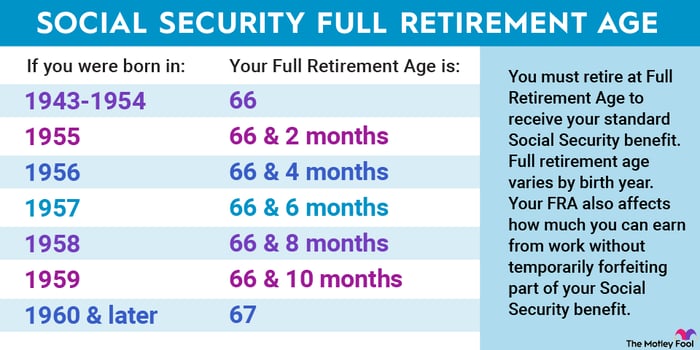
Image source: The Motley Fool.
The biggest difference between claiming spousal benefits early and standard benefits early is by how much benefits are reduced. Claiming spousal benefits early reduces benefits by a larger percentage than claiming standard benefits early.
For each month you claim early, benefits are reduced by 25/36 of 1%, up to 36 months. For each additional month early, benefits are further reduced by 5/12 of 1%. Assuming your full retirement age is 67, claiming benefits at 66 would reduce them by 8.3%; at 64, by 25%; and at 62, by 35%.
However, whereas standard monthly benefits are increased if you delay claiming them past your full retirement age, the same doesn't apply to spousal benefits. The amount you're eligible to receive at your full retirement age is the most you'll get, so that's the latest you should claim them.
The $23,760 Social Security bonus most retirees completely overlook
If you're like most Americans, you're a few years (or more) behind on your retirement savings. But a handful of little-known "Social Security secrets" could help ensure a boost in your retirement income.
One easy trick could pay you as much as $23,760 more... each year! Once you learn how to maximize your Social Security benefits, we think you could retire confidently with the peace of mind we're all after. Join Stock Advisor to learn more about these strategies.
View the "Social Security secrets" »
The Motley Fool has a disclosure policy.
Recommended Articles


