


Meet The Only AI Stock That's a Better Buy Than Nvidia
Key Points
Most of the major AI computing providers utilize Taiwan Semiconductor's foundry services.
Taiwan Semiconductor's stock is valued at a discount to its peers.
- 10 stocks we like better than Taiwan Semiconductor Manufacturing ›
It's no secret that I'm a huge Nvidia fan from an investment standpoint. However, there's one stock that I think is a better pick in the artificial intelligence (AI) realm than Nvidia: Taiwan Semiconductor (NYSE: TSM). Personally, I don't think that Taiwan Semiconductor will outperform Nvidia over the next few years. However, it offers one important quality: Diversification.
I think this makes Taiwan Semiconductor a better investment than Nvidia, and it gives investors some safety when it comes to investing in artificial intelligence hardware.
Where to invest $1,000 right now? Our analyst team just revealed what they believe are the 10 best stocks to buy right now, when you join Stock Advisor. See the stocks »

Image source: Getty Images.
Nvidia has dominated the AI hardware sector so far
Most of the AI models you interact with daily were built on Nvidia's graphics processing units (GPUs). Since the AI spending spree kicked off in 2023, Nvidia's products have dominated the market due to a strong ecosystem with best-in-class control software. This gives Nvidia a first-mover advantage by making it difficult to switch over to other hardware types. However, if products from AMD or Broadcom can compete against Nvidia's GPUs, the cost to switch may be less than the costs of computing units from cheaper providers.
While AMD has lagged in the AI race, it is starting to catch up. It inked a massive deal with OpenAI, and recently gave bold projections regarding its data center sector revenue. It believes it can grow its data center revenue at a 60% compound annual growth rate (CAGR) over the next five years. In the third quarter of 2025, its data center revenue increased by 22%. This projection indicates that AMD's management sees its growth rate rising rapidly, as it could be taking market share from Nvidia.
Broadcom is in a similar boat, as it's developing custom AI accelerator chips directly with AI hyperscalers. The most prominent example of this is the tensor processing unit that Alphabet has developed in tandem with Broadcom. While Google has traditionally only used TPUs for internal use or offered them for rent via Google Cloud, it's reportedly considering a partnership with Meta Platforms to sell TPUs. This could be a huge disruption to Nvidia, as Meta is one of Nvidia's largest clients.
Nvidia has dominated the AI hardware realm for a long time, but there are signs of its dominance starting to crack. While I think Nvidia will still be an incredibly successful investment, it's far less safe than Taiwan Semiconductor.
All AI chips have to come from somewhere
Broadcom, AMD, and Nvidia all have one thing in common: They are all fabless chip companies. This means they design the chip, but then outsource the production work to different companies. The majority of the chip foundry work goes to Taiwan Semiconductor, which is the largest chip foundry by revenue in the world. When it comes to cutting-edge chips, there are really only two other foundries competing against TSMC: Intel and Samsung. Neither of these two has fared very well recently, as TSMC has become the top company to partner with in the chip realm.
Furthermore, TSMC has a history of launching innovative products. That isn't changing, as its 2nm (nanometer) chip node is heading into production right now. This chip node offers huge improvements, namely its power consumption. 2nm chips consume 25% to 30% less power than previous generation 3nm chips when configured to run at the same speed. With how large a factor power consumption is becoming in the AI buildout, this innovation is a big deal.
This technology will likely be adopted by all three of the AI hardware providers discussed above, and TSMC could charge a premium for this tech due to its massive benefits and increased difficulty to manufacture. TSMC's revenue will receive a boost throughout 2026 as this technology is adopted, even though it is already growing at a rapid pace, with revenue rising 41% year over year in U.S. dollars in the third quarter of 2025.
TSMC will be a successful investment regardless of which company is providing the most popular AI hardware. As long as there is massive spending in the AI realm, Taiwan Semiconductor will do well. With Nvidia projecting that global data center spending will reach $3 trillion to $4 trillion by 2030, TSMC makes for a great stock pick.
As a cherry on top, Taiwan Semiconductor is also priced at a far cheaper level than its peers.
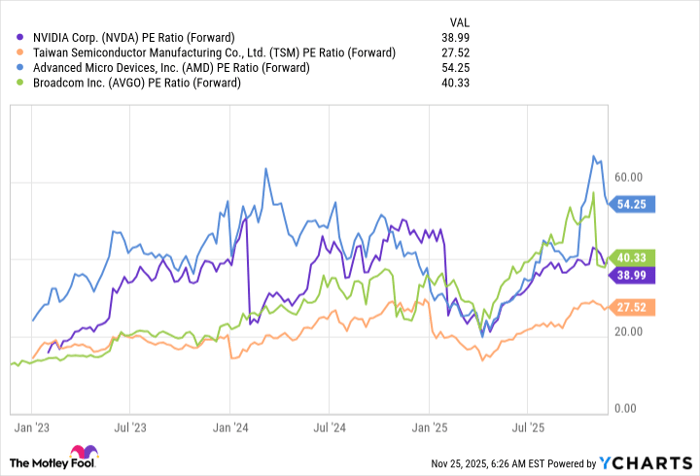
NVDA PE Ratio (Forward) data by YCharts.
At 27 times forward earnings, Taiwan Semiconductor makes for a no-brainer stock to buy now. Its neutral position allows it to benefit from all of the AI spending, regardless of which company it's going to.
Should you invest $1,000 in Taiwan Semiconductor Manufacturing right now?
Before you buy stock in Taiwan Semiconductor Manufacturing, consider this:
The Motley Fool Stock Advisor analyst team just identified what they believe are the 10 best stocks for investors to buy now… and Taiwan Semiconductor Manufacturing wasn’t one of them. The 10 stocks that made the cut could produce monster returns in the coming years.
Consider when Netflix made this list on December 17, 2004... if you invested $1,000 at the time of our recommendation, you’d have $580,171!* Or when Nvidia made this list on April 15, 2005... if you invested $1,000 at the time of our recommendation, you’d have $1,084,986!*
Now, it’s worth noting Stock Advisor’s total average return is 1,004% — a market-crushing outperformance compared to 194% for the S&P 500. Don’t miss out on the latest top 10 list, available when you join Stock Advisor.
See the 10 stocks »
*Stock Advisor returns as of November 24, 2025
Keithen Drury has positions in Alphabet, Broadcom, Meta Platforms, Nvidia, and Taiwan Semiconductor Manufacturing. The Motley Fool has positions in and recommends Advanced Micro Devices, Alphabet, Intel, Meta Platforms, Nvidia, and Taiwan Semiconductor Manufacturing. The Motley Fool recommends Broadcom and recommends the following options: short November 2025 $21 puts on Intel. The Motley Fool has a disclosure policy.
Recommended Articles


