




3 Surprising Reasons to Not Buy Coca-Cola Stock
Key Points
Its longstanding dividend underperforms in one key area.
Coca-Cola stock consistently delivers lower returns when compared to a key metric.
Berkshire Hathaway is a Coca-Cola shareholder, but one aspect of that holding may trouble new investors.
- 10 stocks we like better than Coca-Cola ›
Coca-Cola (NYSE: KO) stock is not a buy.
Indeed, such advice may seem counterintuitive at best and nonsensical at worst. The stock has delivered considerable returns for investors since it went public back in 1919. Also, few companies can match its track record of annual dividend increases, which now spans 63 years.
Where to invest $1,000 right now? Our analyst team just revealed what they believe are the 10 best stocks to buy right now. Continue »
Nonetheless, although Coca-Cola stock may look like an appealing buy on the surface, a closer inspection of the stock highlights some issues. Those challenges probably mean Coca-Cola stock is a hold at best, and three reasons illustrate why.
Image source: Getty Images.
1. The dividend
Admittedly, in the minds of some investors, the dividend may seem like the best reason to buy Coca-Cola stock.
As previously mentioned, it has increased its dividend for 63 straight years, well above the minimum 50-year streak needed to claim Dividend King status. Currently, the market only has 56 Dividend Kings, making this achievement an impressive accomplishment by any measure.
Moreover, Coca-Cola's annual payout of $2.04 per share gives new shareholders a dividend yield of just above 3%. Since the average S&P 500 stock yields less than 1.2%, this might presumably make Coca-Cola an income stock to buy rather than avoid.
However, among beverage stocks, Coca-Cola does not offer the highest dividend yield. That title instead goes to archrival PepsiCo. Currently, PepsiCo shareholders earn a yield of 3.9%. Also, while PepsiCo's 53-year streak of payout hikes does not quite match Coca-Cola's, it is also a Dividend King. Thus, in this regard, income-oriented investors are likely best off choosing PepsiCo over Coca-Cola.
2. Its underperformance
Additionally, Coca-Cola has not beaten the market in recent history.
Indeed, Coca-Cola had a higher return for most of this year. However, if one measures Coca-Cola's returns in most time periods going back to 1990, the stock underperforms the total returns of the S&P 500, which include dividends.
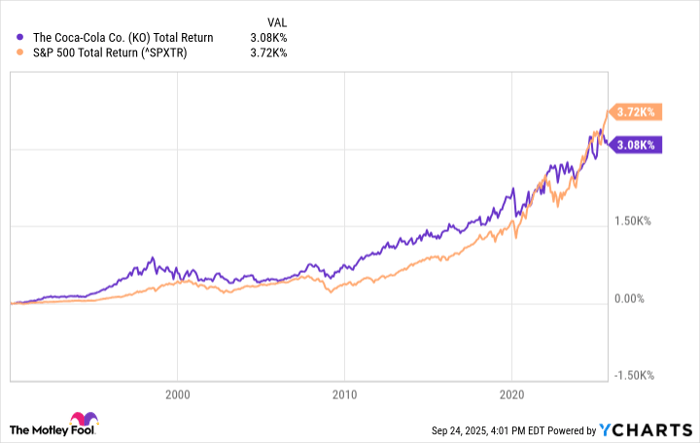
KO Total Return Level data by YCharts
In one sense, this is because Coca-Cola is a victim of its own success. Its flagship beverage is available in almost every corner of the globe. Since that leaves the company with few options for growth, it has branched out into other beverage types and now owns more than 200 brands.
Still, this also means that Coca-Cola has numerous competitors besides PepsiCo. While some of its brands may have more remaining growth potential than its flagship cola beverage, the company's revenue growth rarely breaks above single-digit rates.
Amid such conditions, its 24 P/E ratio may not be low enough to attract new investors. Currently, that is slightly below the five-year average P/E ratio for Coca-Cola, which is 27. Still, when considering the company's slower revenue growth, it is arguably not a bargain stock for investors.
3. Berkshire's take on Coca-Cola
One factor that may cause some investors to dismiss the above concerns about Coca-Cola is the fact that Warren Buffett's Berkshire Hathaway has owned shares in the company since 1988. Considering that Berkshire almost doubled the S&P 500's total returns over a 60-year period, that success may prompt investors to follow Buffett's company into the stock.
However, investors considering such a move need to look more closely at Berkshire's purchase activities. Although Buffett's team added shares of Coca-Cola after 1988, Berkshire Hathaway has neither bought nor sold any Coca-Cola shares since 1994.
In the subsequent 31 years, Berkshire has collected the rising dividends and invested the capital elsewhere. Its 400 million shares will earn Berkshire $816 million in dividend income this year, amounting to a dividend yield for Berkshire of 63%. That may explain why it continues to hold these shares, but with new shareholders earning the aforementioned 3% yield, Coca-Cola stock is likely a less suitable choice for them.
Do not buy Coca-Cola stock
When considering the above challenges, investors should not purchase additional Coca-Cola shares under current conditions.
Admittedly, its decades-long track record is impressive by any measure, and long-term shareholders are earning generous dividend returns.
Nonetheless, its archrival PepsiCo offers investors a higher dividend yield, and Coca-Cola has succeeded to the point that it has no obvious paths for rapid growth. When also considering Berkshire's lack of activity in the stock over the last 31 years, Coca-Cola does not look like much of a buy.
Should you invest $1,000 in Coca-Cola right now?
Before you buy stock in Coca-Cola, consider this:
The Motley Fool Stock Advisor analyst team just identified what they believe are the 10 best stocks for investors to buy now… and Coca-Cola wasn’t one of them. The 10 stocks that made the cut could produce monster returns in the coming years.
Consider when Netflix made this list on December 17, 2004... if you invested $1,000 at the time of our recommendation, you’d have $652,872!* Or when Nvidia made this list on April 15, 2005... if you invested $1,000 at the time of our recommendation, you’d have $1,092,280!*
Now, it’s worth noting Stock Advisor’s total average return is 1,062% — a market-crushing outperformance compared to 189% for the S&P 500. Don’t miss out on the latest top 10 list, available when you join Stock Advisor.
See the 10 stocks »
*Stock Advisor returns as of September 22, 2025
Will Healy has positions in Berkshire Hathaway. The Motley Fool has positions in and recommends Berkshire Hathaway. The Motley Fool has a disclosure policy.
Recommended Articles


