




The Fed's Meeting Minutes Just Echoed Concerns Not Heard Since Alan Greenspan in 1996. History Says This Could Be Both Great and Terrible for the S&P 500
Key Points
In its latest meeting minutes from July, the Federal Open Market Committee discussed financial stability and elevated asset valuations.
The discussion was reminiscent of, although not as dramatic as, concerns raised by former Federal Reserve chair Alan Greenspan during his tenure.
What followed was both great and also terrible for the stock market.
- 10 stocks we like better than S&P 500 Index ›
The Federal Open Market Committee (FOMC) is a committee of the Federal Reserve system that sets monetary policy. Understanding how the group regards the economy is incredibly important for investors, because its views determine whether or not it will change interest rates, and also how it might see the longer-term trajectory of the economy and the stock market. That's why investors regularly read the FOMC's meeting minutes.
In the recently released minutes from the July meeting, members of the FOMC echoed concerns not heard since the days of former Federal Reserve chair Alan Greenspan in 1996. History says that could mean both great news and terrible news for the S&P 500.
Where to invest $1,000 right now? Our analyst team just revealed what they believe are the 10 best stocks to buy right now. Continue »
Source: Getty Images.
"Elevated asset valuation pressures"
Investors are interested in the FOMC's meeting minutes because they provide more in-depth detail on previous decisions by the Fed. Not only did members discuss concerns about inflation, but they also talked about financial stability. Specifically, the FOMC talked about "elevated asset valuation pressures":
Valuations of the S&P 500 index continued to move above long-run average levels, mostly driven by optimism about the largest technology firms' scope to benefit from the further adoption of artificial intelligence (AI). However, valuations of an index of smaller-capitalization firms, although higher over the intermeeting period, remained below their historical averages.
Of course, this isn't exactly new. The S&P 500 Shiller CAPE Ratio, which looks at the price of the S&P 500 compared to its trailing-10-year earnings adjusted for inflation, is close to its 21st-century highs:
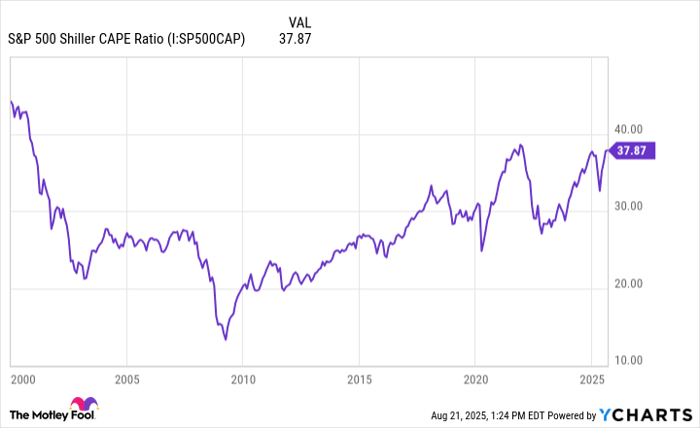
S&P 500 Shiller CAPE Ratio data by YCharts.
While the Fed minutes aren't nearly as dramatic, they do mirror some of the wording from a famous speech made by Fed chair Alan Greenspan in 1996, during another period in which internet and tech stocks drove a massive bull run:
Clearly, sustained low inflation implies less uncertainty about the future, and lower risk premiums imply higher prices of stocks and other earning assets. We can see that in the inverse relationship exhibited by price/earnings ratios and the rate of inflation in the past. But how do we know when irrational exuberance has unduly escalated asset values, which then become subject to unexpected and prolonged contractions as they have in Japan over the past decade?
What does history say and does it apply?
If history is any indication, then the Fed's concerns about elevated asset values could be both good and bad. You may know what happened in the late 1990s: stocks had one of their best runs ever. After Greenspan's speech in 1996, the S&P 500 would go on to rip for several more years before the dot-com bubble in 2000. In fact, between the beginning of 1995 and the very end of 1999, the S&P 500 soared by nearly 220%.
History rarely repeats itself, but it often rhymes. While there are parallels right now to the years leading up to the dot-com bubble, that doesn't mean things will repeat themselves in the same way. While AI is somewhat reminiscent of the internet boom, there are many differences. For one, AI stocks consume a much bigger part of the S&P 500 than in the 1990s. However, AI is also being fueled by companies coming from a position of financial strength.
Additionally, in the 25 years since the dot-com crash, there have been a Great Recession, a pandemic, and quantitative easing, a tool which has pumped trillions of dollars into the economy. The market's structure, particularly with so much passive investing, is also much different.
Investors can't predict the future, but they can gain knowledge and apply it to their investment decisions. If you plan on holding stocks for the next 10 to 20 years and don't need your invested cash right now, then you can probably do nothing and simply be aware that more volatility could be on the way. If you feel a bit overexposed to stocks and are worried, maybe convert some of your investments to cash. Bull markets, recessions, and market sell-offs are simply part of the economic and investment cycle. There's no way around them.
Should you invest $1,000 in S&P 500 Index right now?
Before you buy stock in S&P 500 Index, consider this:
The Motley Fool Stock Advisor analyst team just identified what they believe are the 10 best stocks for investors to buy now… and S&P 500 Index wasn’t one of them. The 10 stocks that made the cut could produce monster returns in the coming years.
Consider when Netflix made this list on December 17, 2004... if you invested $1,000 at the time of our recommendation, you’d have $649,657!* Or when Nvidia made this list on April 15, 2005... if you invested $1,000 at the time of our recommendation, you’d have $1,090,993!*
Now, it’s worth noting Stock Advisor’s total average return is 1,057% — a market-crushing outperformance compared to 185% for the S&P 500. Don’t miss out on the latest top 10 list, available when you join Stock Advisor.
See the 10 stocks »
*Stock Advisor returns as of August 25, 2025
Bram Berkowitz has no position in any of the stocks mentioned. The Motley Fool has no position in any of the stocks mentioned. The Motley Fool has a disclosure policy.
Recommended Articles


