

Bitcoin price could reach $285K by 2030 as Citigroup forecasts $1.6 trillion stablecoin inflows

Source Fxstreet
  • Citigroup projects the stablecoin market could reach $1.6 trillion by 2030 from $240 billion today.
  • Bitcoin price could surge past $285,000 if stablecoin capital rotation follows historical patterns.
  • Regulatory clarity and political tailwinds may accelerate institutional adoption of blockchain-based payments

Bitcoin price outlook strengthens as Citigroup projects $1.6 trillion stablecoin growth, calling them critical bridges between banks and blockchain.

Citigroup predicts stablecoin market cap will hit $1.6 trillion by 2030

Global investment bank Citigroup has forecasted a dramatic rise in stablecoin adoption, projecting the market could expand to $1.6 trillion by the end of 2030. In a recent report, the bank emphasized the growing utility of fiat-backed digital assets in remittances, cross-border settlements, and tokenized financial instruments.

The report described a “multi-rail” financial future, where stablecoins operate alongside traditional banking infrastructure to enable near-instantaneous, 24/7 global transactions. Institutional appetite and regulatory clarity — particularly from US authorities — were identified as pivotal catalysts.
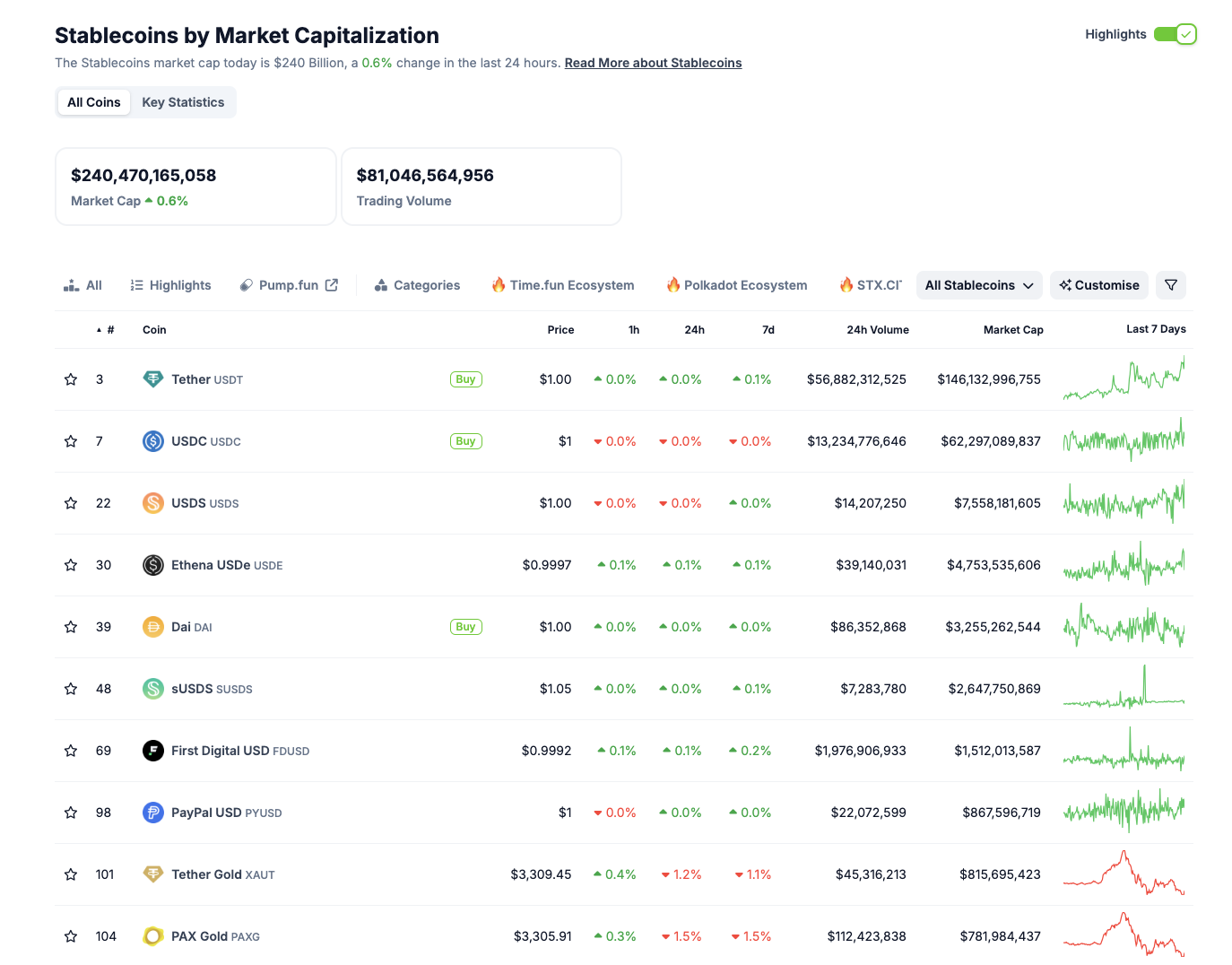
Top 10 Stablecoins as of April 25, 2025 | Source: Coingecko

Top 10 Stablecoins as of April 25, 2025 | Source: Coingecko

The current data in the Coingecko chart above places the total stablecoin market capitalization at approximately $240 billion as of Friday. This includes dominant players like Tether (USDT), Circle’s USDC, and PayPal USD. Their increasing use in payment platforms and treasury operations has signaled a maturing market.

In terms of institutional impact, Visa and Mastercard have already begun integrating stablecoin settlements into select cross-border rails, hinting at gradual adoption into global payments systems. 

This trend, Citigroup suggests, may accelerate under a US administration more favorable to crypto innovation — raising the probability of regulatory guardrails rather than outright restrictions.

Stablecoin market trends in 2025 

The composition of the stablecoin sector also points to increasing institutional participation. USD-backed stablecoins dominate with nearly 98% market share, while US Treasury-backed and yield-bearing stablecoins are gaining traction. The latter saw gains of 1.2% and 1.0%, respectively, in the last 24 hours, indicating demand for tokenized low-risk yield instruments.

Commodity-backed stablecoins rose 2.6% as investors seek hedges against inflation and geopolitical volatility. Meanwhile, algorithmic and exotic fiat-backed stablecoins showed divergent performance — suggesting that institutional capital is gravitating toward fully collateralized, regulated products.
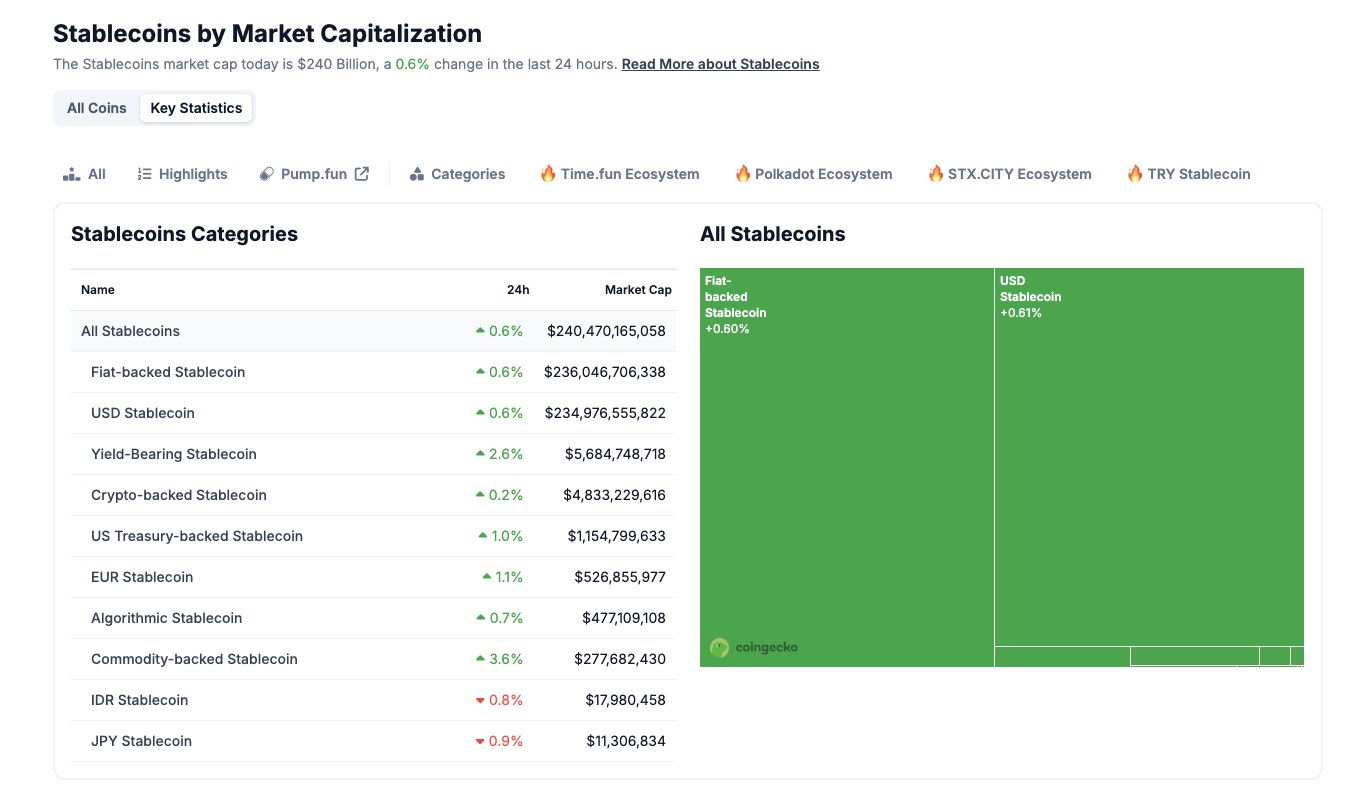
Stablecoin market categories, April 2025 | Source: Coingecko 

Stablecoin market categories, April 2025 | Source: Coingecko 

Notably, stablecoins also serve as on-ramps for new crypto users, allowing easy access to decentralized apps, exchanges and custody solutions without exposure to volatility.

This suggests that imminent stablecoin inflows could eventually funnel capital into Bitcoin and other cryptocurrencies. 

Bipartisan US stablecoin bill could unlock billions in sidelined institutional capital 

Since Trump’s inauguration in January, US regulators have softened their stance on cryptocurrencies. In recent regulatory updates, the US Senate Banking Committee has advanced the Guarding US National Interests in Essential Unified Stablecoins (GENIUS) act. 

According to official filings, the legislative bill aims to establish a clear federal framework for issuing, auditing and redeeming fiat-backed stablecoins.

The Genius Act would permit qualified non-bank entities to issue stablecoins under rigorous reserve requirements, while ensuring oversight from the Federal Reserve (Fed) and the Office of the Comptroller of the Currency (OCC). 

The bill also includes provisions to block algorithmic stablecoins not backed 1:1 by cash or Treasuries, addressing systemic risks without stifling innovation.

If enacted, the Genius Act could unlock billions in sidelined capital, as regulated stablecoin issuers gain access to traditional banking rails and offer stable, yield-bearing products that meet compliance standards. 

Bitcoin price prediction if stablecoin market hits $1.6 trillion by 2030

If Citigroup’s $1.6 trillion market cap prediction materializes, the knock-on effect for Bitcoin price could be significant. Notably, historical data shows stablecoin market inflows have often preceded major BTC rallies.

During the 2020–2021 bull market, stablecoin supply ballooned from $20 billion to $140 billion, coinciding with Bitcoin’s rise from $10,000 to nearly $64,000. The correlation stemmed from market participants parking capital in USD-denominated stablecoins before rotating into risk-on assets like BTC.

If a similar pattern unfolds, Citigroup’s projected 670% growth in the stablecoin market cap, from $240 billion at press time to $1.6 trillion, could potentially propel Bitcoin into new global peaks in the higher six-figure territories. 
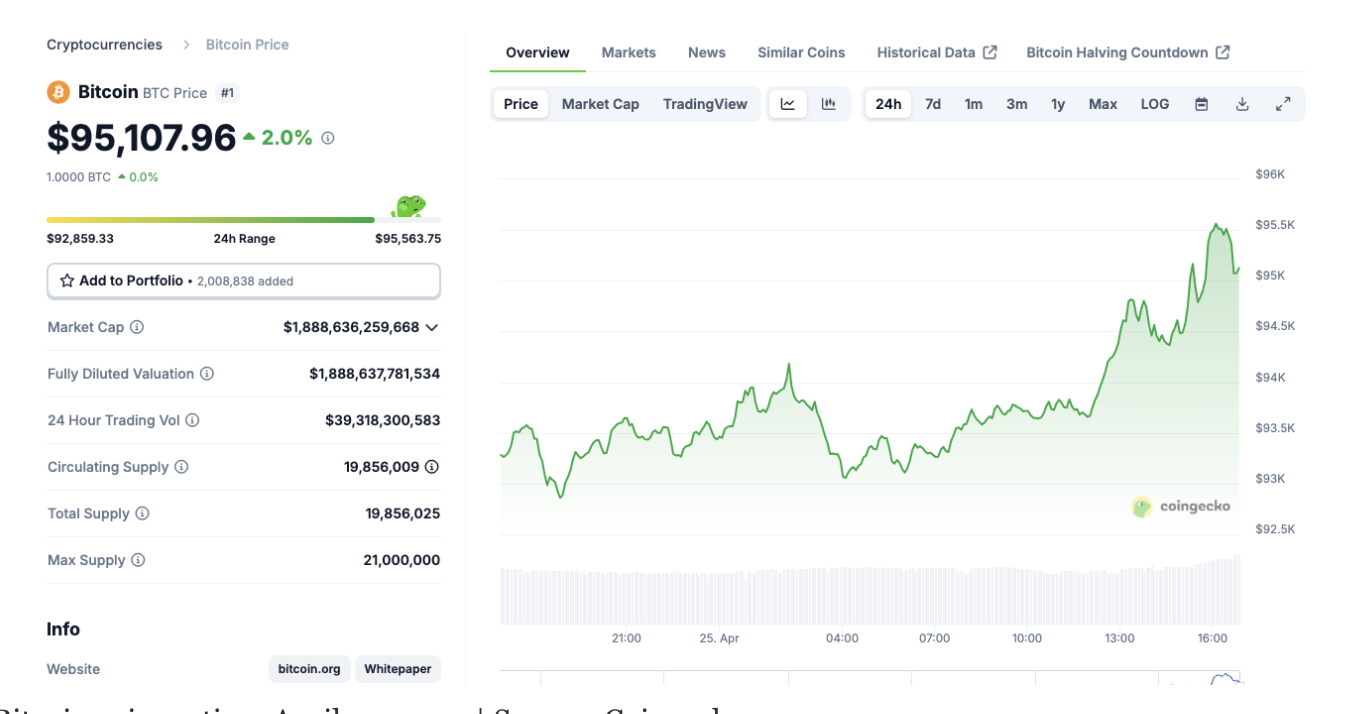
Bitcoin price action, April 25 | 2025 | Source: Coingecko

Bitcoin price action, April 25 | 2025 | Source: Coingecko

At the time of publication, Bitcoin price is trading just above the $95,000 mark, its highest in 60 days of trading

If historical correlations between stablecoin supply growth and Bitcoin price persist, a 6.7x expansion in the stablecoin market could correspond to a 3x to 5x increase in Bitcoin’s price — placing BTC in the $285,000 to $475,000 range.

Even under more conservative assumptions — where just 25% of stablecoin inflows rotate into BTC — Bitcoin could still see gains of 200% to 250% from current levels. This conservative scenario implies a projected price range of $190,000 to $237,500 by 2030, assuming continued alignment between regulatory clarity and capital allocation trends.


Disclaimer: For information purposes only. Past performance is not indicative of future results.
placeholder
Gold Price Forecast: XAU/USD drifts higher above $4,200 as Fed delivers expected cutGold price (XAU/USD) gains momentum to around $4,235 during the early Asian session on Thursday. The precious metal extends its upside after the US Federal Reserve (Fed) delivered an expected third consecutive interest rate cut and maintained its outlook for just one cut in 2026.
Author  FXStreet
Dec 11, Thu
Gold price (XAU/USD) gains momentum to around $4,235 during the early Asian session on Thursday. The precious metal extends its upside after the US Federal Reserve (Fed) delivered an expected third consecutive interest rate cut and maintained its outlook for just one cut in 2026.
placeholder
Ethereum Price Slips Lower — $3,000 Looms as the Key BattlegroundEthereum is attempting to recover from a $3,026 low but remains below $3,200 and the 100-hour SMA, with a bearish trend line near $3,175 capping rebounds as bulls need a clean break above $3,200 to target $3,250–$3,400, while a drop below $3,050 risks a retest of $3,000 and $2,940.
Author  Mitrade
Dec 15, Mon
Ethereum is attempting to recover from a $3,026 low but remains below $3,200 and the 100-hour SMA, with a bearish trend line near $3,175 capping rebounds as bulls need a clean break above $3,200 to target $3,250–$3,400, while a drop below $3,050 risks a retest of $3,000 and $2,940.
placeholder
Macro Analysts: Hawkish Japan Could Push Bitcoin Below $70KAnalysts predict Bitcoin may face further declines towards the $70,000 mark if the Bank of Japan raises interest rates as expected.
Author  Mitrade
Dec 15, Mon
Analysts predict Bitcoin may face further declines towards the $70,000 mark if the Bank of Japan raises interest rates as expected.
placeholder
Bitcoin Slides 5% as Sellers Lean In — Can BTC Reclaim $88,000?Bitcoin has dropped back below $88,000 after rolling over from $90,500, with price still trading under the 100-hour Simple Moving Average. The sell-off found a floor at $85,151, and BTC is now consolidating near that base, but rebounds are facing pressure from a bearish trend line around $89,000. Bulls need to retake $88,000–$89,000 to ease downside risk; failure to do so keeps $85,500–$85,000 and then $83,500 in play, with $80,000 as the deeper “line in the sand.” Bitcoin (BTC) is back in damage-control mode after a sharp pullback wiped out recent gains. The price failed to reclaim the $90,000–$90,500 band, rolled over, and slid through $88,500 before briefly dipping under $87,000. Buyers did show up around $85,000, but the rebound so far looks more like stabilization than a clear trend reversal. Bitcoin dips hard, finds a bid near $85,000(h3) BTC’s latest move lower began when it couldn’t build follow-through above $90,000 and $90,500. Once that upside stalled, sellers took control and pushed price down through $88,500. The slide accelerated enough to spike below $87,000, but the market didn’t free-fall. Bulls defended the $85,000 zone, printing a low at $85,151. Since then, Bitcoin has been consolidating below the 23.6% Fibonacci retracement of the drop from the $93,560 swing high to the $85,151 low — a clue that the bounce is still shallow and that sellers haven’t fully backed off yet. Structurally, BTC is still on the back foot: It’s trading below $88,000, and It remains below the 100-hour Simple Moving Average, keeping short-term trend pressure pointed downward. Resistance is layered, and $89,000 is the problem area(h3) If bulls try to turn this into a recovery, they’ll have to climb through multiple ceilings in quick succession. First, BTC faces resistance around $87,150, followed by a more meaningful barrier near $87,500. From there, the market’s attention snaps back to $88,000 — the level BTC just lost and now needs to reclaim. A close back above $88,000 would improve the tone, but it doesn’t solve the bigger issue: there’s a bearish trend line on the hourly BTC/USD chart (Kraken feed) with resistance near $89,000, which also lines up with the next technical hurdle. If BTC can push through $89,000 and hold, the rebound could extend toward $90,000, with follow-through targets at $91,000 and $91,500. But until price clears that $88,000–$89,000 zone, rallies are at risk of being sold rather than chased. If BTC fails to reclaim resistance, the downside path is clear(h3) The near-term bear case is simple: if Bitcoin can’t climb back above the $87,000 area and keep traction, sellers may attempt another leg lower. Support levels line up like this: Immediate support: $85,500 First major support: $85,000 Next support: $83,500 Then $82,500 in the near term Below that, the major “don’t break this” level is still $80,000. If BTC slips under $80,000, the risk of acceleration to the downside increases significantly — not because it’s magic, but because it’s the kind of psychological and structural level that tends to trigger forced de-risking. Indicators: momentum still leans bearish(h3) The intraday indicators aren’t offering much comfort yet: Hourly MACD is losing pace in the bearish zone. Hourly RSI remains below 50, suggesting sellers still have the upper hand on short timeframes. So while the $85,000 defense held for now, the market hasn’t flipped bullish — it’s just stopped bleeding.
Author  Mitrade
22 hours ago
Bitcoin has dropped back below $88,000 after rolling over from $90,500, with price still trading under the 100-hour Simple Moving Average. The sell-off found a floor at $85,151, and BTC is now consolidating near that base, but rebounds are facing pressure from a bearish trend line around $89,000. Bulls need to retake $88,000–$89,000 to ease downside risk; failure to do so keeps $85,500–$85,000 and then $83,500 in play, with $80,000 as the deeper “line in the sand.” Bitcoin (BTC) is back in damage-control mode after a sharp pullback wiped out recent gains. The price failed to reclaim the $90,000–$90,500 band, rolled over, and slid through $88,500 before briefly dipping under $87,000. Buyers did show up around $85,000, but the rebound so far looks more like stabilization than a clear trend reversal. Bitcoin dips hard, finds a bid near $85,000(h3) BTC’s latest move lower began when it couldn’t build follow-through above $90,000 and $90,500. Once that upside stalled, sellers took control and pushed price down through $88,500. The slide accelerated enough to spike below $87,000, but the market didn’t free-fall. Bulls defended the $85,000 zone, printing a low at $85,151. Since then, Bitcoin has been consolidating below the 23.6% Fibonacci retracement of the drop from the $93,560 swing high to the $85,151 low — a clue that the bounce is still shallow and that sellers haven’t fully backed off yet. Structurally, BTC is still on the back foot: It’s trading below $88,000, and It remains below the 100-hour Simple Moving Average, keeping short-term trend pressure pointed downward. Resistance is layered, and $89,000 is the problem area(h3) If bulls try to turn this into a recovery, they’ll have to climb through multiple ceilings in quick succession. First, BTC faces resistance around $87,150, followed by a more meaningful barrier near $87,500. From there, the market’s attention snaps back to $88,000 — the level BTC just lost and now needs to reclaim. A close back above $88,000 would improve the tone, but it doesn’t solve the bigger issue: there’s a bearish trend line on the hourly BTC/USD chart (Kraken feed) with resistance near $89,000, which also lines up with the next technical hurdle. If BTC can push through $89,000 and hold, the rebound could extend toward $90,000, with follow-through targets at $91,000 and $91,500. But until price clears that $88,000–$89,000 zone, rallies are at risk of being sold rather than chased. If BTC fails to reclaim resistance, the downside path is clear(h3) The near-term bear case is simple: if Bitcoin can’t climb back above the $87,000 area and keep traction, sellers may attempt another leg lower. Support levels line up like this: Immediate support: $85,500 First major support: $85,000 Next support: $83,500 Then $82,500 in the near term Below that, the major “don’t break this” level is still $80,000. If BTC slips under $80,000, the risk of acceleration to the downside increases significantly — not because it’s magic, but because it’s the kind of psychological and structural level that tends to trigger forced de-risking. Indicators: momentum still leans bearish(h3) The intraday indicators aren’t offering much comfort yet: Hourly MACD is losing pace in the bearish zone. Hourly RSI remains below 50, suggesting sellers still have the upper hand on short timeframes. So while the $85,000 defense held for now, the market hasn’t flipped bullish — it’s just stopped bleeding.
placeholder
Senate Delays Crypto Market Structure Hearings to Early 2026The Senate Banking Committee has postponed cryptocurrency market structure hearings until 2026, citing ongoing bipartisan negotiations.
Author  Mitrade
19 hours ago
The Senate Banking Committee has postponed cryptocurrency market structure hearings until 2026, citing ongoing bipartisan negotiations.
goTop
quote