


Fed FOMC Meeting Is Approaching: Where Is the Focus? Will There Be More Rate Cuts This Year?
TradingKey - Global financial markets are set for a "Super Central Bank Week" this week, as five major central banks, including the Federal Reserve, the European Central Bank, and the Bank of Japan, are scheduled to announce their interest rate decisions in quick succession.
For the Federal Reserve, the April policy decision—to be announced in the early hours of April 29, ET—will face market scrutiny against an increasingly complex macroeconomic backdrop: Middle East tensions are drifting toward uncertainty amid recurring volatility, oil price shocks are starting to permeate core inflation, and the U.S. Treasury market is already "pricing in" the outlook for Chairman Powell's leadership transition next year.
What are the key focal points for the April FOMC?
There is little suspense regarding the interest rate decision itself. Data from the CME FedWatch Tool shows that the market is pricing in a 100% consensus probability that the Federal Reserve will leave rates unchanged in April.
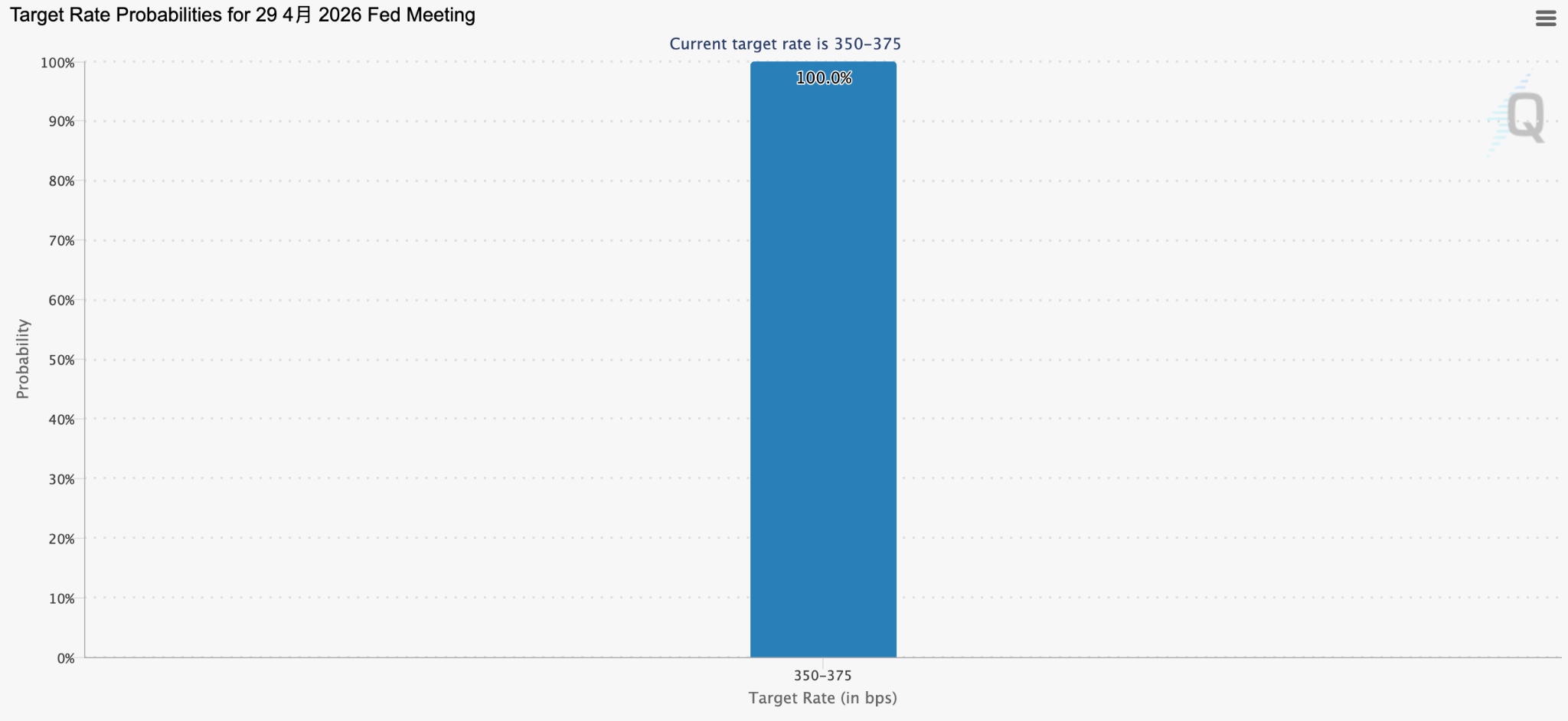
[Probability of a Rate Cut in April, Source: Fed Watch]
Since the March meeting, Federal Reserve officials have mostly maintained a wait-and-see stance. Financial markets are currently pricing in less than one rate cut for 2026. Fed Chair Jerome Powell is expected to continue emphasizing policy uncertainties, and the April meeting is projected to hold rates steady.
The real focus lies in the unique structural factors of this announcement. This meeting marks Powell's final official FOMC meeting as Chair and will likely be the last press conference of his term.
Markets widely expect the Senate Banking Committee to vote on Kevin Warsh's nomination as Fed Chair—nominated by Donald Trump—on the evening of April 29, Beijing time. If confirmed, Warsh will officially succeed Powell in May.
Warsh's testimony remained largely consistent with his previous remarks. His focus on trimmed-mean inflation indicates a continued desire to push for rate cuts, advocating for a dual path of "balance sheet reduction and rate cuts." While he made no explicit commitments regarding interest rates, his rhetoric showed a distinct dovish tilt.
When the results of this policy meeting are released, the highlight will most likely be Powell's remarks at the press conference.
Observers are closely watching whether Powell will signal a clearer inclination toward a rate-cut path as a prelude to handing the reins over to Warsh.
Meanwhile, traders are noting that this meeting includes no updated "dot plot" or economic projections. This means the incremental information available for analysts and traders to dissect will consist almost entirely of Powell's wording during the press conference.
Christian Scherrmann, Chief U.S. Economist at DWS, noted in a recent preview that inflation stemming from the Iranian conflict has begun to surface in economic data. Headline CPI for March jumped nearly a full percentage point year-over-year to 3.3%, while consumer confidence simultaneously plummeted to historic lows.
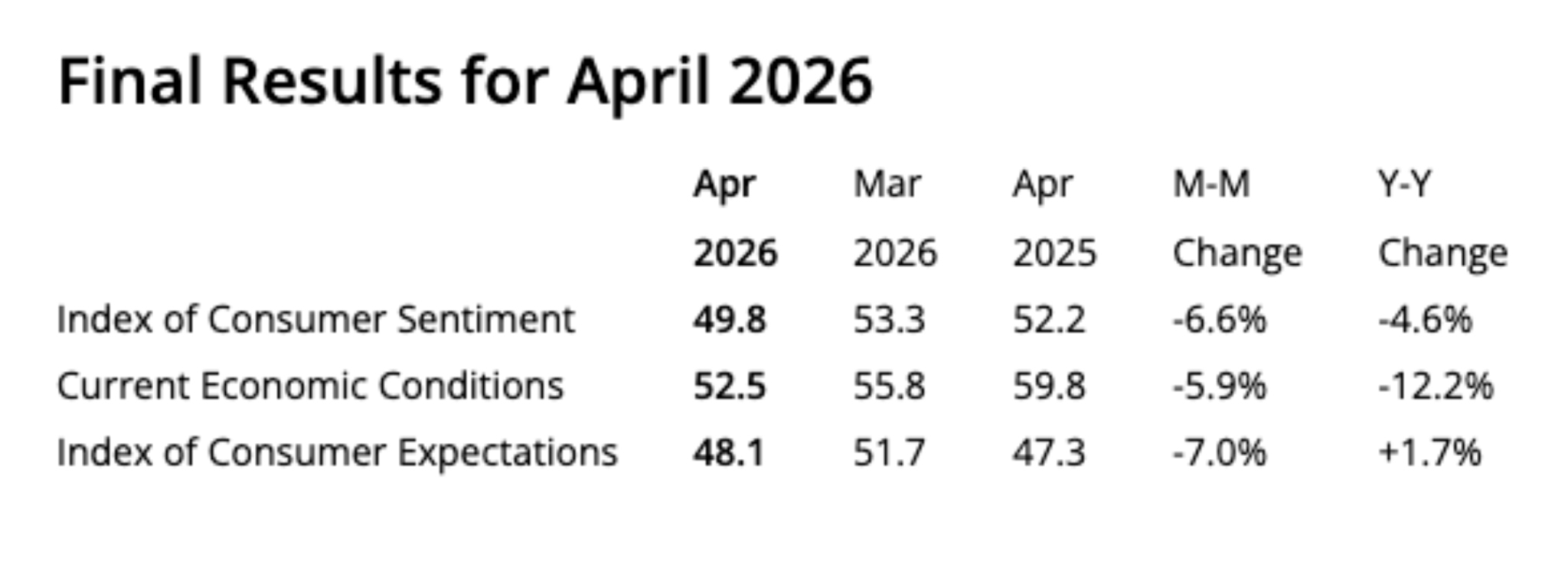
However, core inflation has yet to see significant pass-through from energy prices, and long-term inflation expectations remain stable. This "hot headline, cool core" situation exemplifies the Fed’s textbook response: holding steady on rates while shifting toward a more hawkish tone in its rhetoric.
Chicago Fed President Austan Goolsbee, a voting member of the FOMC, warned as early as April 7 of a worst-case scenario: inflationary pressures from high oil prices, combined with persistent tariff effects, could cause U.S. consumers to lose confidence entirely, leading to a stagflationary recession.
However, while the window for verifying inflation data remains open, the Fed is unlikely to take a decisive step in its posture. Behind the consensus to hold rates steady in the short term, Wall Street's forecasts for the Fed's medium-term trajectory show unprecedented divergence.
Michael Feroli, Chief U.S. Economist at JPMorgan, believes the Fed will keep rates unchanged through the remainder of 2026, with a potential 25-basis-point hike not coming until the third quarter of 2027. Conversely, Bank of America still expects the Fed to cut rates twice this year.
Will there be further rate cuts this year?
The current probability of a rate cut has been placed in an extremely delicate neutral range by two-sided market pricing; while a cut remains possible, the timing of its initiation is highly likely to be delayed.
A Reuters survey conducted from April 17 to 21 covering 103 economists showed that 71 expect at least one rate cut this year, with the median forecast calling for one cut—consistent with the dot plot released by the Federal Reserve last month. However, nearly one-third of economists expect the Fed to keep rates unchanged for the entire year, a proportion that has nearly doubled since the previous survey.
On one hand, the duration of the energy shock remains the greatest unknown. LSEG data indicates that markets expect less than a standard 25-basis-point cut by December, whereas before the outbreak of the conflict between the U.S. and Iran, markets had priced in at least two cuts.
Some analysts also point out that even if the rally in oil prices slows, overall price levels remain elevated, making a rate cut inappropriate in the short term; the FedWatch tool also shows the probability of rates remaining unchanged at year-end is nearly 70%.
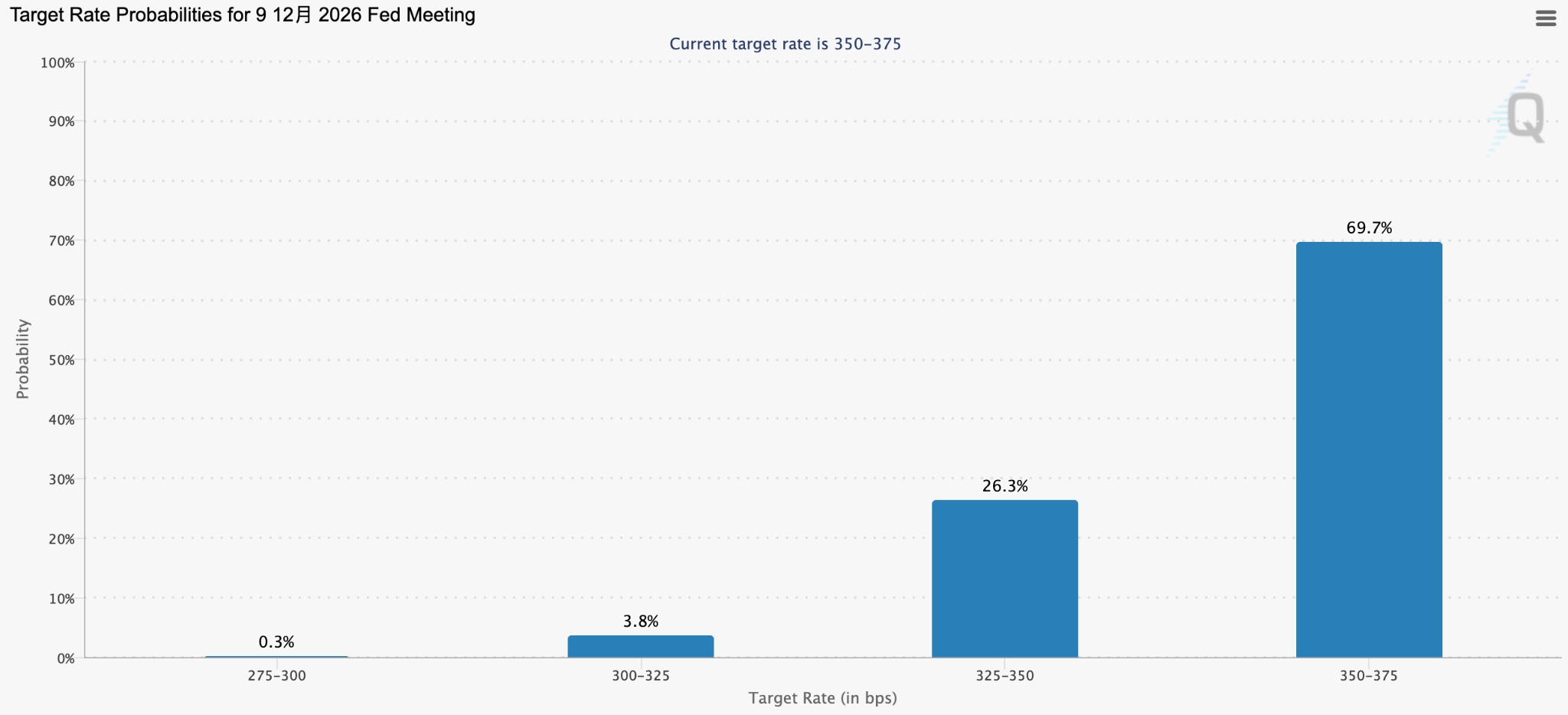
[Probability of a rate cut in December 2026, Source: FedWatch]
In its March FOMC statement, the Federal Reserve explicitly stated, "the impact of the Middle East situation on the U.S. economy remains uncertain."
On the other hand, the transition in Fed leadership is injecting new variables into the rate-cut narrative. Jefferies global economist Kumar believes a Warsh-led Fed would be more "dovish" on interest rates, expecting the Fed to cut rates twice this year.
However, Deutsche Bank economists warn that Warsh is just a single policymaker; even if he advocates for rapid cuts, he would still need to persuade the policy committee, and it will take time after he takes office to build trust and credibility within the committee.
Barclays' analysis serves as the current median reference for Wall Street: amid widespread uncertainty regarding inflation trends, the Fed is likely to adopt a wait-and-see stance; if inflation recedes as expected, the Fed will gain sufficient confidence around September to begin easing policy.
From data points to official rhetoric and the leadership transition, the Fed's future path is layered with multiple unknowns beyond what is currently certain; the fate of transit through the Strait of Hormuz may ultimately drive the global inflation inflection point, while the new chair taking office in May will determine the dovish or hawkish character of the Fed's lineup for the next economic cycle.
Recommended Articles


