


Dow Jones Industrial Average treads water on Tuesday as investors await key data
- The Dow Jones failed to make meaningful headway on Tuesday.
- A trio of US data prints loom overhead throughout the week's back half.
- With hopes of a September rate cut pinned, traders will be hoping for easing data.
The Dow Jones Industrial Average (DJIA) went nowhere fast on Tuesday, sticking close to the day’s opening bids as investors shuffle their feet ahead of a hectic US data schedule in the back half of the trading week. Wednesday will be kicking things off with a fresh print of S&P Global Purchasing Managers Index (PMI) activity survey figures. Markets are expecting a lopsided print with a slight uptick in the Manufacturing PMI and a deceleration in the Services PMI component.
Thursday will follow up with an update to US quarterly Gross Domestic Product (GDP) in Q2. Friday will close out the trading week and the US data docket with Personal Consumption Expenditure Price Index (PCE) inflation figures.
With markets broadly pricing in a September rate cut as a sure thing, investors will be looking for softening data from the US, specifically a continued easing in PCE inflation. According to the CME’s FedWatch Tool, rate markets are pricing in nearly 100% odds of at least a quarter-point rate trim when the Federal Open Market Committee (FOMC) meets on September 18th.
Dow Jones news
Despite trading relatively flat on Tuesday, most of the Dow Jones’ constituent securities are tilted towards the downside, with nearly two-thirds of the index’s listed stocks seeing red. However, steeper gains in key sectors are keeping headline index tickers in the midrange.
Boeing Co. (BA) rallied 3.5% on Tuesday to $185.18 per share, while Amazon.com Inc. (AMZN) climbed 2.67% to $187.41 per share. Walt Disney Co. (DIS) fell -3.8% to $90.53 per share as India’s Competition Commission weighs a move to block Disney’s merging with Reliance. A merger between the two media companies would represent a 40% market share of television advertising in India. Teamsters at Disneyland also voted to authorize a strike in order to force Disney to the negotiating table to improve worker conditions, which could significantly impact Disney’s operations.
Dow Jones technical outlook
The Dow Jones appears to have pumped the brakes on a near-term decline from record highs set at 41,371.38 last week, however it could be a while yet before a bullish rebound takes shape. Price action continues to trade well above the 200-day Exponential Moving Average (EMA) at 37,882.57, while a pullback to the 50-day EMA at 39,449.38 could see a renewed push back into the topend.
Dow Jones daily chart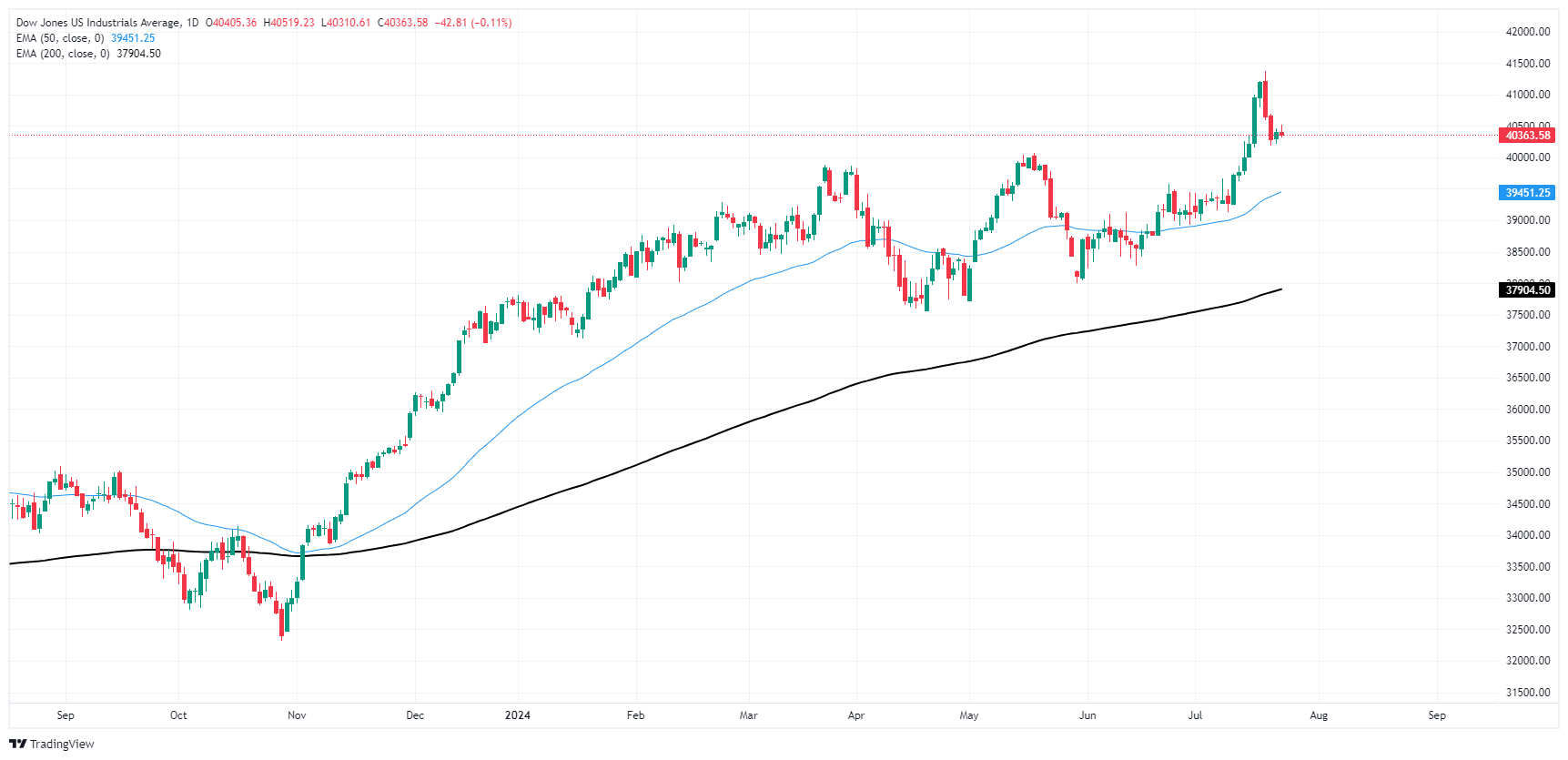
Dow Jones FAQs
The Dow Jones Industrial Average, one of the oldest stock market indices in the world, is compiled of the 30 most traded stocks in the US. The index is price-weighted rather than weighted by capitalization. It is calculated by summing the prices of the constituent stocks and dividing them by a factor, currently 0.152. The index was founded by Charles Dow, who also founded the Wall Street Journal. In later years it has been criticized for not being broadly representative enough because it only tracks 30 conglomerates, unlike broader indices such as the S&P 500.
Many different factors drive the Dow Jones Industrial Average (DJIA). The aggregate performance of the component companies revealed in quarterly company earnings reports is the main one. US and global macroeconomic data also contributes as it impacts on investor sentiment. The level of interest rates, set by the Federal Reserve (Fed), also influences the DJIA as it affects the cost of credit, on which many corporations are heavily reliant. Therefore, inflation can be a major driver as well as other metrics which impact the Fed decisions.
Dow Theory is a method for identifying the primary trend of the stock market developed by Charles Dow. A key step is to compare the direction of the Dow Jones Industrial Average (DJIA) and the Dow Jones Transportation Average (DJTA) and only follow trends where both are moving in the same direction. Volume is a confirmatory criteria. The theory uses elements of peak and trough analysis. Dow’s theory posits three trend phases: accumulation, when smart money starts buying or selling; public participation, when the wider public joins in; and distribution, when the smart money exits.
There are a number of ways to trade the DJIA. One is to use ETFs which allow investors to trade the DJIA as a single security, rather than having to buy shares in all 30 constituent companies. A leading example is the SPDR Dow Jones Industrial Average ETF (DIA). DJIA futures contracts enable traders to speculate on the future value of the index and Options provide the right, but not the obligation, to buy or sell the index at a predetermined price in the future. Mutual funds enable investors to buy a share of a diversified portfolio of DJIA stocks thus providing exposure to the overall index.
Recommended Articles


