


Dow Jones Industrial Average churns on Wednesday as investors wait for signs
- Dow Jones falls back below 38,400 and then recovers as risk appetite wobbles.
- US Durable Goods Orders missed forecasts, but still climbed.
- US GDP, PCE inflation are key data highlights for the rest of the week.
The Dow Jones Industrial Average (DJIA) stumbled on Wednesday, falling from recent highs near 38,550.00 as investors ease off of Tuesday’s risk appetite. The index recovered heading into the late American trading session as US data continues to vex financial markets that remain overwhelmingly focused on rate cuts from the US Federal Reserve.
US Durable Goods Orders in March failed to meet modelled forecasts, with Durable Goods Orders Excluding Defense rising 2.3% versus the forecast 2.5%, and Durable Goods Orders Excluding Transportation rising only 0.2% against the forecast 0.3%. Despite missing forecasts, both figures beat their previous prints handily (1.5% revised from 2.2% and 0.1% revised from 0.5%, respectively). Headline Durable Goods Orders rose 2.6% MoM compared to the previous month’s 0.7% (revised from 1.4%).
The uptick in US activity throws a wrench in market hopes for an accelerated path towards rate cuts that were reignited on Tuesday after the US’ Purchasing Managers Index (PMI) figures missed expectations. Markets will now to turn to Thursday’s US Gross Domestic Product (GDP) and Friday’s US Personal Consumption Expenditure (PCE) inflation. US GDP is expected to ease to 2.5% for the annualized first quarter from the previous 3.4%, while Core US PCE Price Index inflation is expected to hold steady at 0.3% MoM in March.
Dow Jones news
The Dow Jones is recovering from an early US session dip, which briefly drove it back below 38,300.00. The major equity index is now churning near 38,500.00. Earnings season is in full swing, with Meta Platforms (META), IBM (IBM), and Chipotle (CMG) all reporting earnings after market close on Wednesday. Corporate earnings are helping to bolster equity valuations, but batter rate-cut hopefuls continue to weigh on investors’ outlook, crimping recent gains.
Close to half of the individual equities that make up the Dow Jones are currently in the red for Wednesday, with the loss leaders including Boeing Co. (BA) and Home Depot Inc. (HD), down 2.75% and 1.76%, respectively at the time of writing. Topside in the DJIA goes to Coca-Cola Co. (KO) and Intel Corp. (INTC), each up around 1.3% on the day.
Dow Jones technical outlook
The Dow Jones set an early high for Wednesday at 38,558.96, with the day’s low etched in at 38,925.14. Overall momentum is still tilting into the bullish side, with the index up 2.35% from the last swing low near 37,500.00.
The Dow Jones is set to break a three-day winning streak as the major index grapples on the softly down side. The DJIA remains hamstung in a tricky midrange between the last major swing high approaching 40,000.00 and the 200-day Exponential Moving Average (EMA) providing major technical support from 36,720.70.
Dow Jones five minute chart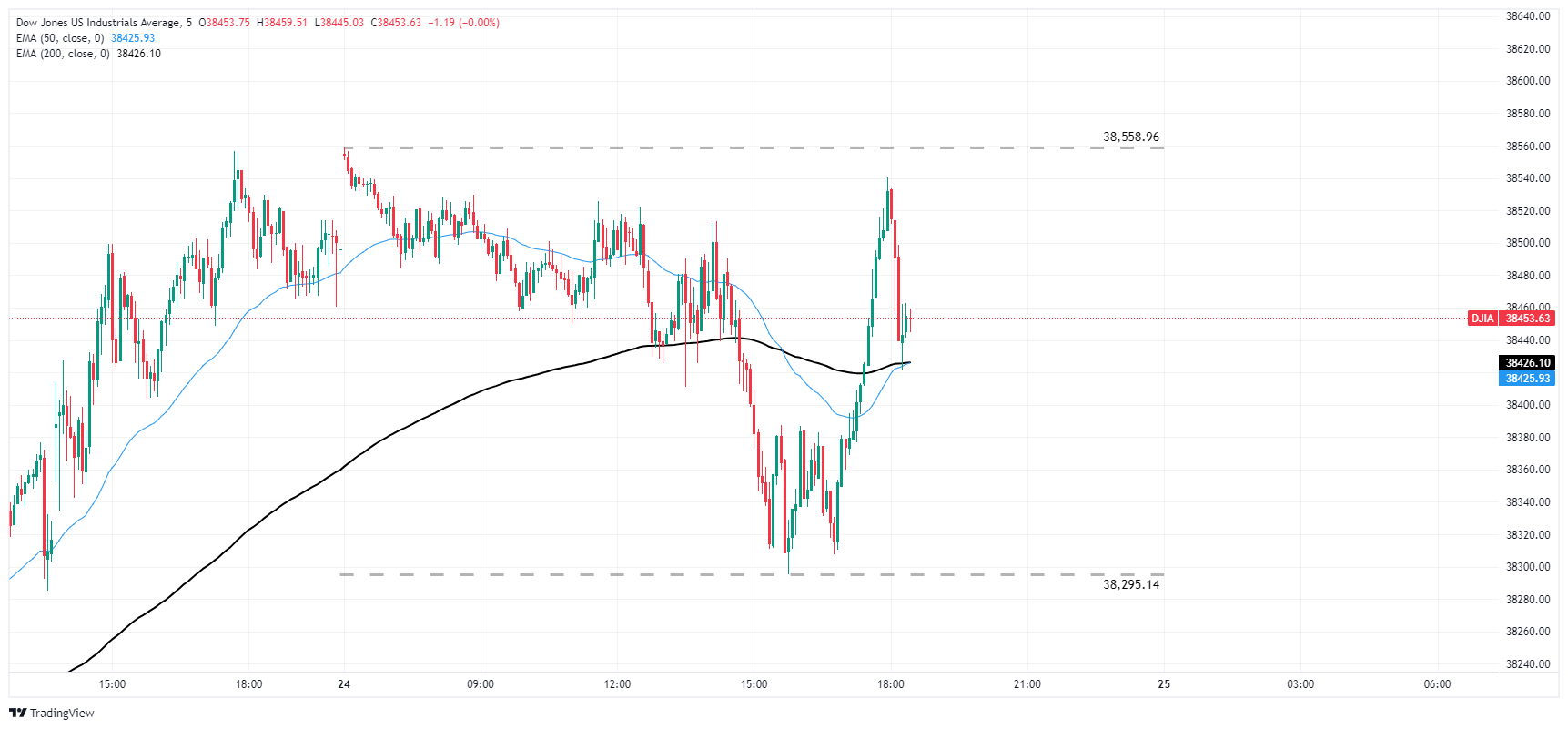
Dow Jones daily chart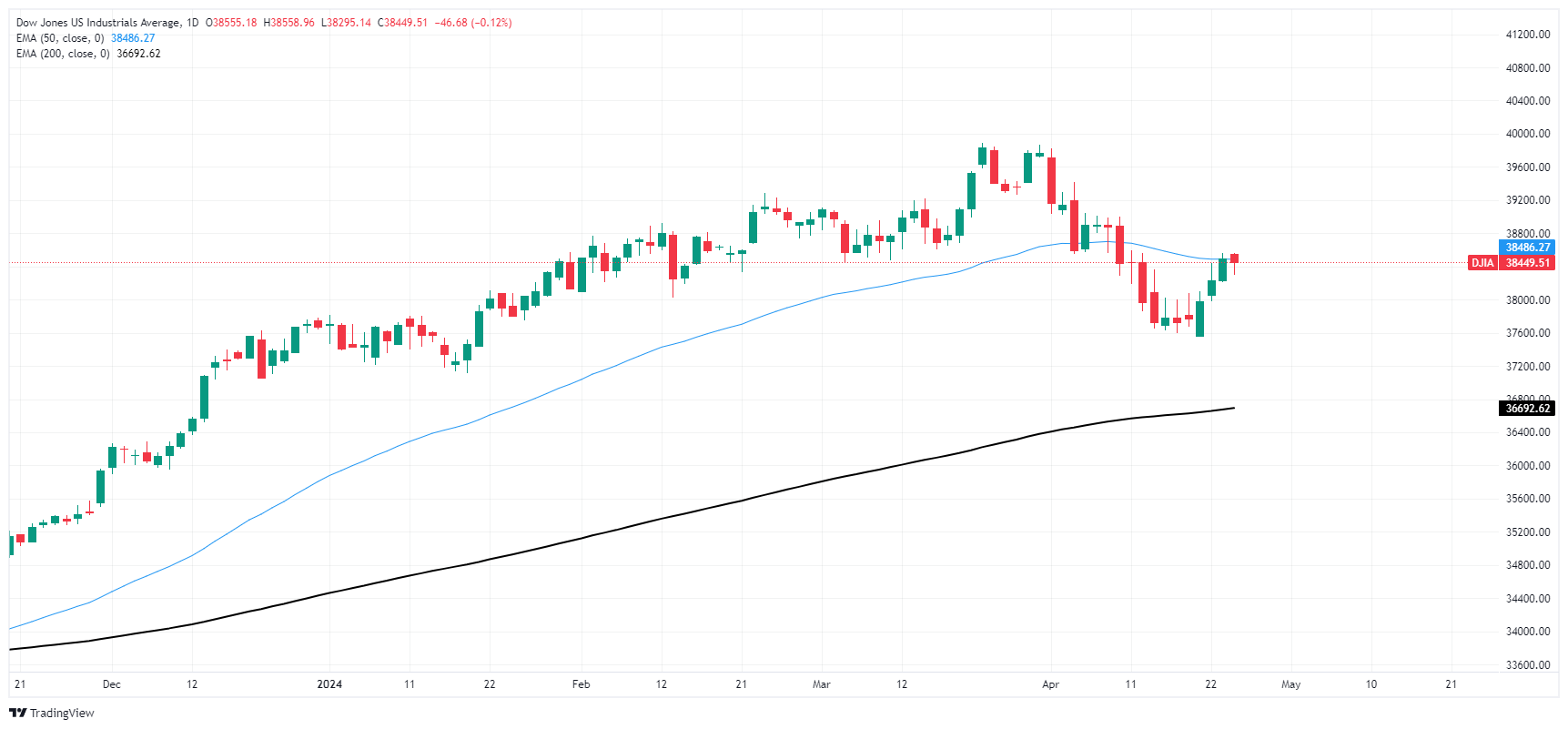
Dow Jones FAQs
The Dow Jones Industrial Average, one of the oldest stock market indices in the world, is compiled of the 30 most traded stocks in the US. The index is price-weighted rather than weighted by capitalization. It is calculated by summing the prices of the constituent stocks and dividing them by a factor, currently 0.152. The index was founded by Charles Dow, who also founded the Wall Street Journal. In later years it has been criticized for not being broadly representative enough because it only tracks 30 conglomerates, unlike broader indices such as the S&P 500.
Many different factors drive the Dow Jones Industrial Average (DJIA). The aggregate performance of the component companies revealed in quarterly company earnings reports is the main one. US and global macroeconomic data also contributes as it impacts on investor sentiment. The level of interest rates, set by the Federal Reserve (Fed), also influences the DJIA as it affects the cost of credit, on which many corporations are heavily reliant. Therefore, inflation can be a major driver as well as other metrics which impact the Fed decisions.
Dow Theory is a method for identifying the primary trend of the stock market developed by Charles Dow. A key step is to compare the direction of the Dow Jones Industrial Average (DJIA) and the Dow Jones Transportation Average (DJTA) and only follow trends where both are moving in the same direction. Volume is a confirmatory criteria. The theory uses elements of peak and trough analysis. Dow’s theory posits three trend phases: accumulation, when smart money starts buying or selling; public participation, when the wider public joins in; and distribution, when the smart money exits.
There are a number of ways to trade the DJIA. One is to use ETFs which allow investors to trade the DJIA as a single security, rather than having to buy shares in all 30 constituent companies. A leading example is the SPDR Dow Jones Industrial Average ETF (DIA). DJIA futures contracts enable traders to speculate on the future value of the index and Options provide the right, but not the obligation, to buy or sell the index at a predetermined price in the future. Mutual funds enable investors to buy a share of a diversified portfolio of DJIA stocks thus providing exposure to the overall index.
Recommended Articles


