

Why Litecoin Won’t Break Out—Analytics Firm Reveals the Cause

Source Newsbtc

The market intelligence platform IntoTheBlock has explained the reason why Litecoin has been stuck inside the $90 to $130 range recently.

Litecoin Exchange Netflow Has Followed An Interesting Pattern Recently

In a new post on X, the analytics firm IntoTheBlock has discussed about a pattern that the Litecoin Exchange Netflow has shown during the recent phase of consolidation in the asset’s price.

The “Exchange Netflow” here refers to an on-chain indicator that keeps track of the net amount of the cryptocurrency that’s entering into or exiting the wallets associated with all centralized exchanges.

When the value of this metric is positive, it means the inflows for these platforms outweigh the outflows. Generally, one of the main reasons why investors would deposit their coins into the custody of exchanges is for selling-related purposes, so this kind of trend can be a bearish sign for LTC’s price.

On the other hand, the indicator being under zero suggests the holders are withdrawing a net number of tokens from the exchanges. Such a trend can be a sign that the investors are in a phase of accumulation, which can naturally have a bullish impact on the asset.

Now, here is the chart shared by IntoTheBlock, which shows the trend in the Litecoin Exchange Netflow over the last few months:
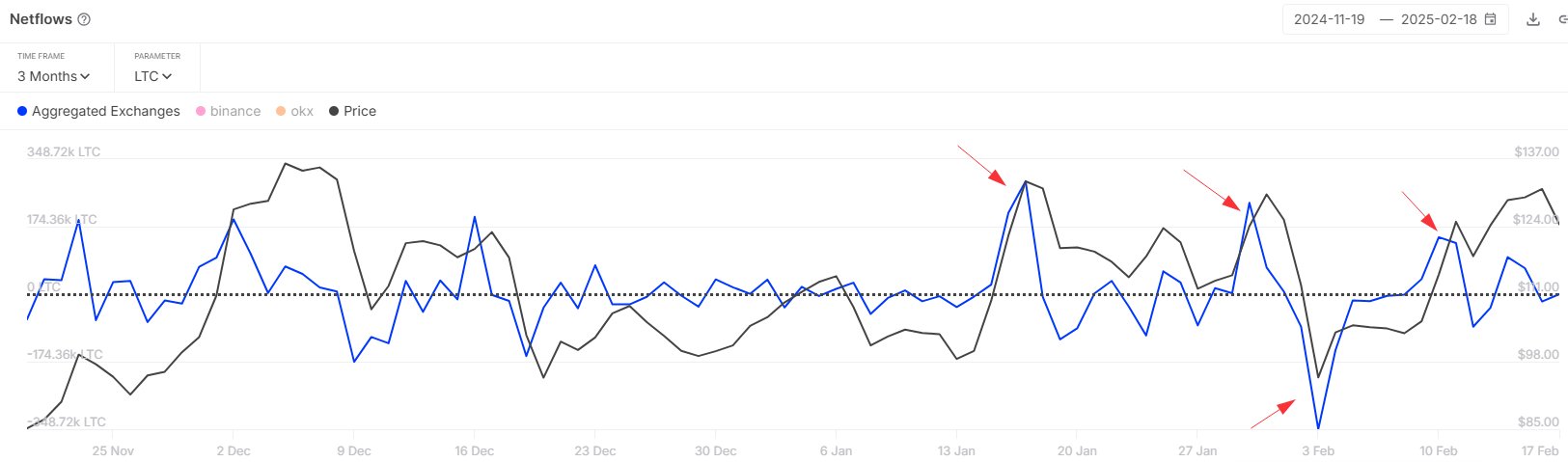
Litecoin Exchange Netflow

As is visible in the above graph, the LTC Exchange Netflow has displayed an interesting pattern during the last couple of months. It would seem that deposits have ramped up when the cryptocurrency has gone up to retest the $130 upper level of its recent consolidation range, while outflows have occurred during dips.

“Data suggests Litecoin traders are capitalizing on price swings, ramping up withdrawals and deposits to sell on spikes and buy on dips,” notes the analytics firm. “This pattern has helped keep LTC trading in a range between 90 and 130 for about three months.”

Given this trend, it’s possible that the cryptocurrency would have trouble escaping out of this range, so as long as the whales continue to trade in this manner. Thus, the Exchange Netflow could be kept an eye on, to check when trader behavior finally shifts.

At present, Litecoin is trading quite near the upper level of the sideways channel, but the Exchange Netflow is still at a neutral level (that is, the inflows are balancing out the outflows). It only remains to be seen whether this is a sign that the whales are switching things up, or if it’s only a temporary deviation.

LTC Price

Most of the cryptocurrency sector has found the past day to be a red one, but Litecoin has shown divergence as its price has jumped almost 3%, reaching the $127 mark.

Litecoin Price Chart
Disclaimer: For information purposes only. Past performance is not indicative of future results.
placeholder
Fed hike odds near 90% into Wednesday's decision — how to trade the dollar, gold and the S&P 500A 0.3% monthly core CPI print has lifted the market-implied probability of a 25bp Fed hike on 16 September to roughly 86.5% ~ 90%, which would be the first increase since July 2023. Here is the decision timeline, the pricing versus the forecasts, both scenarios, and the key levels for the dollar, gold and the S&P 500.
Author  Suzie
Sep 14, Mon
A 0.3% monthly core CPI print has lifted the market-implied probability of a 25bp Fed hike on 16 September to roughly 86.5% ~ 90%, which would be the first increase since July 2023. Here is the decision timeline, the pricing versus the forecasts, both scenarios, and the key levels for the dollar, gold and the S&P 500.
placeholder
Bitcoin falls below $75,000 as the CLARITY Act fails in the Senate — what the vote means for cryptoThe US Senate blocked the Digital Asset Market CLARITY Act in a 49-50 procedural vote, sending Bitcoin briefly below $75,000 — its biggest one-day drop since June. Ethereum fell more than 8%, Coinbase slid 10% and $75 billion of crypto market value evaporated. Here is what the vote was, why it failed, and the levels that matter now.
Author  Suzie
Sep 16, Wed
The US Senate blocked the Digital Asset Market CLARITY Act in a 49-50 procedural vote, sending Bitcoin briefly below $75,000 — its biggest one-day drop since June. Ethereum fell more than 8%, Coinbase slid 10% and $75 billion of crypto market value evaporated. Here is what the vote was, why it failed, and the levels that matter now.
placeholder
Dollar index tops 100 for the first time since July as the Fed's hawkish dot plot sinks inThe U.S. dollar index broke back above 100 for the first time since 31 July after the Fed delivered its first rate hike since 2023, with the dot plot showing 16 of 18 officials expect at least one more increase this year. Here are the levels that matter for DXY, the currencies feeling it most, and what to watch next.
Author  Irene Q.
Sep 17, Thu
The U.S. dollar index broke back above 100 for the first time since 31 July after the Fed delivered its first rate hike since 2023, with the dot plot showing 16 of 18 officials expect at least one more increase this year. Here are the levels that matter for DXY, the currencies feeling it most, and what to watch next.
placeholder
Gold rebounds to near $4,350 on weaker US Dollar, falling oil pricesGold price (XAU/USD) rises to near $4,345 during the early Asian session on Friday. The precious metal rebounds from a six-week low amid falling oil prices and a weaker US Dollar (USD). Traders continue to assess the latest Federal Reserve (Fed) rate hike and policy cues.
Author  FXStreet
Yesterday 01: 32
Gold price (XAU/USD) rises to near $4,345 during the early Asian session on Friday. The precious metal rebounds from a six-week low amid falling oil prices and a weaker US Dollar (USD). Traders continue to assess the latest Federal Reserve (Fed) rate hike and policy cues.
placeholder
US to delay new "overcapacity" tariffs on China — what the pause means for trade, inflation and the dollarWashington is expected to hold off announcing new tariffs over Chinese "overcapacity" until after the 24 September summit, according to Bloomberg. The postponed plan would have added 7.5% to Chinese goods, taking second-term US tariffs to around 20%. Here is what is on the table, and what a deal versus no deal would mean for the yuan, Hong Kong equities and the dollar.
Author  Mitrade
22 hours ago
Washington is expected to hold off announcing new tariffs over Chinese "overcapacity" until after the 24 September summit, according to Bloomberg. The postponed plan would have added 7.5% to Chinese goods, taking second-term US tariffs to around 20%. Here is what is on the table, and what a deal versus no deal would mean for the yuan, Hong Kong equities and the dollar.
goTop
quote