

Chainlink (LINK) price fails another $20 breakout test as BTC stagnation drains market momentum

Source Fxstreet
  • Chainlink (LINK) price has failed to breach the $20 resistance over the past week since forming a local bottom at $17 on February 10.
  • Chainlink’s Top 1,000 largest investors acquired LINK tokens worth over $28 million since February 3, capitalizing on declining prices. 
  • Despite a 1% decline on Monday, seven of the top ten largest projects in the Real World Asset (RWA) protocols maintain sizable gains in the seven-day timeframe.

Chainlink (LINK) price has plunged 6% in the last 24 hours hitting $17.8 as bulls failed another attempt to breach the $20 resistance. On-chain data trends suggest steady whale demand could keep LINK price above the $17 local bottom formed in the near term. 

Chainlink (LINK) price down 6% as macro tailwinds trigger volatility 

Chainlink (LINK) has benefitted from growing institutional interest in Real World Asset (RWA) tokenization, a sector that has surged in adoption over recent weeks.

As a key provider of oracle price feeds for on-chain financial instruments, Chainlink’s role in the ecosystem remains pivotal, but its price action has been heavily influenced by broader market trends.

The altcoin started the week on a strong note, buoyed by bullish sentiment surrounding the United States (US) Securities and Exchange Commission’s (SEC) acknowledgment of new ETF filings for Dogecoin and Ripple (XRP).

However, Bitcoin’s failure to sustain upward momentum has stifled market-wide gains. 

BTC dropped to a three-day low of $95,800 on Monday, with investors reallocating capital into select altcoins, including Chainlink.

This BTC stagnation has hampered broader market sentiment, preventing a sustained breakout above $20 for LINK.
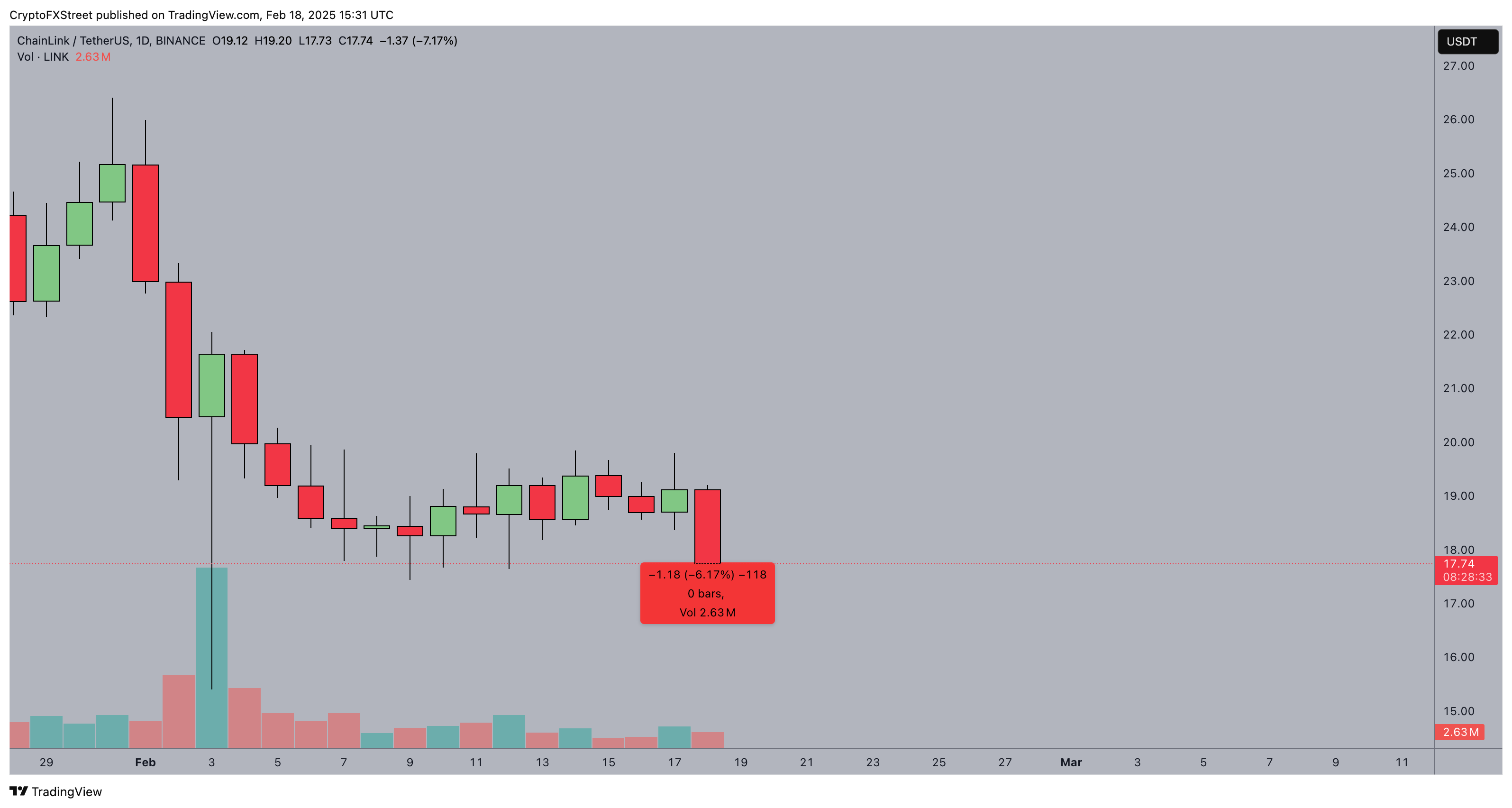
Chainlink (LINK) Price Action | Source: TradingView

Chainlink (LINK) Price Action | Source: TradingView

As a result, Chainlink price sharply rejected the $20 resistance level on Monday, plunging 6% to reach $17.8 at press time on Tuesday.

The downturn suggests that in the absence of fresh capital inflows—whether in the form of renewed BTC demand or increased stablecoin issuance—altcoins like LINK may continue experiencing heightened volatility.

The current market environment favors capital rotation, with speculative traders cycling liquidity among different assets for short-term gains, while more strategic investors remain on the sidelines. Declining trading volumes reinforce this cautious stance, as liquidity constraints weigh on LINK's ability to stage a breakout.

Whales spotted buying $28M LINK amid RWA sector rally

Following its latest failed breakout attempt, Chainlink has entered a notable 6% correction, but on-chain data suggests that large investors remain actively engaged in accumulating LINK.

Whale accumulation could provide a crucial support mechanism, mitigating further downside risk.

Blockchain analytics firm Santiment reports that top holders—measured by the net balance of the 1,000 largest Chainlink wallets—have steadily increased their holdings since the start of February. Notably, LINK whales added 1.6 million LINK tokens between February 3 and February 17, raising their total balance from 669.9 million to 671.5 million tokens.

Valued at current prices of $18 per token, this whale has effectively spent $28 million buying the dip over the last two weeks. 
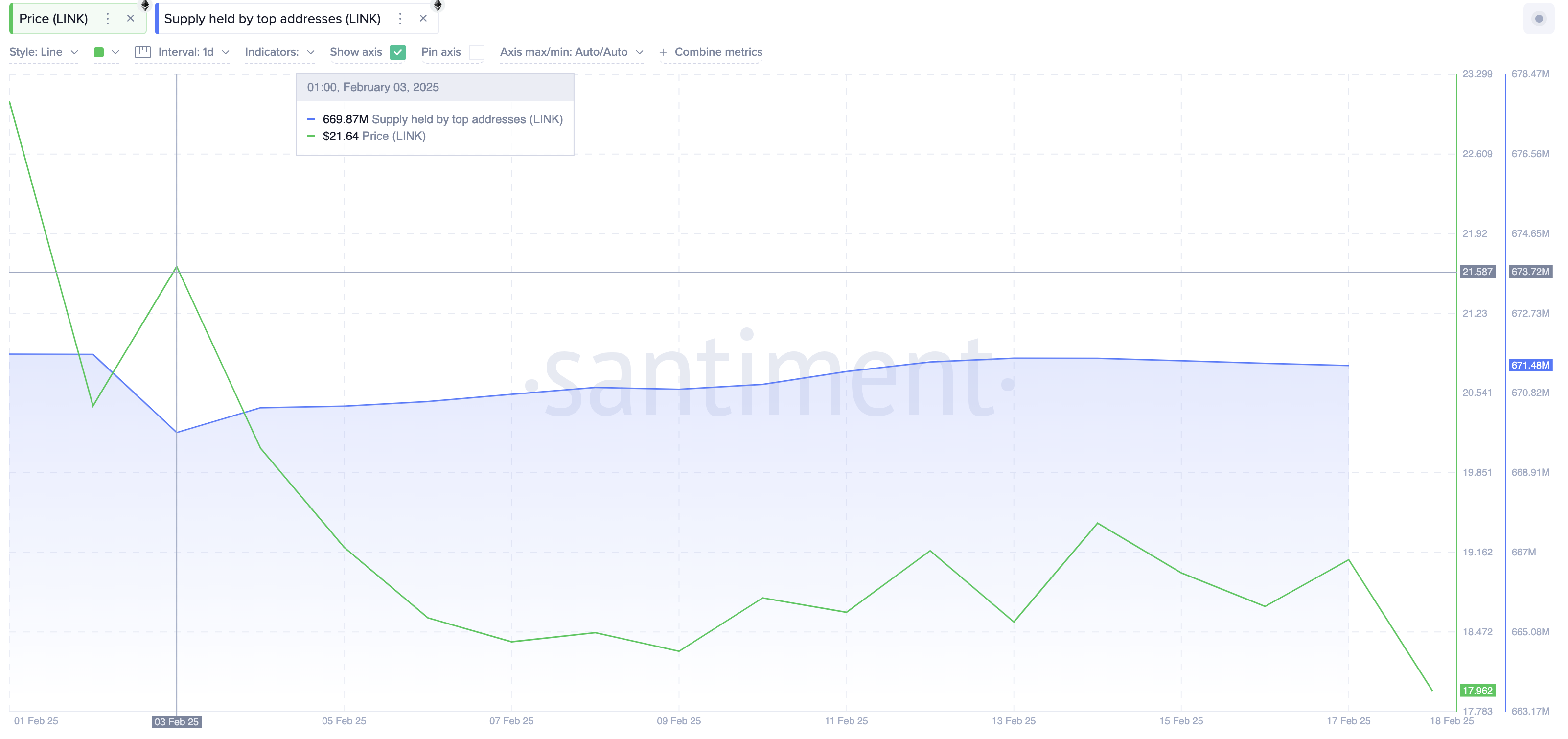
Chainlink (LINK) Top 1,000 Holders’ Wallet Balances | Source: TradingView

Chainlink (LINK) Top 1,000 Holders’ Wallet Balances | Source: TradingView

Historically, sustained whale buying pressure has acted as a stabilizing force in Chainlink’s price.

Whales capitalizing on declining prices to strengthen their positions often signal a belief in long-term upside potential. 

As seen in previous accumulation cycles, whale support can prevent excessive drawdowns, particularly in times of market inactivity.

With seven of the top ten Real World Asset protocols maintaining gains over the past week, Chainlink’s fundamental relevance in tokenized asset pricing could further bolster investor confidence.

Beyond that, the persistent whale demand could provide a much-needed buffer against negative social sentiment, discouraging aggressive short selling and limiting the severity of downward movements. 

While broader market trends will continue to shape short-term price action, the $28 million inflows from the top 1,000 holders over the last two weeks suggest that Chainlink remains a preferred asset among large investors, reinforcing its long-term growth prospects.

Chainlink Price Forecast: $17 support set to hold steady 

Chainlink (LINK) price has dropped 6.85% in the past 24 hours, currently trading at $17.81, testing a crucial support level.

The daily chart reveals that despite the bearish engulfing candlestick, LINK remains above the 200-day simple moving average (SMA) at $16.23, which has historically provided strong support. Meanwhile, the 50-day SMA at $21.31 looms as resistance, indicating that bulls must regain momentum to prevent extended consolidation.
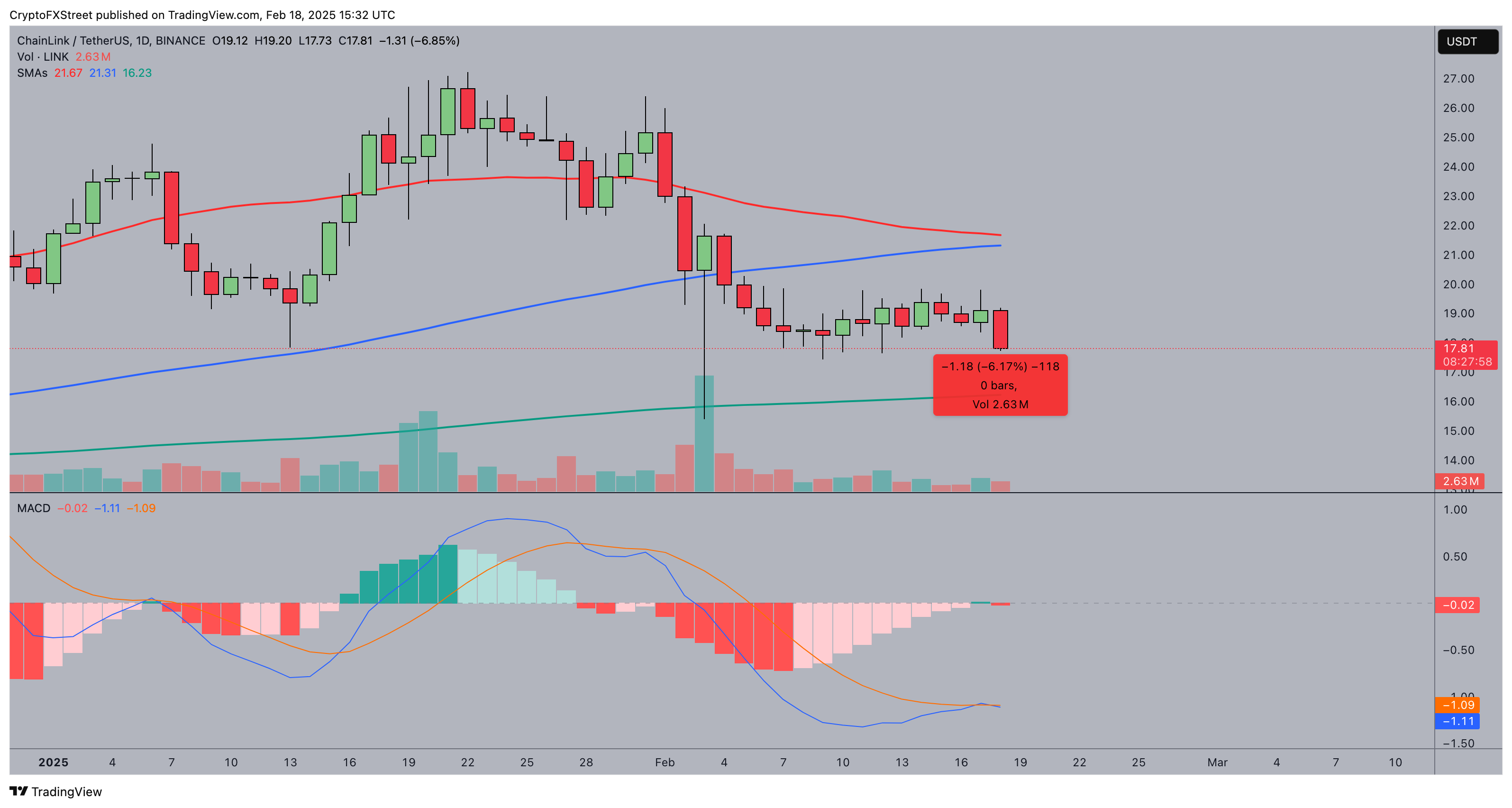
Chainlink Price Forecast: (LINKUSD)

Chainlink Price Forecast: (LINKUSD)

The MACD indicator shows intensifying bearish momentum, with the MACD line crossing below the signal line.

However, the histogram's declining negative bars suggest waning selling pressure.

If buyers step in at the $17 support zone, LINK could consolidate and push toward the $19.20 resistance before challenging the psychological $20 level once again.

On the contrary, a breakdown below $17 with increasing volume could see LINK extend losses toward $16, aligning with the 200-day SMA.

The next few trading sessions will be critical in determining whether whale accumulation can sustain price stability or if broader market weakness pulls LINK lower.

For now, cautious optimism prevails, with $17 remaining a key level to watch.


Disclaimer: For information purposes only. Past performance is not indicative of future results.
placeholder
U.S. November Nonfarm Payrolls: What Does the Rare "Weak Jobs, Strong Economy" Mix Mean for U.S. Equities?1. IntroductionAfter retreating from the late-October highs, U.S. equities embarked on a bottoming rebound in mid-to-late November, a trend driven by the interplay of multiple factors. That said, it i
Author  TradingKey
5 hours ago
1. IntroductionAfter retreating from the late-October highs, U.S. equities embarked on a bottoming rebound in mid-to-late November, a trend driven by the interplay of multiple factors. That said, it i
placeholder
Senate Delays Crypto Market Structure Hearings to Early 2026The Senate Banking Committee has postponed cryptocurrency market structure hearings until 2026, citing ongoing bipartisan negotiations.
Author  Mitrade
10 hours ago
The Senate Banking Committee has postponed cryptocurrency market structure hearings until 2026, citing ongoing bipartisan negotiations.
placeholder
Bitcoin Slides 5% as Sellers Lean In — Can BTC Reclaim $88,000?Bitcoin has dropped back below $88,000 after rolling over from $90,500, with price still trading under the 100-hour Simple Moving Average. The sell-off found a floor at $85,151, and BTC is now consolidating near that base, but rebounds are facing pressure from a bearish trend line around $89,000. Bulls need to retake $88,000–$89,000 to ease downside risk; failure to do so keeps $85,500–$85,000 and then $83,500 in play, with $80,000 as the deeper “line in the sand.” Bitcoin (BTC) is back in damage-control mode after a sharp pullback wiped out recent gains. The price failed to reclaim the $90,000–$90,500 band, rolled over, and slid through $88,500 before briefly dipping under $87,000. Buyers did show up around $85,000, but the rebound so far looks more like stabilization than a clear trend reversal. Bitcoin dips hard, finds a bid near $85,000(h3) BTC’s latest move lower began when it couldn’t build follow-through above $90,000 and $90,500. Once that upside stalled, sellers took control and pushed price down through $88,500. The slide accelerated enough to spike below $87,000, but the market didn’t free-fall. Bulls defended the $85,000 zone, printing a low at $85,151. Since then, Bitcoin has been consolidating below the 23.6% Fibonacci retracement of the drop from the $93,560 swing high to the $85,151 low — a clue that the bounce is still shallow and that sellers haven’t fully backed off yet. Structurally, BTC is still on the back foot: It’s trading below $88,000, and It remains below the 100-hour Simple Moving Average, keeping short-term trend pressure pointed downward. Resistance is layered, and $89,000 is the problem area(h3) If bulls try to turn this into a recovery, they’ll have to climb through multiple ceilings in quick succession. First, BTC faces resistance around $87,150, followed by a more meaningful barrier near $87,500. From there, the market’s attention snaps back to $88,000 — the level BTC just lost and now needs to reclaim. A close back above $88,000 would improve the tone, but it doesn’t solve the bigger issue: there’s a bearish trend line on the hourly BTC/USD chart (Kraken feed) with resistance near $89,000, which also lines up with the next technical hurdle. If BTC can push through $89,000 and hold, the rebound could extend toward $90,000, with follow-through targets at $91,000 and $91,500. But until price clears that $88,000–$89,000 zone, rallies are at risk of being sold rather than chased. If BTC fails to reclaim resistance, the downside path is clear(h3) The near-term bear case is simple: if Bitcoin can’t climb back above the $87,000 area and keep traction, sellers may attempt another leg lower. Support levels line up like this: Immediate support: $85,500 First major support: $85,000 Next support: $83,500 Then $82,500 in the near term Below that, the major “don’t break this” level is still $80,000. If BTC slips under $80,000, the risk of acceleration to the downside increases significantly — not because it’s magic, but because it’s the kind of psychological and structural level that tends to trigger forced de-risking. Indicators: momentum still leans bearish(h3) The intraday indicators aren’t offering much comfort yet: Hourly MACD is losing pace in the bearish zone. Hourly RSI remains below 50, suggesting sellers still have the upper hand on short timeframes. So while the $85,000 defense held for now, the market hasn’t flipped bullish — it’s just stopped bleeding.
Author  Mitrade
13 hours ago
Bitcoin has dropped back below $88,000 after rolling over from $90,500, with price still trading under the 100-hour Simple Moving Average. The sell-off found a floor at $85,151, and BTC is now consolidating near that base, but rebounds are facing pressure from a bearish trend line around $89,000. Bulls need to retake $88,000–$89,000 to ease downside risk; failure to do so keeps $85,500–$85,000 and then $83,500 in play, with $80,000 as the deeper “line in the sand.” Bitcoin (BTC) is back in damage-control mode after a sharp pullback wiped out recent gains. The price failed to reclaim the $90,000–$90,500 band, rolled over, and slid through $88,500 before briefly dipping under $87,000. Buyers did show up around $85,000, but the rebound so far looks more like stabilization than a clear trend reversal. Bitcoin dips hard, finds a bid near $85,000(h3) BTC’s latest move lower began when it couldn’t build follow-through above $90,000 and $90,500. Once that upside stalled, sellers took control and pushed price down through $88,500. The slide accelerated enough to spike below $87,000, but the market didn’t free-fall. Bulls defended the $85,000 zone, printing a low at $85,151. Since then, Bitcoin has been consolidating below the 23.6% Fibonacci retracement of the drop from the $93,560 swing high to the $85,151 low — a clue that the bounce is still shallow and that sellers haven’t fully backed off yet. Structurally, BTC is still on the back foot: It’s trading below $88,000, and It remains below the 100-hour Simple Moving Average, keeping short-term trend pressure pointed downward. Resistance is layered, and $89,000 is the problem area(h3) If bulls try to turn this into a recovery, they’ll have to climb through multiple ceilings in quick succession. First, BTC faces resistance around $87,150, followed by a more meaningful barrier near $87,500. From there, the market’s attention snaps back to $88,000 — the level BTC just lost and now needs to reclaim. A close back above $88,000 would improve the tone, but it doesn’t solve the bigger issue: there’s a bearish trend line on the hourly BTC/USD chart (Kraken feed) with resistance near $89,000, which also lines up with the next technical hurdle. If BTC can push through $89,000 and hold, the rebound could extend toward $90,000, with follow-through targets at $91,000 and $91,500. But until price clears that $88,000–$89,000 zone, rallies are at risk of being sold rather than chased. If BTC fails to reclaim resistance, the downside path is clear(h3) The near-term bear case is simple: if Bitcoin can’t climb back above the $87,000 area and keep traction, sellers may attempt another leg lower. Support levels line up like this: Immediate support: $85,500 First major support: $85,000 Next support: $83,500 Then $82,500 in the near term Below that, the major “don’t break this” level is still $80,000. If BTC slips under $80,000, the risk of acceleration to the downside increases significantly — not because it’s magic, but because it’s the kind of psychological and structural level that tends to trigger forced de-risking. Indicators: momentum still leans bearish(h3) The intraday indicators aren’t offering much comfort yet: Hourly MACD is losing pace in the bearish zone. Hourly RSI remains below 50, suggesting sellers still have the upper hand on short timeframes. So while the $85,000 defense held for now, the market hasn’t flipped bullish — it’s just stopped bleeding.
placeholder
AUD/USD remains depressed below mid-0.6600s; downside seems limited ahead of US NFP reportThe AUD/USD pair attracts some sellers for the fourth straight day on Tuesday and trades around the 0.6630 region, down just over 0.10%, during the Asian session.
Author  FXStreet
14 hours ago
The AUD/USD pair attracts some sellers for the fourth straight day on Tuesday and trades around the 0.6630 region, down just over 0.10%, during the Asian session.
placeholder
Macro Analysts: Hawkish Japan Could Push Bitcoin Below $70KAnalysts predict Bitcoin may face further declines towards the $70,000 mark if the Bank of Japan raises interest rates as expected.
Author  Mitrade
Yesterday 05: 48
Analysts predict Bitcoin may face further declines towards the $70,000 mark if the Bank of Japan raises interest rates as expected.
goTop
quote