

Stablecoins Market Cap Up By 65% – Driving The Bull Rally Forward?

Source Newsbtc

Amidst a momentary pause in the current crypto bull run, stablecoins have emerged as a potential factor capable of driving the market forward. Market analyst Burak Kesmeci has provided much insight on this possibility while highlighting the impressive market gains of these stable digital assets in recent times.

Stablecoins Surpass All-Time High Market Cap Value Of $202 Billion

In a new post on X, Kesmeci discusses the potential of stablecoins providing a much-needed boost to the crypto market amidst much uncertainty as evidenced by consistent range-bound movement by major assets.

First, the crypto analyst notes that the stablecoin market cap has recorded a 65% gain from a local bottom of $123 billion in October 2023. At press time, these assets have seen their market shares exceed their previous all-time high of $202 billion recorded in August 2022.

However, despite this gain,  more data from IntoTheBlock shows that the stablecoins crypto market dominance has declined by 7.91% in comparison to Bitcoin and Ethereum, indicating investors’ preference for these riskier, volatile assets. Generally, a rise in stablecoin supply still remains a bullish sign as these assets represent an important source of liquidity for market traders. 
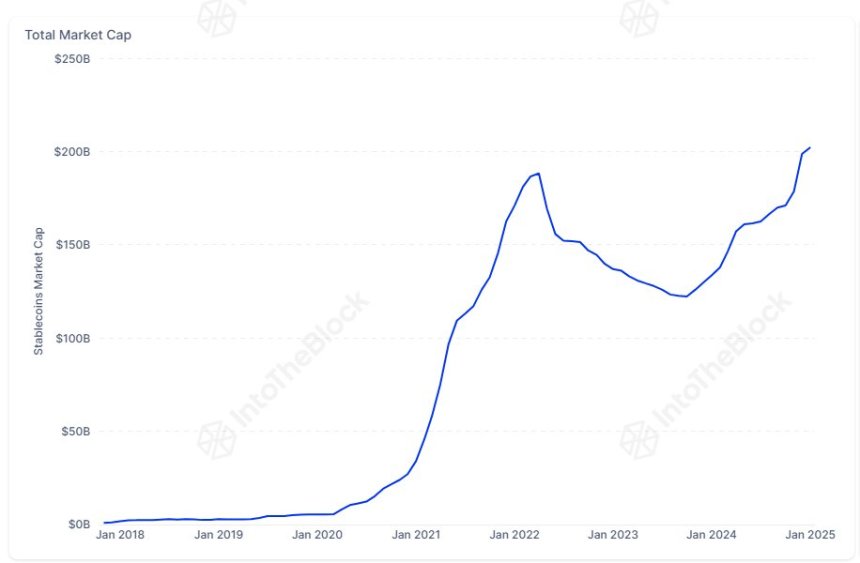
Stablecoins

Due to their fixed price nature,  traders often move their funds to stablecoins during periods of uncertainty which can easily be deployed into other cryptocurrencies later resulting in market rallies. However,  Kesmsci notes that this current stablecoin liquidity surge alone would be insufficient to re-ignite the crypto bull run. 

This notion is because compared to the previous 2020-2021 bull cycle, stablecoins exchange inflows are still considerably weak, indicating investors’ hesitation to engage the crypto market. Kesmeci explains that this low investor risk appetite can be ameliorated by a fall in interest rates and an increase in quantitative easing which will allow excess capital to flow into cryptocurrencies via the stablecoins.

Stablecoin Market Overview 

In other news, Kesmeci further states Tether’s USDT remains the unchallenged leader of the stablecoin market with a market of $139 billion. This report proves impressive considering the recent FUD on USDT over reports of potential delisting due to MiCA regulations in Europe.

The Circle USDC ranks second with $59 billion in market cap after an impressive 10% gain in the last month. Meanwhile, Ethana’s USDE has climbed to third place with market shares valued at $5.7 billion ahead of the premier decentralized stablecoin DAI.

According to data from CoinMarketCap, the total stablecoin market is valued at $221.86 billion following a 0.28% gain in the past day. Meanwhile, daily trading volume is down by 29.93% and valued at $129.23 billion. At the time of writing, stablecoins represent 6.13% of the total crypto market.


Stablecoins


Disclaimer: For information purposes only. Past performance is not indicative of future results.
placeholder
WTI (USOIL) Is down 2.03% on Sep 25: Here Is WhyWTI (USOIL) is down 2.03% at Sep 24 22:20(UTC+0), now at $92.517, with a 7-day down of 3.63%.What is driving WTI (USOIL)’s stock price down today?The drop in WTI crude oil prices was primarily driven by
Author  TradingKey
Yesterday 04: 57
WTI (USOIL) is down 2.03% at Sep 24 22:20(UTC+0), now at $92.517, with a 7-day down of 3.63%.What is driving WTI (USOIL)’s stock price down today?The drop in WTI crude oil prices was primarily driven by
placeholder
Silver Price Forecast: XAG/USD remains steady near $64.00 as oil prices easeSilver price (XAG/USD) inches higher after two days of losses, trading around $63.90 per troy ounce during Asian hours on Friday. Non-yielding Silver is finding underlying support as inflation concerns ease following a pullback in crude oil prices.
Author  FXStreet
Yesterday 03: 30
Silver price (XAG/USD) inches higher after two days of losses, trading around $63.90 per troy ounce during Asian hours on Friday. Non-yielding Silver is finding underlying support as inflation concerns ease following a pullback in crude oil prices.
placeholder
Gold Price Forecast: Gold Drops Below $4,300, Will It Continue to Fall? As of the European session on September 24, gold prices (XAUUSD) extended their correction, dipping below $4,300 intraday to hit a low of $4,262.45. After previously rebounding close to $
Author  TradingKey
Sep 24, Thu
As of the European session on September 24, gold prices (XAUUSD) extended their correction, dipping below $4,300 intraday to hit a low of $4,262.45. After previously rebounding close to $
placeholder
Yen touches 158.37 as Tokyo reopens, then slips back — ¥15.4 trillion of intervention and the 200-day line stand between here and 160USD/JPY reached 158.37 overnight, its highest since early September, then eased to 157.88 as Japanese markets reopened after a three-day holiday. The Ministry of Finance has spent ¥15.4 trillion defending the yen since late July and the BOJ ran a rate check on September 18. The 200-day average sits at 158.43.
Author  Irene Q.
Sep 24, Thu
USD/JPY reached 158.37 overnight, its highest since early September, then eased to 157.88 as Japanese markets reopened after a three-day holiday. The Ministry of Finance has spent ¥15.4 trillion defending the yen since late July and the BOJ ran a rate check on September 18. The 200-day average sits at 158.43.
placeholder
US input costs rose at the fastest pace in four years — the September flash PMI beat is an inflation story, not a growth storyUS September flash PMIs came in far above expectations, with the composite at 58.4, a five-year high. But the detail that moved markets was input cost inflation at its fastest since October 2022, driven by fuel, transport and supply shortages. Brent is back above $100 and the 10-year Treasury yield has hit its highest since 2007.
Author  Suzie
Sep 24, Thu
US September flash PMIs came in far above expectations, with the composite at 58.4, a five-year high. But the detail that moved markets was input cost inflation at its fastest since October 2022, driven by fuel, transport and supply shortages. Brent is back above $100 and the 10-year Treasury yield has hit its highest since 2007.
goTop
quote