

JP Morgan says the EU’s MiCA regulations are likely to boost euro-denominated stablecoins

Source Cryptopolitan

The crypto industry wanted regulation, and now they have it – with the EU’s MiCA. You would think this will be embraced at first glance. But No. The MiCA regulations have caused the crypto industry sleepless nights. However, they have their benefits. 

According to JPMorgan (JPM), the EU’s MiCA regulations, which were implemented on Dec. 30, 2024, are expected to increase the demand for euro-denominated stablecoins.

Presently, euro-pegged stablecoins account for only 0.12% of the stablecoin market share. However, MiCA has the potential to grow this figure by promoting European banks and financial institutions’ adoption of euro stablecoins for customer requirements and blockchain-based financial settlements.

JPM analysts led by Nikolaos Panigirtzoglou wrote, “Under MiCA, only compliant stablecoins can be used as trading pairs in regulated markets, prompting EU exchanges to adjust their offerings.” 
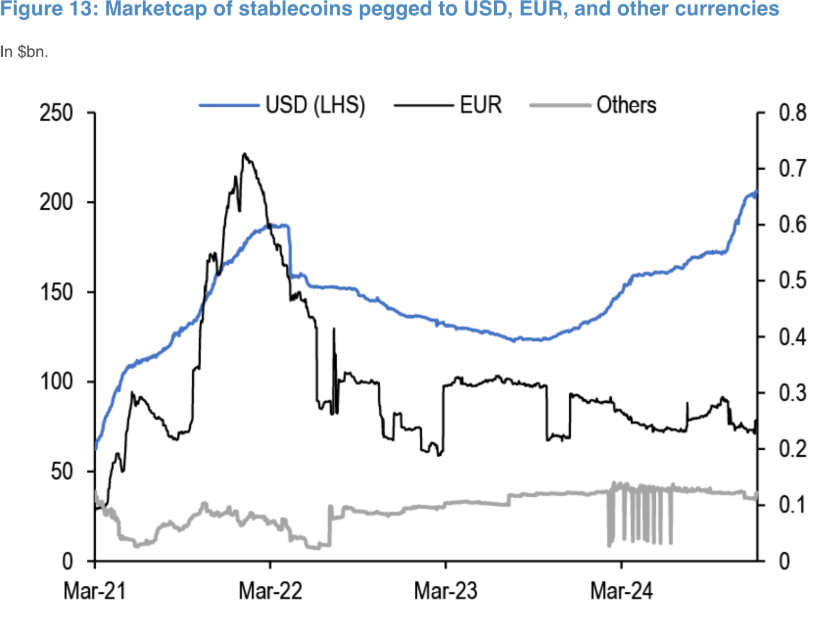
Source: J.P. Morgan

The analysts cited Societe Generale’s EURCV stablecoin and BBVA’s forthcoming stablecoin launch in partnership with Visa as notable examples.

MiCA’s impact on global stablecoins

The report noted that stablecoin issuers, such as Tether, are required to secure trading licenses within the EU and maintain substantial reserves in European institutions under the new regulations.

This has led to the strengthening of compliant stablecoins, such as Circle’s EURC. Non-compliant stablecoins, such as Tether’s EURT, have encountered difficulties. Already, Coinbase delisted Tether’s USDt, citing concerns about compliance with the EU’s MiCA regulations.

However, the bank stated that Tether continues to be a “dominant force” in the global stablecoin market despite the challenges it faces. It is also noted that tether is extensively used in Asian markets, where there are fewer restrictions.

The report further stated that Tether’s investment in stablecoin issuers that are MiCA-compliant, such as Quantoz Payments, demonstrates its dedication to sustaining a presence in the EU. Platforms like Binance and Crypto.com  chose to hold off on any action until the situation became clearer.

Notably, in December, the organization disclosed that it had also made an investment in StablR, a European stablecoin issuer. 

Generally, the analysts stated that MiCA’s long-term impact on the crypto market could be positive. This is because it could attract institutional investors and promote the adoption of euro-pegged stablecoins. 

Still, although it introduces higher compliance costs, the U.S. is likely to adopt its own crypto legislation under the incoming Donald Trump administration as the EU takes this regulatory leap.

MiCA regulations and their demand on the crypto industry

The first thing MICA regulations did was to kick out algorithmic stablecoins. Apparently, MiCA does not regard algorithmic stablecoins as asset-referenced tokens. This is because they lack explicit reserves that are associated with any conventional asset. 

This essentially implies that algorithmic stablecoins are prohibited under MiCA. The new regulations will necessitate that stablecoins are recognized by MiCA and be supported by a liquid reserve with a 1:1 ratio.

MiCA has stated that its explicit objective is to safeguard the financial stability and monetary sovereignty of the European market. As a result, the regulations regarding stablecoins, particularly those that pertain to variant issuers, are quite stringent.

Therefore, before listing or publicly offering their assets in the EU, individuals who intend to issue EMTs and ARTs must obtain authorization. The issuer must provide this authorization unless they expressly grant written consent to another party to do so.

Notably, MiCA does not employ the term “stablecoin;” both ARTs and EMTs are regarded as stablecoins.

After publishing a whitepaper and notifying their supervisory authority, authorized credit institutions may offer or list EMTs. EU-based ART issuers are subject to additional requirements, including the approval of their whitepaper before publication. 

More importantly, the European Banking Authority may classify them as “significant” based on specific criteria, which would subject them to more stringent regulatory policy and supervision. This is where the EU-based stablecoins will benefit.

A Step-By-Step System To Launching Your Web3 Career and Landing High-Paying Crypto Jobs in 90 Days.

Disclaimer: For information purposes only. Past performance is not indicative of future results.
placeholder
Bitcoin CME gaps at $35,000, $27,000 and $21,000, which one gets filled first?Prioritize filling the $27,000 gap and even try higher.
Author  FXStreet
Aug 22, 2023
Prioritize filling the $27,000 gap and even try higher.
placeholder
Pinduoduo Earnings Incoming: Morgan Stanley Sees Long-Term Profit Potential​Insights – On November 21, Chinese e-commerce giant Pinduoduo (PDD) will release its Q3 2024 earnings.
Author  Mitrade
Nov 20, 2024
​Insights – On November 21, Chinese e-commerce giant Pinduoduo (PDD) will release its Q3 2024 earnings.
placeholder
Elon Musk’s xAI and Neuralink Launch New Funding Rounds​Billionaire Elon Musk recently raised funds for his two high-profile tech companies, xAI and Neuralink.
Author  Insights
Jun 03, 2025
​Billionaire Elon Musk recently raised funds for his two high-profile tech companies, xAI and Neuralink.
placeholder
Bitcoin briefly loses 2025 gains as crypto plunges over the weekend.Bitcoin experienced a sharp decline this weekend, briefly erasing its 2025 gains and dipping below its year-opening value of $93,507. The cryptocurrency fell to a low of $93,029 on Sunday, representing a 25% drop from its all-time high in October. Although it has rebounded slightly to around $94,209, the pressures on the market remain significant. The downturn occurred despite the reopening of the U.S. government on Thursday, which many had hoped would provide essential support for crypto markets. This year initially appeared promising for cryptocurrencies, particularly after the inauguration of President Donald Trump, who has established the most pro-crypto administration thus far. However, ongoing political tensions—including Trump's tariff strategies and the recent government shutdown, lasting a historic 43 days—have contributed to several rapid price pullbacks for Bitcoin throughout the year. Market dynamics are also being influenced by Bitcoin whales—investors holding large amounts of Bitcoin—who have been offloading portions of their assets, consequently stalling price rallies even as positive regulatory developments emerge. Despite these sell-offs, analysts from Glassnode argue that this behavior aligns with typical patterns seen among long-term investors during the concluding stages of bull markets, suggesting it is not indicative of a mass exodus. Notably, Bitcoin is not alone in its struggles, as Ethereum and Solana have also recorded declines of 7.95% and 28.3%, respectively, since the start of the year, while numerous altcoins have faced even steeper losses. Looking ahead, questions linger regarding the viability of the four-year cycle thesis, particularly given the increasing institutional support and regulatory frameworks now in place in the crypto landscape. Matt Hougan, chief investment officer at Bitwise, remains optimistic, suggesting a potential Bitcoin resurgence in 2026 driven by the “debasement trade” thesis and a broader trend toward increased adoption of stablecoins, tokenization, and decentralized finance. Hougan emphasized the soundness of the underlying fundamentals, pointing to a positive outlook for the sector in the longer term.
Author  Mitrade
Nov 17, 2025
Bitcoin experienced a sharp decline this weekend, briefly erasing its 2025 gains and dipping below its year-opening value of $93,507. The cryptocurrency fell to a low of $93,029 on Sunday, representing a 25% drop from its all-time high in October. Although it has rebounded slightly to around $94,209, the pressures on the market remain significant. The downturn occurred despite the reopening of the U.S. government on Thursday, which many had hoped would provide essential support for crypto markets. This year initially appeared promising for cryptocurrencies, particularly after the inauguration of President Donald Trump, who has established the most pro-crypto administration thus far. However, ongoing political tensions—including Trump's tariff strategies and the recent government shutdown, lasting a historic 43 days—have contributed to several rapid price pullbacks for Bitcoin throughout the year. Market dynamics are also being influenced by Bitcoin whales—investors holding large amounts of Bitcoin—who have been offloading portions of their assets, consequently stalling price rallies even as positive regulatory developments emerge. Despite these sell-offs, analysts from Glassnode argue that this behavior aligns with typical patterns seen among long-term investors during the concluding stages of bull markets, suggesting it is not indicative of a mass exodus. Notably, Bitcoin is not alone in its struggles, as Ethereum and Solana have also recorded declines of 7.95% and 28.3%, respectively, since the start of the year, while numerous altcoins have faced even steeper losses. Looking ahead, questions linger regarding the viability of the four-year cycle thesis, particularly given the increasing institutional support and regulatory frameworks now in place in the crypto landscape. Matt Hougan, chief investment officer at Bitwise, remains optimistic, suggesting a potential Bitcoin resurgence in 2026 driven by the “debasement trade” thesis and a broader trend toward increased adoption of stablecoins, tokenization, and decentralized finance. Hougan emphasized the soundness of the underlying fundamentals, pointing to a positive outlook for the sector in the longer term.
placeholder
Gold Price Forecast: XAU/USD struggles to extend recovery above 20-day EMAGold price (XAU/USD) is down 0.8% to near $4,140 during the European trading session on Monday. The precious metal faces selling pressure as the three-day rally hits a pause after failing to extend above $4,202.
Author  FXStreet
Yesterday 10: 23
Gold price (XAU/USD) is down 0.8% to near $4,140 during the European trading session on Monday. The precious metal faces selling pressure as the three-day rally hits a pause after failing to extend above $4,202.
goTop
quote