

Avalanche Revenue Nosedives Over 40% In Q2 – Impact On AVAX Price

Source Newsbtc

Avalanche (AVAX) has had a terrible Q2 2024 by several standards, going by a significant decline in market capitalization coupled with low revenue generation.

Messari’s recent report indicated that AVAX faced a fierce correction after two quarters of growth on the trot. Market capitalization dipped by 40% within the last quarter to stand at $11.6 billion. Well, despite this slump, the ecosystem is still sound as AVAX still has a market cap of $4.5 billion — that’s a 157% surge compared to the same period in 2023.

Price Forecast Shines Through The Dip

The slump is paining the larger ecosystem, but the future of AVAX seems brighter. In fact, the price forecast of the token will shine hope for investors. AVAX is seen going up 70.68% over the next three months, showing a bounce from the recent prices, analysis from CoinCheckup shows.
This bullish sentiment is bolstered by long-term projections that suggest a 166% growth over the next year. It seems AVAX is poised for recovery, making it an intriguing asset for traders keeping an eye on the market.

Revenue Plunge And On-Chain Activity

Revenue for the Avalanche ecosystem was another source of worry, as its value went down from 176,700 AVAX in Q2 2024 to 96,200 AVAX during the same period. In dollar terms, that translated into $7.5 million going down to $3.5 million.

Pullback is due to slowed activity across different on-chain platforms. However, some analysts believe that a renewed interest in on-chain-based transactions could help revive revenue growth in the short term.

Despite these drops, staking remains robust within the Avalanche ecosystem. There is a 6% increase in the number of staked AVAX tokens due to new measures to boost staking. Staking rewards continue to attract new investors despite a fall in active validator count by 7%. This reflects some unease among validators amidst these market conditions.

Network Stability

Average transaction counts remain mixed. With approximately 11,262 transactions and an average block time of 1.61 seconds, Avalanche is showing stability. More than 2% of the total coins have been sent from the Elliptic Curve Digital Signature Algorithm wallet. Despite the recorded drops, new initiatives are expected to boost staking and future coin balances.

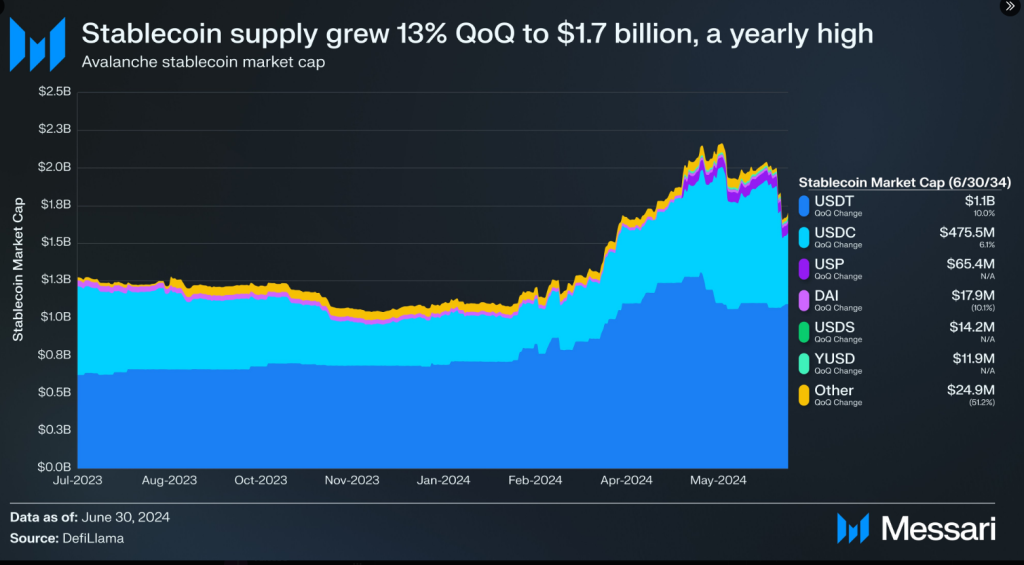
Interestingly, where the network had an average transaction that depreciated by 57% from 495,000 to 201,500, some protocols on Avalanche refused to abide by this trend. Tether (USDT) and GMX increased transaction volumes, which indicated specific sectors in the system are doing well despite this broad slowdown for the crypto market.

Since AVAX is preparing for a potential rebound from the market, its investors may be able to see renewed interest in the asset in case such forecasted growth in price comes true.

The partial recovery in the transaction volumes for selected protocols also suggests something more is being involved under the surface–a sign that Avalanche might pick up fast once the crypto market picks up. For now, investors are keen enough to observe how AVAX acts in the short and medium terms.

Featured image from Durango.com, chart from TradingView

Disclaimer: For information purposes only. Past performance is not indicative of future results.
placeholder
The Fed will sit still on October 28 — but 100 of 100 economists now expect a December hikeA Reuters poll run October 16-20 found 94 of 100 economists expecting the Fed to hold at 3.75-4.00% on October 28 — and all 100 expecting a hike in December, against less than half a month earlier. The market is close to the same price, with CME FedWatch at roughly 17% for October and 82.8% for December. With the Fed in blackout since October 17, here are the five dates that decide the rest of the year, what each one is priced for, and the two directions each can take.
Author  Irene Q.
Oct 22, Thu
A Reuters poll run October 16-20 found 94 of 100 economists expecting the Fed to hold at 3.75-4.00% on October 28 — and all 100 expecting a hike in December, against less than half a month earlier. The market is close to the same price, with CME FedWatch at roughly 17% for October and 82.8% for December. With the Fed in blackout since October 17, here are the five dates that decide the rest of the year, what each one is priced for, and the two directions each can take.
placeholder
Big Tech's $800 billion AI bill faces its first real test — free cash flow is the judgeAlphabet and Microsoft report after the close on October 28, Amazon on October 29, with hyperscaler AI capex running near $800 billion a year. Meta's negative free cash flow and 9.40% drop on October 22 was the warning; this week's prints decide whether cloud growth and backlog can pay for the buildout. Here are the consensus numbers, the free-cash-flow table and the two-sided test.
Author  Irene Q.
Oct 26, Mon
Alphabet and Microsoft report after the close on October 28, Amazon on October 29, with hyperscaler AI capex running near $800 billion a year. Meta's negative free cash flow and 9.40% drop on October 22 was the warning; this week's prints decide whether cloud growth and backlog can pay for the buildout. Here are the consensus numbers, the free-cash-flow table and the two-sided test.
placeholder
Anthropic files for a $2 trillion IPO — the $80.7 billion loss is the decoy, the $450 billion compute bill is the riskAnthropic publicly filed its S-1 on October 26, revealing $16.29 billion of first-half revenue (+1,304% year over year) and a $80.7 billion net loss — of which $72.4 billion is a non-cash convertible-note charge. The real number is the $450 billion of signed, mostly non-cancelable compute commitments. Here is what the filing says, why NVDA, ARM and MU are the tradeable read-through, and the conditions that decide whether the AI trade passes its first public valuation test.
Author  Irene Q.
Oct 27, Tue
Anthropic publicly filed its S-1 on October 26, revealing $16.29 billion of first-half revenue (+1,304% year over year) and a $80.7 billion net loss — of which $72.4 billion is a non-cash convertible-note charge. The real number is the $450 billion of signed, mostly non-cancelable compute commitments. Here is what the filing says, why NVDA, ARM and MU are the tradeable read-through, and the conditions that decide whether the AI trade passes its first public valuation test.
placeholder
Fed October Rate Decision Preview: Rate Hike Pause Has Become Consensus, How Will US Stocks, Dollar, and Gold React?The Federal Reserve will announce its October interest rate decision at 14:00 Eastern Time on October 28, and Fed Chair Warsh will hold a press conference at 14:30. Markets currently wide
Author  TradingKey
Oct 27, Tue
The Federal Reserve will announce its October interest rate decision at 14:00 Eastern Time on October 28, and Fed Chair Warsh will hold a press conference at 14:30. Markets currently wide
placeholder
Brent's $115 front month sits $4.6 above January — the $14 spread to WTI is the supply-risk premiumDecember Brent trades at $115.29 while January is $110.71, a $4.58 backwardation. The December Brent-WTI spread is $14.2, versus a $3-5 normal. That gap, not the headline, is where the Middle East supply risk is priced. Here is what the curve says, why the December contract's expiry on October 30 will mechanically cut the headline by $4.6, and the 108.81 neckline that decides the next move.
Author  Irene Q.
22 hours ago
December Brent trades at $115.29 while January is $110.71, a $4.58 backwardation. The December Brent-WTI spread is $14.2, versus a $3-5 normal. That gap, not the headline, is where the Middle East supply risk is priced. Here is what the curve says, why the December contract's expiry on October 30 will mechanically cut the headline by $4.6, and the 108.81 neckline that decides the next move.
goTop
quote