

Bitcoin (BTC) Whales Cut Back on Holdings: Why It’s Not a Red Flag

Source Beincrypto

Bitcoin’s (BTC) large holders have gradually reduced their coin holdings since the cryptocurrency reached a new high in March. While this may seem like a bearish signal, there’s no need for concern.

These major stakeholders are simply waiting strategically as the leading coin navigates ongoing volatility.

Bitcoin Large Holders Bide Their Time

In a September 11 post on X, blockchain analytics platform Santiment wrote that there has been a “noticeable drop-off” in crypto whale transactions since mid-August. The on-chain data provider noted a 33.6% decline in weekly BTC whale transactions valued above $100,000 since the coin surged to a new high in March.

For context, weekly transactions of $100,000 or more involving Bitcoin totaled 88,163 when the coin climbed to its new high in March. As its price dropped, the whales reduced their trading activity. By mid-August, this had declined to 58,539 Bitcoin whale transactions weekly. 

Read more: 5 Best Platforms To Buy Bitcoin Mining Stocks After 2024 Halving
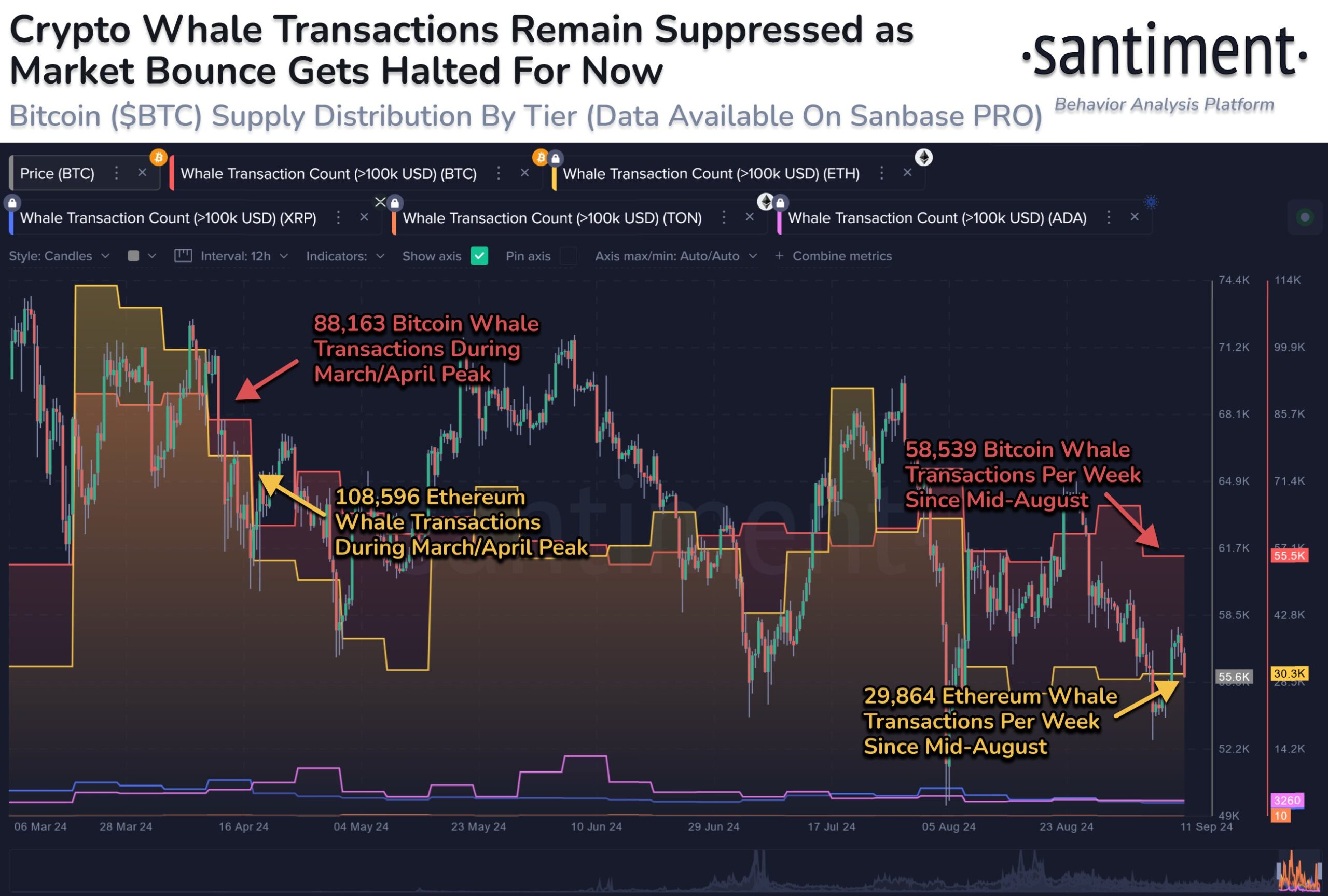
crypto whale transactionsCrypto Whale Transactions. Source: X

While this may come off to many as a bearish signal, the data provider noted that it may not be the case, as Bitcoin whales can be just as active in both bull and bear markets. 

“This does indicate that large key stakeholders continue to bide their time as they wait to make their next moves during times of extreme crowd greed or extreme fear,” Santiment wrote.

As of this writing, the overall sentiment in the cryptocurrency market is “fear,” as highlighted by the Crypto Fear & Greed Index. This sentiment continues to linger as BTC navigates ongoing volatility, which some analysts argue would be temporary. 

“Bitcoin CPI traders having a lot of fun again today I see. Both sides stop hunted multiple times. Quite a lot of volatility but nothing we’re not used to the past few weeks,” a prominent analyst Daan Crypto wrote.

BTC Price Prediction: Price May Swing in Either Direction

BeinCrypto’s analysis of Bitcoin’s one-day chart aligns with Daan Crypto Trades’ perspective on its volatility. The gap between the upper and lower bands of Bitcoin’s Bollinger Bands, which track market volatility, has expanded gradually over the past week.

The upper band marks the higher range of price movements, while the lower band follows the lower range. A widening gap between these bands indicates rising volatility.

Additionally, Bitcoin’s Bollinger Bandwidth, which helps traders assess market volatility and spot breakout opportunities, has also increased in recent days. A higher bandwidth further confirms elevated volatility.

Read more: Where To Trade Bitcoin Futures: A Comprehensive Guide
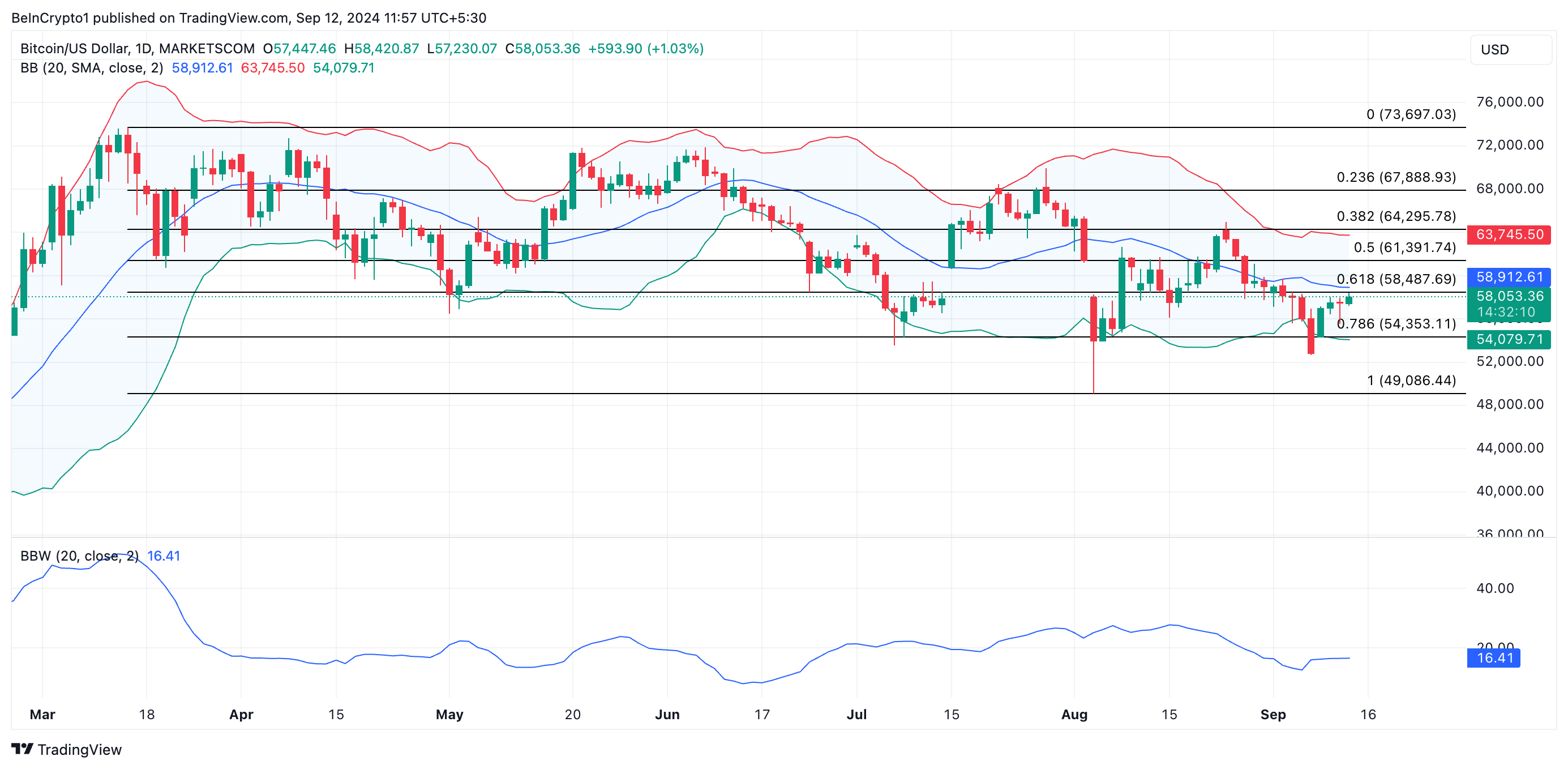
btc bollinger bands and price predictionBitcoin Daily Analysis. Source: TradingView

This suggests Bitcoin’s price could move sharply in either direction. If the price rises, it may break resistance at $61,391 and aim for $64,295.

Conversely, if the price falls, Bitcoin could drop below $54,353, possibly revisiting the August 5 low of $49,086.

Disclaimer: For information purposes only. Past performance is not indicative of future results.
placeholder
Bitcoin CME gaps at $35,000, $27,000 and $21,000, which one gets filled first?Prioritize filling the $27,000 gap and even try higher.
Author  FXStreet
Aug 22, 2023
Prioritize filling the $27,000 gap and even try higher.
placeholder
Bitcoin briefly loses 2025 gains as crypto plunges over the weekend.Bitcoin experienced a sharp decline this weekend, briefly erasing its 2025 gains and dipping below its year-opening value of $93,507. The cryptocurrency fell to a low of $93,029 on Sunday, representing a 25% drop from its all-time high in October. Although it has rebounded slightly to around $94,209, the pressures on the market remain significant. The downturn occurred despite the reopening of the U.S. government on Thursday, which many had hoped would provide essential support for crypto markets. This year initially appeared promising for cryptocurrencies, particularly after the inauguration of President Donald Trump, who has established the most pro-crypto administration thus far. However, ongoing political tensions—including Trump's tariff strategies and the recent government shutdown, lasting a historic 43 days—have contributed to several rapid price pullbacks for Bitcoin throughout the year. Market dynamics are also being influenced by Bitcoin whales—investors holding large amounts of Bitcoin—who have been offloading portions of their assets, consequently stalling price rallies even as positive regulatory developments emerge. Despite these sell-offs, analysts from Glassnode argue that this behavior aligns with typical patterns seen among long-term investors during the concluding stages of bull markets, suggesting it is not indicative of a mass exodus. Notably, Bitcoin is not alone in its struggles, as Ethereum and Solana have also recorded declines of 7.95% and 28.3%, respectively, since the start of the year, while numerous altcoins have faced even steeper losses. Looking ahead, questions linger regarding the viability of the four-year cycle thesis, particularly given the increasing institutional support and regulatory frameworks now in place in the crypto landscape. Matt Hougan, chief investment officer at Bitwise, remains optimistic, suggesting a potential Bitcoin resurgence in 2026 driven by the “debasement trade” thesis and a broader trend toward increased adoption of stablecoins, tokenization, and decentralized finance. Hougan emphasized the soundness of the underlying fundamentals, pointing to a positive outlook for the sector in the longer term.
Author  Mitrade
Nov 17, 2025
Bitcoin experienced a sharp decline this weekend, briefly erasing its 2025 gains and dipping below its year-opening value of $93,507. The cryptocurrency fell to a low of $93,029 on Sunday, representing a 25% drop from its all-time high in October. Although it has rebounded slightly to around $94,209, the pressures on the market remain significant. The downturn occurred despite the reopening of the U.S. government on Thursday, which many had hoped would provide essential support for crypto markets. This year initially appeared promising for cryptocurrencies, particularly after the inauguration of President Donald Trump, who has established the most pro-crypto administration thus far. However, ongoing political tensions—including Trump's tariff strategies and the recent government shutdown, lasting a historic 43 days—have contributed to several rapid price pullbacks for Bitcoin throughout the year. Market dynamics are also being influenced by Bitcoin whales—investors holding large amounts of Bitcoin—who have been offloading portions of their assets, consequently stalling price rallies even as positive regulatory developments emerge. Despite these sell-offs, analysts from Glassnode argue that this behavior aligns with typical patterns seen among long-term investors during the concluding stages of bull markets, suggesting it is not indicative of a mass exodus. Notably, Bitcoin is not alone in its struggles, as Ethereum and Solana have also recorded declines of 7.95% and 28.3%, respectively, since the start of the year, while numerous altcoins have faced even steeper losses. Looking ahead, questions linger regarding the viability of the four-year cycle thesis, particularly given the increasing institutional support and regulatory frameworks now in place in the crypto landscape. Matt Hougan, chief investment officer at Bitwise, remains optimistic, suggesting a potential Bitcoin resurgence in 2026 driven by the “debasement trade” thesis and a broader trend toward increased adoption of stablecoins, tokenization, and decentralized finance. Hougan emphasized the soundness of the underlying fundamentals, pointing to a positive outlook for the sector in the longer term.
placeholder
ECB Policy Outlook for 2026: What It Could Mean for the Euro’s Next MoveWith the ECB likely holding rates steady at 2.15% and the Fed potentially extending cuts into 2026, EUR/USD may test 1.20 if Eurozone growth proves resilient, but weaker growth and an ECB pivot could pull the pair back toward 1.13 and potentially 1.10.
Author  Mitrade
Dec 26, 2025
With the ECB likely holding rates steady at 2.15% and the Fed potentially extending cuts into 2026, EUR/USD may test 1.20 if Eurozone growth proves resilient, but weaker growth and an ECB pivot could pull the pair back toward 1.13 and potentially 1.10.
placeholder
Gold Price Forecast: XAU/USD opens lower around $4,450 on fears of widening Iran conflictsGold price (XAU/USD) opens over 1% lower to near $4,445.00 on Monday, as oil prices have rallied further on fears of further widening of conflicts in the Middle East. WTI Oil price is up almost 3% above $102.50 in the opening trade, increasing fears of higher inflation expectations globally.
Author  FXStreet
Mar 30, Mon
Gold price (XAU/USD) opens over 1% lower to near $4,445.00 on Monday, as oil prices have rallied further on fears of further widening of conflicts in the Middle East. WTI Oil price is up almost 3% above $102.50 in the opening trade, increasing fears of higher inflation expectations globally.
placeholder
Crypto Weekly Radar: All eyes on Donald Trump’s ultimatum, US macroeconomic dataCrypto markets begin the week with mixed sentiment, with Bitcoin (BTC) trading above $69,000 following last week’s rebound. Still, markets remain cautious as traders weigh risks stemming from Donald Trump’s renewed threats toward Iran ahead of the ultimatum set for Tuesday.
Author  FXStreet
3 hours ago
Crypto markets begin the week with mixed sentiment, with Bitcoin (BTC) trading above $69,000 following last week’s rebound. Still, markets remain cautious as traders weigh risks stemming from Donald Trump’s renewed threats toward Iran ahead of the ultimatum set for Tuesday.
goTop
quote