

Optimism Activates Fault-Proofs On Mainnet, OP Is Down 55% In 3 Months

Source Newsbtc

In a major milestone for Ethereum and layer-2s, Optimism, a layer-2 scaling platform for the second most valuable network, has announced the activation of open source and permissionless fault proofs.

Even though the platform manages over $7 billion of assets, according to L2Beat, Optimism, like most optimistic rollups, lacked a way of trustlessly verifying transactions. It relied on a centralized sequencer and fraud-proof system for this function.
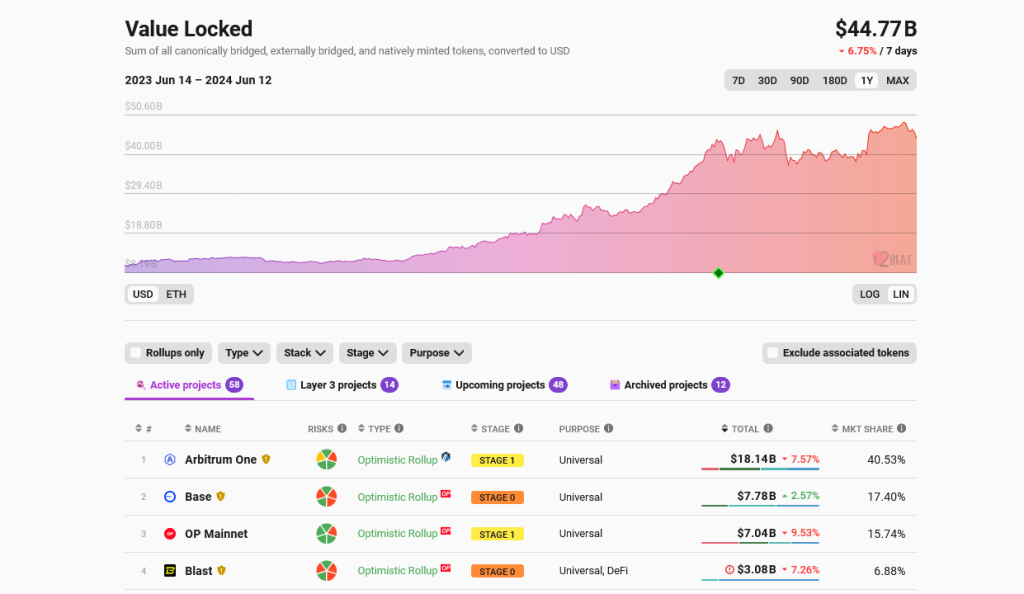
Optimism TVL | Source: L2BEAT

Optimism Activates Trustless Fraud-Proof System

Activating the open-source fault-proof system is crucial to creating a more decentralized and secure future for the Optimism ecosystem. Overall, fault proofs are a critical component, allowing users to verify the validity of all offchain transactions.

Most importantly, it allows users to challenge any fraudulent activity on Optimism, creating a safeguard against unauthorized withdrawals, for example, and much more.  

In a post, Optimism Labs said the layer-2 platform relied on a centralized system. Here, the Optimism Security Council held the power to initiate withdrawals.

However, the platform eliminates this dependency with trustless fault proof in place. This means that any user can withdraw tokens without the council intervening. The power move is huge for the community and decentralization.

Even so, to ensure the safe implementation of this fault-proof system, the Optimism Security Council will still have the power, at least temporarily, to intervene in cases of critical failures. This decision means Optimism will continue to operate securely as it decentralizes gradually.  

Eventually, the platform plans to release a “multi-proof nirvana” that is open-source and modular, possibly including zero-knowledge proofs. This will go beyond the current “Cannon” system.

Buterin Acknowledgement, But Why Is OP Crashing?

Vitalik Buterin, the co-founder of Ethereum, acknowledged this milestone, welcoming Optimism to the “club of stage 1 L2s.” Nonetheless, the co-founder still needed more zero-knowledge proof-based layer-2 platforms to join the ranks.
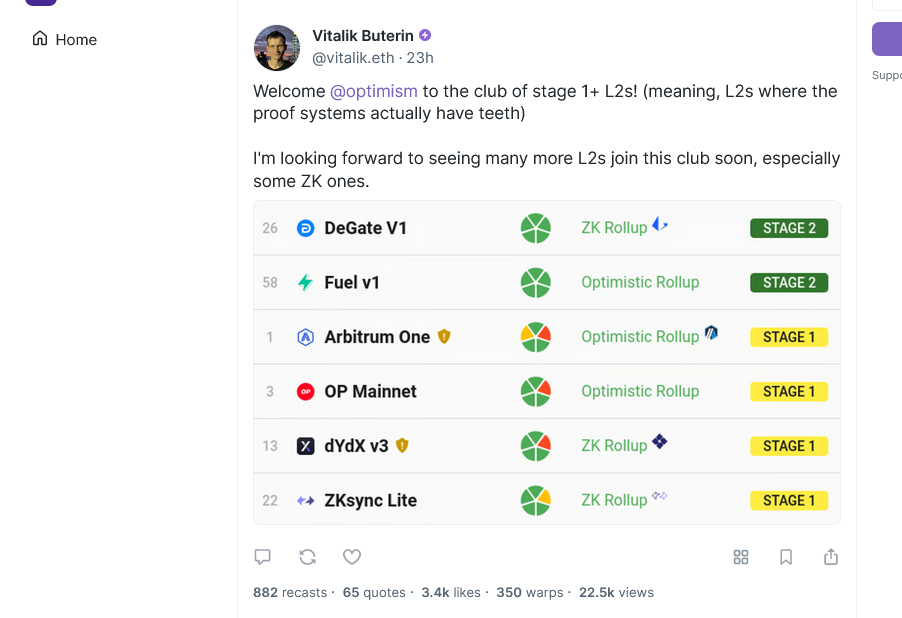
Vitalik Buterin acknowledges the Optimism milestone | Source: Vitalik Buterin via Warpcast


Optimism is the second layer-2 platform after Arbitrum to announce the release of fault-proof systems, though both are still being tested. Dubbed the Bounded Liquidity Delay (BOLD), Arbitrum’s fraud-proof system was launched on Testnet early last month.

OP price trending lower on the daily chart | Source: OPUSDT on Binance, TradingView

Despite this milestone, OP is firm but under pressure in the first half of June.

At spot rates, OP is down roughly 55% from March highs. With Ethereum and Bitcoin prices under pressure, the token could break May lows of $1.8 with eyes on $1.1.

Disclaimer: For information purposes only. Past performance is not indicative of future results.
placeholder
Bitcoin CME gaps at $35,000, $27,000 and $21,000, which one gets filled first?Prioritize filling the $27,000 gap and even try higher.
Author  FXStreet
Aug 22, 2023
Prioritize filling the $27,000 gap and even try higher.
placeholder
Natural Gas sinks to pivotal level as China’s demand slumpsNatural Gas price (XNG/USD) edges lower and sinks to $2.56 on Monday, extending its losing streak for the fifth day in a row. The move comes on the back of China cutting its Liquified Natural Gas (LNG) imports after prices rose above $3.0 in June. It
Author  FXStreet
Jul 01, 2024
Natural Gas price (XNG/USD) edges lower and sinks to $2.56 on Monday, extending its losing streak for the fifth day in a row. The move comes on the back of China cutting its Liquified Natural Gas (LNG) imports after prices rose above $3.0 in June. It
placeholder
Bitcoin briefly loses 2025 gains as crypto plunges over the weekend.Bitcoin experienced a sharp decline this weekend, briefly erasing its 2025 gains and dipping below its year-opening value of $93,507. The cryptocurrency fell to a low of $93,029 on Sunday, representing a 25% drop from its all-time high in October. Although it has rebounded slightly to around $94,209, the pressures on the market remain significant. The downturn occurred despite the reopening of the U.S. government on Thursday, which many had hoped would provide essential support for crypto markets. This year initially appeared promising for cryptocurrencies, particularly after the inauguration of President Donald Trump, who has established the most pro-crypto administration thus far. However, ongoing political tensions—including Trump's tariff strategies and the recent government shutdown, lasting a historic 43 days—have contributed to several rapid price pullbacks for Bitcoin throughout the year. Market dynamics are also being influenced by Bitcoin whales—investors holding large amounts of Bitcoin—who have been offloading portions of their assets, consequently stalling price rallies even as positive regulatory developments emerge. Despite these sell-offs, analysts from Glassnode argue that this behavior aligns with typical patterns seen among long-term investors during the concluding stages of bull markets, suggesting it is not indicative of a mass exodus. Notably, Bitcoin is not alone in its struggles, as Ethereum and Solana have also recorded declines of 7.95% and 28.3%, respectively, since the start of the year, while numerous altcoins have faced even steeper losses. Looking ahead, questions linger regarding the viability of the four-year cycle thesis, particularly given the increasing institutional support and regulatory frameworks now in place in the crypto landscape. Matt Hougan, chief investment officer at Bitwise, remains optimistic, suggesting a potential Bitcoin resurgence in 2026 driven by the “debasement trade” thesis and a broader trend toward increased adoption of stablecoins, tokenization, and decentralized finance. Hougan emphasized the soundness of the underlying fundamentals, pointing to a positive outlook for the sector in the longer term.
Author  Mitrade
Nov 17, 2025
Bitcoin experienced a sharp decline this weekend, briefly erasing its 2025 gains and dipping below its year-opening value of $93,507. The cryptocurrency fell to a low of $93,029 on Sunday, representing a 25% drop from its all-time high in October. Although it has rebounded slightly to around $94,209, the pressures on the market remain significant. The downturn occurred despite the reopening of the U.S. government on Thursday, which many had hoped would provide essential support for crypto markets. This year initially appeared promising for cryptocurrencies, particularly after the inauguration of President Donald Trump, who has established the most pro-crypto administration thus far. However, ongoing political tensions—including Trump's tariff strategies and the recent government shutdown, lasting a historic 43 days—have contributed to several rapid price pullbacks for Bitcoin throughout the year. Market dynamics are also being influenced by Bitcoin whales—investors holding large amounts of Bitcoin—who have been offloading portions of their assets, consequently stalling price rallies even as positive regulatory developments emerge. Despite these sell-offs, analysts from Glassnode argue that this behavior aligns with typical patterns seen among long-term investors during the concluding stages of bull markets, suggesting it is not indicative of a mass exodus. Notably, Bitcoin is not alone in its struggles, as Ethereum and Solana have also recorded declines of 7.95% and 28.3%, respectively, since the start of the year, while numerous altcoins have faced even steeper losses. Looking ahead, questions linger regarding the viability of the four-year cycle thesis, particularly given the increasing institutional support and regulatory frameworks now in place in the crypto landscape. Matt Hougan, chief investment officer at Bitwise, remains optimistic, suggesting a potential Bitcoin resurgence in 2026 driven by the “debasement trade” thesis and a broader trend toward increased adoption of stablecoins, tokenization, and decentralized finance. Hougan emphasized the soundness of the underlying fundamentals, pointing to a positive outlook for the sector in the longer term.
placeholder
WTI Price Forecast: Seems vulnerable near $90.50 as technical breakdown comes into playWest Texas Intermediate (WTI) – the benchmark US Crude Oil price – plummets to a nearly two-week trough during the Asian session on Wednesday in reaction to news that the US and Iran have agreed to a two-week ceasefire.
Author  FXStreet
Yesterday 01: 48
West Texas Intermediate (WTI) – the benchmark US Crude Oil price – plummets to a nearly two-week trough during the Asian session on Wednesday in reaction to news that the US and Iran have agreed to a two-week ceasefire.
placeholder
Gold remains depressed as skepticism over US-Iran truce supports USDGold (XAU/USD) once again shows some resilience below the $4,700 mark during the Asian session on Thursday, and for now, seems to have stalled the previous day's retracement slide from a three-week high.
Author  FXStreet
10 hours ago
Gold (XAU/USD) once again shows some resilience below the $4,700 mark during the Asian session on Thursday, and for now, seems to have stalled the previous day's retracement slide from a three-week high.
goTop
quote