


84% of prediction market traders lose money
The numbers are in, and they are not pretty for everyday traders who bet on prediction markets.
Despite handling tens of billions of dollars in trades, these platforms appear to be leaving the overwhelming majority of users worse off financially.
Prediction markets have grown fast. By 2025, platforms like Polymarket and Kalshi were processing $28 billion in trading volume.
The idea behind them is simple: people bet on future events, and the odds that form are supposed to reflect what the public genuinely believes will happen.
Supporters have called them powerful tools for forecasting. But a closer look at who actually makes money tells a very different story.
A congresswoman raises the alarm
Arizona Democrat Yassamin Ansari recently targeted both Polymarket and Kalshi, calling them “casinos where the rich and powerful are the house and everyone else is the chips.”
She posted on X that 99.96% of users lose everything while the top 0.04% walk away with billions.
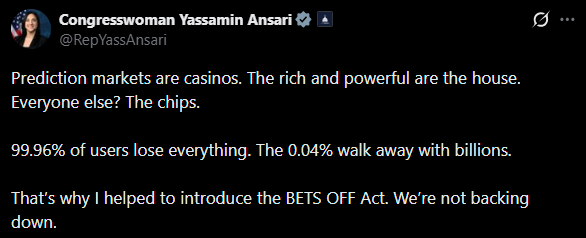
Source: @RepYassAnsari
Her claim comes from a December 2025 on-chain analysis by a blockchain researcher known as DeFi Oasis.
That study found that less than 0.04% of Polymarket wallet addresses captured more than 70% of all realized profits, totaling $3.7 billion.
Analysts, however, pointed out that Ansari’s wording mixes up two separate figures. The 0.04% refers to who captured most of the winnings, not simply who won anything at all.
Ansari is co-sponsoring a bill called the BETS OFF Act alongside Sen. Chris Murphy of Connecticut and Reps. Greg Casar and Rashida Tlaib of Texas and Michigan, respectively. The bill would ban betting on events like war, terrorism, assassination, and government decisions.
Whatever the exact interpretation of the 0.04% figure, more recent data puts the problem in sharper focus.
Research published in April 2026 by analyst Andrey Sergeenkov found that 84.1% of Polymarket traders have not made a profit. That means fewer than one in six users is actually in the green. Two years ago, around 40% of traders were profitable.
The sharp drop, according to Sergeenkov, is tied to a flood of new and inexperienced users drawn in by the buzz around the November 2024 U.S. presidential election. “Less experienced users tend to trade less successfully,” he noted.
The 84.1% figure is also higher than what a 2025 study from researchers Felix Reichenbach and Martin Walther found.
Their paper put the losing share at around 70%. The difference, Sergeenkov explains, comes down to how the math is done.
His method accounts for wallet splits and merges, which earlier analyses left out. “When splits are left out, an address looks more profitable because one category of expenses is simply invisible,” he said.
The numbers behind the losses
A deeper look at the data shows just how rare meaningful earnings are on these platforms. Of 2.5 million wallets studied, only 2% had ever made more than $1,000 in total. Just 0.32% had cleared $10,000, and only 840 wallets, that is 0.033%, had earned more than $100,000.
The average trade on Polymarket is $89, and 80% of traders never place a bet larger than $500 on average.
The idea of replacing a regular paycheck through trading appears almost out of reach. The average monthly salary in the United States is roughly $5,000. Only 0.98% of traders ever hit that mark in a single month.
The number who managed it for 12 months straight: just 35 out of 2.5 million people.
The findings carry weight at a time when major financial institutions have moved in.
The Intercontinental Exchange, which owns the New York Stock Exchange, completed a $2 billion deal with Polymarket in March. Kalshi recently raised $1 billion, pushing its valuation to $22 billion.
The BETS OFF Act and a separate bill called the Death Bets Act, introduced by Rep. Mike Levin, are not widely expected to pass in the current Congress. Still, observers say the push for stronger protections for everyday users is not going away.
If you're reading this, you’re already ahead. Stay there with our newsletter.
Recommended Articles


