




Bitcoin’s Sell-Off Reveals Deep Market Divides: Opportunity or Structural Vulnerability?
Bitcoin’s recent sell-off has exposed a growing tension in crypto markets, pitting seasoned “buy-the-dip” investors against mounting evidence of structural vulnerabilities.
As the digital asset fell alongside a broader risk-off move in global markets, analysts offered sharply contrasting interpretations of the downturn and its implications for investors.
Bitcoin’s Sell-Off Reveals a Deepening Clash Between Conviction Buyers and Structural Market Weakness
For long-time Bitcoin bull and author Robert Kiyosaki, the decline represents a rare buying opportunity. He compared market behavior to retail sales, noting that while many rush to buy discounted goods in stores, investors often panic during asset-market sell-offs.
“The gold, silver, and Bitcoin market just crashed… I am waiting with cash in hand to begin buying more,” Kiyosaki said, framing the current market conditions as a discounted entry point for long-term accumulation.
Other experts, however, urge caution. CryptoQuant CEO Ki Young Ju pointed to a lack of fresh capital inflows and flatlined Realized Cap—a metric tracking the value of coins at their last moved price—as signals that the sell-off reflects profit-taking rather than sustainable market growth.
“Bitcoin is dropping as selling pressure persists. When market cap falls in that environment, it’s not a bull market,” he said, noting that while a dramatic crash akin to previous cycles seems unlikely, the market bottom remains uncertain.
The weakness in Bitcoin is also part of a broader cross-asset correction. Macro strategists at Bull Theory described the decline as a sequential chain reaction, beginning with small-cap equities and the US dollar, cascading through stocks and precious metals, and finally spilling into highly leveraged crypto markets.
“This wasn’t random. It was a chain reaction: small caps, dollar, equities, metals, crypto,” the firm noted, highlighting the interconnectivity of global markets.
Quant Models Highlight Bitcoin’s Undervaluation Amid Structural Market Risks
Despite these bearish indicators, some quantitative analyses suggest Bitcoin may be historically undervalued.
A recent power-law model indicates that BTC is trading roughly 35% below its 15-year trend, placing it in an “oversold” range historically associated with sharp mean-reversion.
According to this model, Bitcoin could rebound to $113,000 by mid-2026 and exceed $160,000 by early 2027, with projected returns over the next 12 months potentially exceeding 100%.
Yet the sell-off also illustrates a deeper structural lesson. Analyst JA Maartun emphasized that markets consistently test concentration and conviction.
When price action depends on continuous buying by a few participants, any slowdown exposes weaknesses.
Past events, from Terra/LUNA to MicroStrategy’s Bitcoin holdings, show that reliance on concentrated inflows can amplify volatility once those flows pause.
As Bitcoin searches for stability, the market appears caught between two forces: conviction-driven investors seizing discounted prices and structural pressures stemming from a lack of fresh capital and leveraged positions.
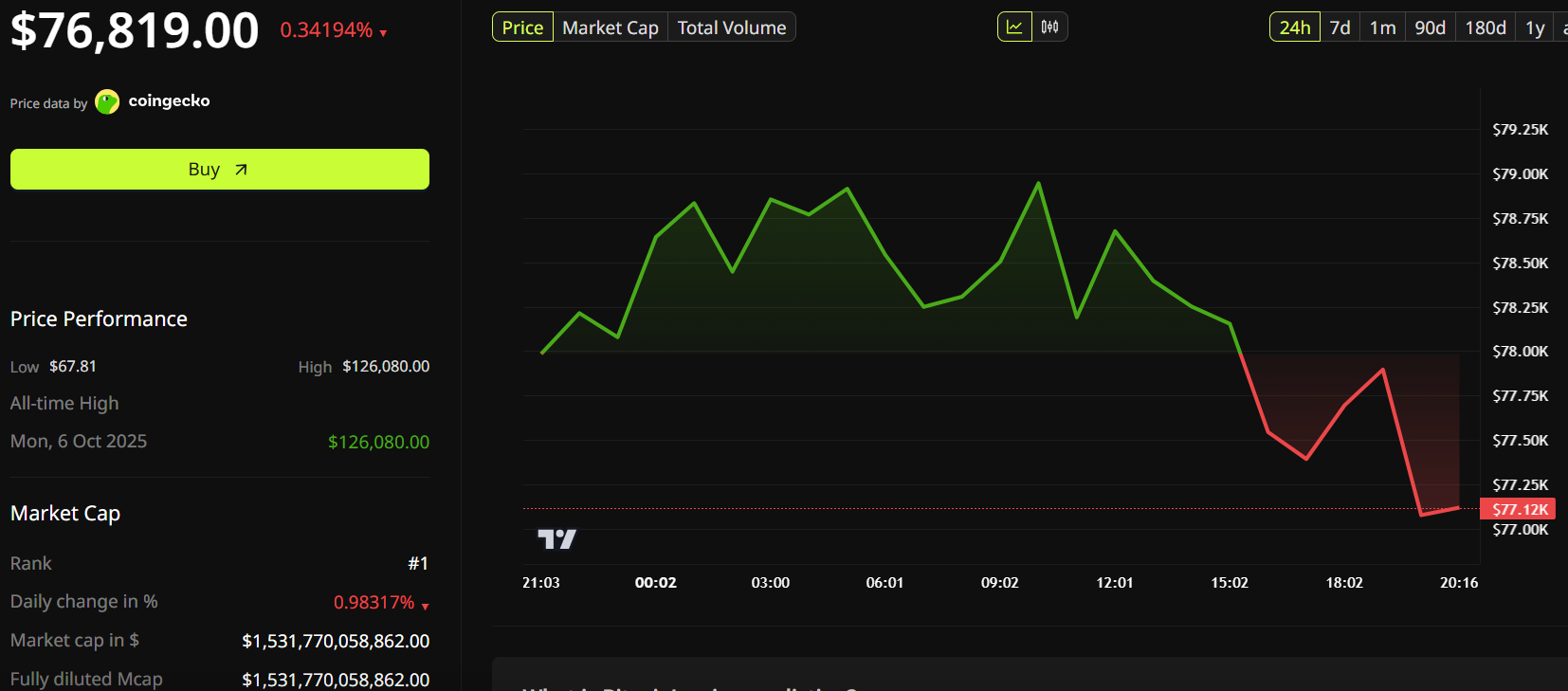 Bitcoin (BTC) Price Performance. Source: BeInCrypto
As of this writing, Bitcoin was trading for $76,819, down by 0.34% in the last 24 hours.
Recommended Articles


