




Memecoin Strength Returns After Historic Market Decline: A Setup For A Comeback?
The memecoin market went through a brutal reset in 2025, marking one of its sharpest downturns since the sector became a dominant force within crypto speculation. Following the euphoric memecoin mania that peaked and ultimately collapsed in November 2024, selling pressure steadily took control. Liquidity dried up, momentum faded, and most memecoins entered prolonged drawdowns that significantly underperformed the broader market.
As risk appetite weakened, memecoin dominance within the altcoin market continued to erode throughout the year. By December 2025, this dominance fell to a historical low, reflecting widespread capitulation among retail participants and a clear shift away from high-beta speculative assets. Many traders exited positions entirely, reinforcing the narrative that the memecoin cycle had fully played out.
However, extreme pessimism often marks important turning points. According to an analysis by Darkfost from CryptoQuant, the current compression in memecoin dominance closely mirrors prior structural lows observed in past cycles. Notably, the last time memecoin dominance reached comparable levels, it occurred shortly before a powerful resurgence in the sector, driven by renewed liquidity, fresh narratives, and aggressive speculative flows.
Memecoin Dominance Shows Early Signs of Stabilization
Recent on-chain analysis highlights how far the memecoin sector has fallen relative to the broader altcoin market—and why some investors are starting to pay attention again. According to Darkfost’s framework, the key ratio compares the combined market capitalization of major memecoins against that of leading altcoins.
At the height of the speculative frenzy in November 2024, this ratio climbed to roughly 0.11, meaning memecoins represented about 11% of total altcoin market value. That level reflected peak enthusiasm, heavy retail participation, and aggressive risk-taking.

By December 2025, however, the same ratio had collapsed to around 0.032. In practical terms, memecoins had lost nearly two-thirds of their relative weight within the altcoin universe. This sharp contraction aligns with prolonged underperformance, capital rotation into larger assets, and widespread capitulation after months of declining prices.
Importantly, recent price action suggests the bleeding may be slowing. Over the past several days, some of the largest memecoins have posted notable rebounds, hinting at renewed speculative interest. While this move is far too early to confirm a full trend reversal, it does suggest that selling pressure is no longer one-sided.
For now, the data points to a tentative stabilization phase rather than a confirmed memecoin season. Still, for high-risk investors, such deeply compressed relative valuations have historically preceded sharp, sentiment-driven rallies—provided risk is managed carefully and expectations remain realistic.
Technical Rebound After A Prolonged Downtrend
The memecoin market cap chart shows a clear shift in structure after months of sustained weakness. Throughout the second half of 2025, total memecoin capitalization trended decisively lower, forming a sequence of lower highs and lower lows while remaining capped below the 50-day and 100-day moving averages.
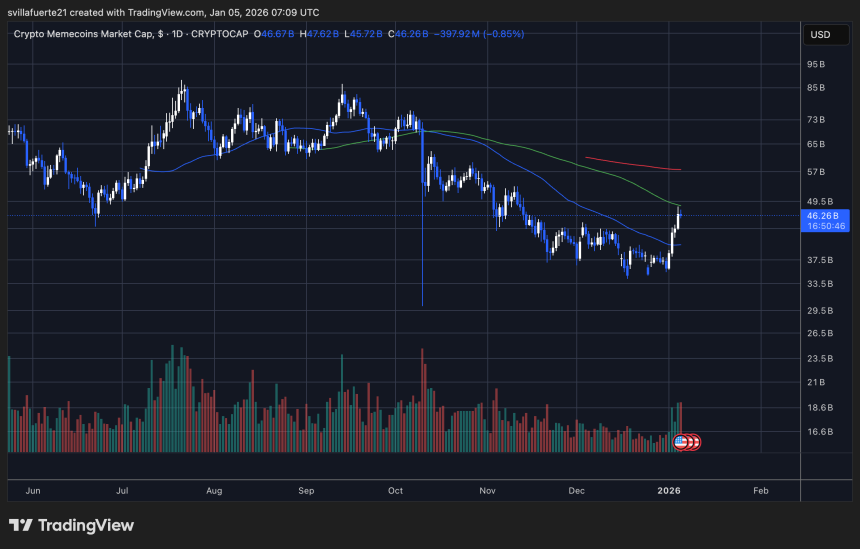
However, recent price action suggests the first meaningful attempt at stabilization. The market cap has rebounded sharply from the December lows near the $35–38 billion zone and is now trading back above the short-term moving average, reclaiming the $46 billion area. This move is accompanied by a noticeable pickup in volume, indicating renewed participation rather than a purely technical bounce on thin liquidity.
Despite this improvement, the broader trend remains cautious. The memecoin market cap is still trading below the longer-term moving averages, which continue to slope downward and act as overhead resistance around the $50–55 billion range. This suggests that while downside momentum has slowed, the market has not yet transitioned into a confirmed uptrend.
In practical terms, the chart points to a relief rally within a broader bearish structure. For memecoins to regain sustained momentum, the market would need to consolidate above current levels and reclaim higher moving averages. Signaling that speculative capital is returning with conviction rather than opportunism.
Featured image from ChatGPT, chart from TradingView.com
Recommended Articles


