

Over $300 Billion Net Outflow from Cryptocurrency Market in 2025: How Will Market Cap Change in 2026?
2025 Cryptocurrency Market Cap Net Outflows Exceed $300 Billion
TradingKey - In 2025, the cryptocurrency market began with a total market capitalization of $3.26 trillion, subsequently rising gradually over the next half-month, accumulating a gain of over 11% to $3.64 trillion. However, the crypto market's rally was short-lived, followed by a three-month correction. On January 20, the cryptocurrency market peaked before declining, with its market capitalization falling to $2.42 trillion, marking its lowest point of the year, with capital outflows exceeding $1 trillion and a cumulative decline of over 33%.
On April 9, the cryptocurrency market rebounded from its bottom, initiating a six-month uptrend. By October 7, the crypto market capitalization had risen to $4.28 trillion, reaching an all-time high, a rebound of over 76% from its lowest point. Similarly, the crypto market failed to sustain its upward momentum, subsequently experiencing a continuous decline and currently standing at $2.94 trillion. Over the past year, the total cryptocurrency market capitalization experienced two significant surges and declines, ultimately accumulating a decline of nearly 10%, with a net outflow of $320 billion.
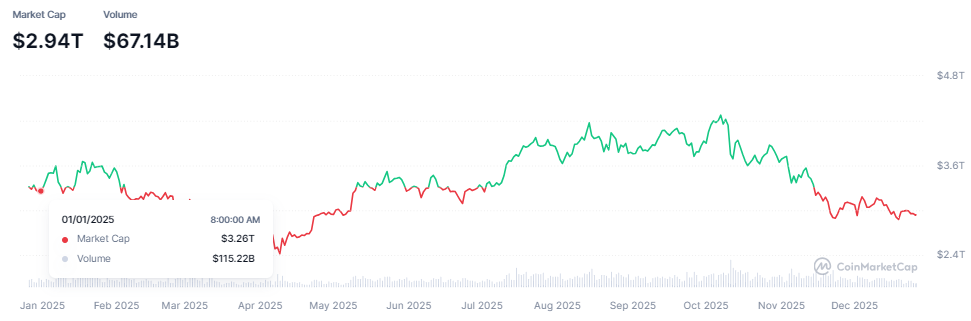 Cryptocurrency Market Capitalization (2025), Source: CoinMarketCap.
What events occurred in the cryptocurrency market in 2025?
The cryptocurrency market experienced two roller coaster cycles in 2025, with influencing factors primarily stemming from the United States. These mainly comprised three events, namely: Donald Trump's election as President, a significant shift in U.S. crypto regulation, and Federal Reserve interest rate decisions.
On January 20, 2025, Donald Trump was sworn in as the 47th President, officially commencing his second term. On that day, the cryptocurrency market saw a broad rally, with its market capitalization surging to a first-quarter high. Subsequently, the market experienced a "buy the rumor, sell the news" phenomenon, leading to a sustained decline in crypto market capitalization.
On April 10, Paul Atkins, President Trump's nominee for the new SEC Chair, assumed office, boosting cryptocurrency market confidence; its market capitalization subsequently bottomed out and gradually trended higher. Following Paul Atkins' takeover of the SEC, the hostile crypto regulatory stance of the Biden administration concluded, primarily manifested through the gradual withdrawal of previous accusations against projects like Coinbase and TRX, a redefinition and classification of cryptocurrencies, the promotion of asset tokenization, and innovation exemptions for cryptocurrency companies, among other measures.
On September 17, the Federal Reserve cut interest rates by 25 basis points, restarting an easing cycle after more than four years, which further bolstered crypto market confidence, with the total cryptocurrency market capitalization surging to an all-time high. However, despite the Fed continuing to cut rates in October and December, it also released hawkish signals suggesting potential liquidity tightening; this significantly damaged investor confidence, leading to a massive capital flight.
How will cryptocurrency market capitalization change in 2026?
According to institutions such as Fidelity, JPMorgan, Bitwise, Bernstein, and Grayscale, the four-year cycle pattern in the cryptocurrency market has been broken, and the crypto bull market has not ended. A larger market rally is expected in 2026, with Bitcoin reaching new all-time highs.
According to this perspective, the cryptocurrency market capitalization could not only reclaim its October high of $4.28 trillion but also surpass that level to establish new all-time highs. However, among the currently foreseeable events, Federal Reserve interest rate cuts and the U.S. midterm elections do not provide a catalytic factor, as they possess a high degree of uncertainty and could potentially turn negative.
In other words, without the catalyst of major positive events, the four-year cycle invalidation theory championed by all institutions and professionals appears anemic. This narrative will not provide impetus to the market, and the cryptocurrency market will continue to decline along the path of least resistance, meaning it will gradually descend into a bear market in line with past trends, potentially falling to $1 trillion in extreme scenarios.
It should be noted that, while the cryptocurrency market may generally lean bearish in 2026, local upward movements cannot be entirely ruled out. It is highly probable that, similar to 2025, it could surge to new highs before a significant correction, resulting in a year where it ultimately declines rather than rises.
Recommended Articles


